TutorZone(www.tutorzone.com.hk)原創模擬試題 · 非考評局官方試題
Quick answer: Cambridge International AS & A Level Mathematics (9709) is made up of six papers, and A Level candidates sit four: Paper 1 (Pure Mathematics 1) — 1 h 50, 75 marks and Paper 3 (Pure Mathematics 3) — 1 h 50, 75 marks are compulsory, plus either Paper 4 (Mechanics) + Paper 5 (Probability & Statistics 1) or Paper 5 + Paper 6 (Probability & Statistics 2). Papers 4 and 6 cannot be combined, because Paper 6 depends on Paper 5. Paper 1 is worth 60% of the AS Level and 30% of the A Level, so it is the foundation paper of the whole qualification. A scientific calculator is required in every paper; graphical calculators and calculators with symbolic manipulation are not permitted. The MF19 list of formulae and statistical tables is provided in the examination.
| Paper | Component | Duration | Marks | Format | Weighting (AS / A Level) | Status |
|---|---|---|---|---|---|---|
| Paper 1 | Pure Mathematics 1 | 1 h 50 | 75 | 10–12 structured questions | AS 60% / A Level 30% | Compulsory for AS and A Level |
| Paper 2 | Pure Mathematics 2 | 1 h 15 | 50 | 6–8 structured questions | AS 40% | AS only (pure-mathematics route) |
| Paper 3 | Pure Mathematics 3 | 1 h 50 | 75 | 9–11 structured questions | A Level 30% | Compulsory for A Level |
| Paper 4 | Mechanics | 1 h 15 | 50 | 6–8 structured questions | AS 40% / A Level 20% | Optional (see routes) |
| Paper 5 | Probability & Statistics 1 | 1 h 15 | 50 | 6–8 structured questions | AS 40% / A Level 20% | Compulsory for A Level |
| Paper 6 | Probability & Statistics 2 | 1 h 15 | 50 | 6–8 structured questions | A Level 20% | Optional (A Level only) |
All six components are written examinations, externally assessed, with no coursework. AS Level grades run a–e; A Level grades run A*–E. Assessment-objective weightings: AO1 knowledge and understanding — AS 55% / A Level 52%; AO2 application and communication — AS 45% / A Level 48%.
The four rules candidates most often get wrong: ① A Level candidates must take Paper 1 and Paper 3 — an AS result alone cannot be upgraded; ② the AS pure-mathematics route (Paper 1 + Paper 2) cannot be carried forward to complete the A Level, because Paper 2 is an AS-only paper whose content is largely a subset of Paper 3; ③ Papers 4 and 6 cannot be combined (Paper 6 requires the prior knowledge of Paper 5); ④ Paper 2 and Paper 3 may not be taken in the same series.
| Route | Combination | Notes |
|---|---|---|
| AS Level (one year) | Paper 1 + Paper 2 | Pure mathematics only; cannot count towards the A Level |
| Paper 1 + Paper 4 | Pure mathematics + mechanics | |
| Paper 1 + Paper 5 | Pure mathematics + probability & statistics | |
| A Level (single series) | Paper 1 + Paper 3 + Paper 4 + Paper 5 | The most common combination in Hong Kong (pure, mechanics, statistics) |
| Paper 1 + Paper 3 + Paper 5 + Paper 6 | Pure mathematics with statistics deepened — useful for data, economics or psychology | |
| A Level (staged) | Year 1: P1 + P4, Year 2: P3 + P5 | Take the AS components first and carry the result forward, then complete two more components in a later series (within the carry-forward time limits) |
| Year 1: P1 + P5, Year 2: P3 + P4 | ||
| Year 1: P1 + P5, Year 2: P3 + P6 |
Choosing components: engineering, physics or actuarial science applicants should almost always take Paper 4; economics, business, psychology or data-science applicants get more mileage from Paper 5 with Paper 6. If your school leaves the choice open, Paper 1 + Paper 3 + Paper 4 + Paper 5 is the safest default and also supports progression to Further Mathematics (9231).
This mock paper was written by the TutorZone tutor team against the assessment structure and subject content published in the Cambridge International AS & A Level Mathematics 9709 syllabus for examinations in 2026 and 2027 (version 4; the 2028–2030 version was checked and the assessment structure is unchanged). It is not an official Cambridge question paper, specimen paper or past paper. Cambridge and its syllabus documents remain the copyright of Cambridge Assessment International Education, and no official paper or syllabus content is reproduced here. Every question, solution and marking point is original, every numerical answer has been recalculated and verified, and the mark allocation per question is our own (the paper totals the official 75 marks, with the official 1 h 50 duration).
Instructions: a scientific calculator is permitted (graphical calculators and calculators with symbolic algebra, differentiation or integration are not); bring a ruler — a protractor and compasses are not required. Unless told otherwise, angles are in degrees and non-exact answers should be given to 3 significant figures. Section A (6 questions, 37 marks) and Section B (6 questions, 38 marks); show all working.
1. (a) Expand and simplify (3 + √2)(5 − 2√2), giving your answer in the form a + b√2 where a and b are integers. (2 marks)
(b) Express 1/(3 − √2) in the form (a + b√2)/c, where a, b and c are integers. (2 marks)
(c) Solve the equation x − 6√x + 8 = 0. (2 marks)
2. The curve y = 2x² − 12x + 7 is given.
(a) Express y in the completed-square form a(x + b)² + c. (2 marks)
(b) State the coordinates of the minimum point and the minimum value of y. (2 marks)
(c) Solve 2x² − 12x + 7 = 0, giving your answers in surd form. (2 marks)
3. The functions f and g are defined by f(x) = (x + 4)/3 for x ∈ ℝ and g(x) = x² − 6x + 5 for x ≥ 3.
(a) Find f⁻¹(x). (2 marks)
(b) Write g(x) in completed-square form and state the range of g. (2 marks)
(c) Find g⁻¹(x) and its domain. (2 marks)
4. The circle C has equation x² + y² − 8x + 6y − 24 = 0.
(a) Find the centre and radius of C. (3 marks)
(b) Show that the point P(11, −3) lies on C. (1 mark)
(c) Find the equation of the tangent to C at P. (2 marks)
5. The sector OAB has radius 6 cm and angle ∠AOB = 1.2 radians.
(a) Find the length of the arc AB and the perimeter of the sector. (2 marks)
(b) Find the area of the sector OAB. (2 marks)
(c) Find the area of the segment, giving your answer to 3 significant figures. (2 marks)
6. (a) Solve the equation 2sin²θ + 3cosθ − 3 = 0 for 0° ≤ θ ≤ 360°. (4 marks)
(b) Express 3sinθ + 4cosθ in the form R sin(θ + α), where R > 0 and 0° < α < 90°, and hence state the maximum value of 3sinθ + 4cosθ. (3 marks)
Section B (6 questions, 38 marks)
7. (a) The third term of an arithmetic progression is 11 and the eighth term is 31. Find the first term a and the common difference d. (3 marks)
(b) Find the sum of the first 20 terms. (2 marks)
(c) A geometric progression has first term 24 and sum to infinity 60. Find the common ratio r. (2 marks)
8. (a) Expand (2 − x/4)⁶, giving the first three terms in ascending powers of x. (3 marks)
(b) Hence find the coefficient of x² in the expansion of (1 + 2x)(2 − x/4)⁶. (3 marks)
9. (a) Given y = (2x − 5)⁷, find dy/dx. (2 marks)
(b) Given y = (3x + 1)/(x − 2), find dy/dx. (2 marks)
(c) The curve y = x³ − 4x + 1 is given. Find the equation of the tangent to the curve at the point where x = 2. (3 marks)
10. (a) Find the coordinates of the stationary points of the curve y = x³ − 3x² − 9x + 5 and determine the nature of each. (4 marks)
(b) A 40 m length of fencing encloses a rectangular garden, with one side formed by a wall that needs no fencing. Find the maximum area that can be enclosed and the corresponding width. (3 marks)
11. (a) Evaluate ∫₁³ (2x + 3) dx. (2 marks)
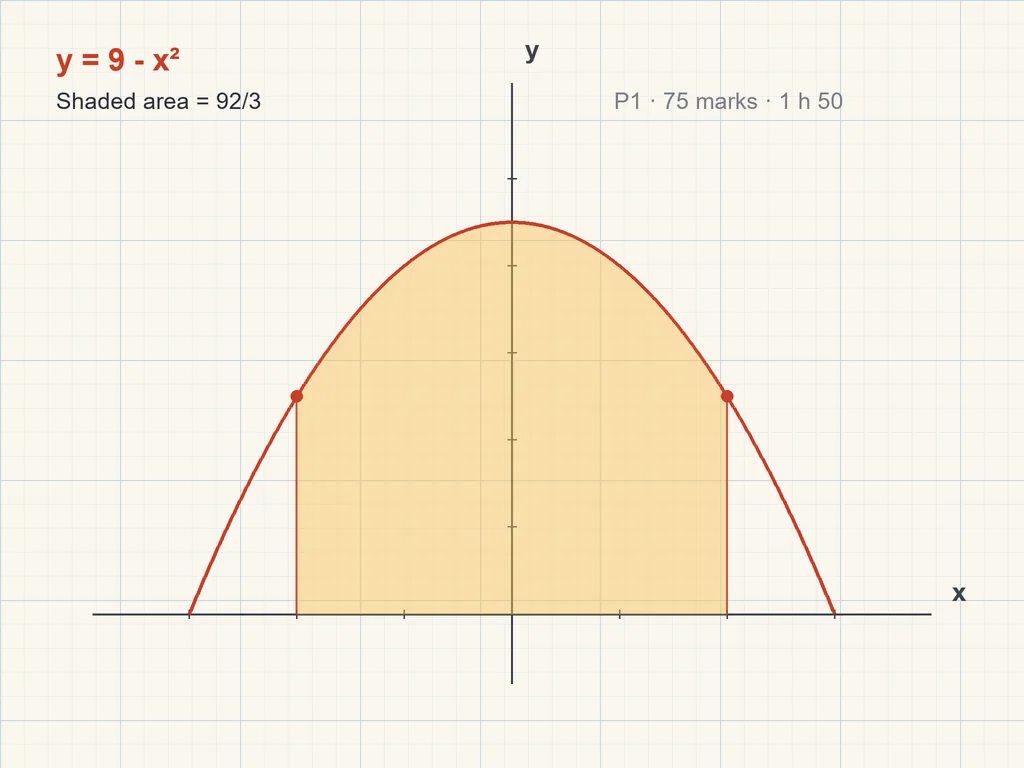
(b) Find the area enclosed between the curve y = 9 − x² and the x-axis from x = −2 to x = 2. (2 marks)
(c) The curve y = x² for x = 0 to x = 3 is rotated through 360° about the x-axis. Find the volume of the solid formed, in terms of π. (2 marks)
12. (a) Solve the simultaneous equations y = x + 2 and y = x² − 4. (3 marks)
(b) Solve the inequality x² − 5x + 4 ≥ 0. (2 marks)
1. (a) 2 marks: expansion = 15 − 6√2 + 5√2 − 4 (1); 11 − √2 (1). (b) 2 marks: multiply numerator and denominator by (3 + √2) (1); (3 + √2)/7 (1). (c) 2 marks: let u = √x, so u² − 6u + 8 = 0, giving u = 2 or 4 (1); x = 4 or x = 16 (1). Jumping straight to the answer without stating the substitution forfeits the method mark.
2. (a) 2 marks: 2(x² − 6x) + 7 = 2[(x − 3)² − 9] + 7 (1); y = 2(x − 3)² − 11 (1). (b) 2 marks: minimum point (3, −11) (1); minimum value −11 (1). (c) 2 marks: 2(x − 3)² = 11, so (x − 3)² = 11/2 (1); x = 3 ± √22/2 ≈ 5.35 or 0.65 (1).
3. (a) 2 marks: y = (x + 4)/3 ⇒ x = 3y − 4, so f⁻¹(x) = 3x − 4 (2). (b) 2 marks: g(x) = (x − 3)² − 4 (1); since x ≥ 3, the range is g(x) ≥ −4 (1). (c) 2 marks: y = (x − 3)² − 4 ⇒ x − 3 = +√(y + 4) (1); g⁻¹(x) = 3 + √(x + 4) with domain x ≥ −4 (1). The negative root is rejected because the domain of g is x ≥ 3.
4. (a) 3 marks: complete the square: (x − 4)² + (y + 3)² = 24 + 16 + 9 = 49 (2); centre (4, −3), radius 7 (1). (b) 1 mark: (11 − 4)² + (−3 + 3)² = 49, so the distance equals the radius and P lies on C. (The squared-distance comparison must be shown.) (c) 2 marks: the centre and P lie on the same horizontal line, so the radius is horizontal and the tangent is vertical (1); x = 11 (1).
5. (a) 2 marks: arc length = 6 × 1.2 = 7.2 cm (1); perimeter = 7.2 + 6 + 6 = 19.2 cm (1). (b) 2 marks: ½ × 6² × 1.2 = 21.6 cm² (2). (c) 2 marks: triangle area = ½ × 6² × sin 1.2 = 16.7767 (1); segment = 21.6 − 16.7767 = 4.82 cm² (1).
6. (a) 4 marks: use sin²θ = 1 − cos²θ to get 2cos²θ − 3cosθ + 1 = 0 (2); (2cosθ − 1)(cosθ − 1) = 0, so cosθ = 1/2 or 1 (1); θ = 0°, 60°, 300°, 360° (1). Giving only 60° and 300° loses the final mark. (b) 3 marks: R = √(3² + 4²) = 5 (1); tan α = 4/3 so α = 53.1° (1); 3sinθ + 4cosθ = 5 sin(θ + 53.1°), maximum value 5 (1).
7. (a) 3 marks: a + 2d = 11 and a + 7d = 31 (1); subtracting gives 5d = 20, so d = 4 (1); a = 11 − 2(4), so a = 3 (1). (b) 2 marks: S₂₀ = 20/2 [2(3) + 19(4)] = 10(6 + 76) (1) = 820 (1). (c) 2 marks: 24/(1 − r) = 60, so 1 − r = 0.4 (1), giving r = 0.6 (1; note that the sum-to-infinity formula requires |r| < 1).
8. (a) 3 marks: 2⁶ = 64 (1); 6 · 2⁵ · (−x/4) = −48x (1); 15 · 2⁴ · (x/4)² = 15x² (1), i.e. 64 − 48x + 15x². (b) 3 marks: the x² term comes from 1 × 15x² and from 2x × (−48x) (1); 15 + (−96) (1) = −81 (1). Writing only 15 and missing the cross term is the most common loss here.
9. (a) 2 marks: the chain rule gives 7(2x − 5)⁶ × 2 (1) = 14(2x − 5)⁶ (1). (b) 2 marks: the quotient rule gives [(3)(x − 2) − (3x + 1)(1)]/(x − 2)² (1) = −7/(x − 2)² (1). (c) 3 marks: y(2) = 8 − 8 + 1 = 1 (1); dy/dx = 3x² − 4, so m = 3(4) − 4 = 8 (1); the tangent is y = 8x − 15 (1).
10. (a) 4 marks: dy/dx = 3x² − 6x − 9 = 0 ⇒ x² − 2x − 3 = 0 ⇒ x = −1 or 3 (1); y(−1) = 10 and y(3) = −22 (2); y″ = 6x − 6, so at x = −1, y″ = −12 < 0 giving a maximum at (−1, 10), and at x = 3, y″ = 12 > 0 giving a minimum at (3, −22) (1). (b) 3 marks: let the two sides perpendicular to the wall each be x, so the side parallel to the wall is 40 − 2x (1); A = x(40 − 2x) and dA/dx = 40 − 4x = 0 ⇒ x = 10 (1); A = 10 × 20 = 200 m² (1; confirm the maximum with d²A/dx² = −4 < 0).
11. (a) 2 marks: [x² + 3x]₁³ (1) = (9 + 9) − (1 + 3) = 18 − 4 = 14 (1). (b) 2 marks: ∫₋₂² (9 − x²) dx = [9x − x³/3]₋₂² (1) = (18 − 8/3) − (−18 + 8/3) = 92/3 ≈ 30.7 square units (1). (c) 2 marks: V = π∫₀³ (x²)² dx = π[x⁵/5]₀³ (1) = 243π/5 = 48.6π ≈ 152.7 cubic units (1). Volume questions require V = π∫y² dx before any marks are awarded for the method.
12. (a) 3 marks: x + 2 = x² − 4 ⇒ x² − x − 6 = 0 (1); (x − 3)(x + 2) = 0, so x = 3 or x = −2 (1); the intersections are (3, 5) and (−2, 0) (1). (b) 2 marks: (x − 1)(x − 4) ≥ 0 (1), so x ≤ 1 or x ≥ 4 (1). An answer of 1 ≤ x ≤ 4 reverses the inequality and scores nothing.
| Paper 1 topic | What is examined |
|---|---|
| Quadratics | Completing the square, the discriminant, quadratic inequalities, simultaneous equations (line and curve) |
| Functions | Domain and range, composite functions, inverse functions, graph transformations |
| Coordinate geometry | Equations of lines and circles, intersections of a line and a circle, tangents and normals |
| Circular measure | Arc length, sector area, segment area |
| Trigonometry | Identities, solving trigonometric equations, expressing a sinθ + b cosθ as R sin(θ ± α) |
| Series | Arithmetic and geometric progressions, sums to infinity, binomial expansion |
| Differentiation | Chain, product and quotient rules, tangents and normals, stationary points, rates of change |
| Integration | Indefinite and definite integrals, areas, volumes of revolution |
| Weeks | Content | Practice focus |
|---|---|---|
| 1–2 | Quadratics, functions and graph transformations | Completing the square and the discriminant in word problems; domains of inverse functions |
| 3–4 | Coordinate geometry (lines, circles, tangents), inequalities, simultaneous equations | The three cases of a line meeting a circle: two points, one point (tangent), none |
| 5 | Circular measure (arc, sector, segment) | Degrees–radians conversion; segment area |
| 6–7 | Trigonometry: identities, equations, R sin(θ ± α) | Timed equation solving — complete every root within 6 minutes |
| 8 | Series: arithmetic, geometric, binomial expansion | Condition for a sum to infinity; a named coefficient in an expansion |
| 9–10 | Differentiation: rules, tangents and normals, stationary points, rates of change | State the rule first; use the second derivative to classify each point |
| 11 | Integration: definite integrals, areas, volumes of revolution | Sketch to fix the limits; start volume questions with V = π∫y² dx |
| 12 | Timed Paper 1 (1 h 50, 75 marks) | About 1.5 minutes per mark, with the last 10 minutes spent checking missing roots and rounding |
How many papers do I sit for A Level Mathematics?
Four. Paper 1 and Paper 3 are compulsory, and then you take either (Paper 4 + Paper 5) or (Paper 5 + Paper 6). Papers 4 and 6 cannot be combined because Paper 6 depends on the prior knowledge in Paper 5.
Can I sit the AS Level only?
Yes — two components (Paper 1 plus one of Papers 2, 4 or 5), graded a–e. Note, however, that the Paper 1 + Paper 2 pure-mathematics route cannot be carried forward to complete the A Level; if you may want the full A Level later, take Paper 1 with Paper 4 or Paper 5 instead.
Are calculators allowed?
Yes, and a calculator with standard scientific functions is required. Computers, graphical calculators and calculators with symbolic algebra, differentiation or integration are not permitted. The MF19 list of formulae and statistical tables is supplied, and you should bring your own ruler; a protractor and compasses are not required.
How is A* awarded?
A Level grades run A*–E. A* is not simply a total-mark threshold: candidates must achieve a high overall standard across the A Level components and reach a specified level in the two pure mathematics papers (Papers 1 and 3). Grade thresholds are published by Cambridge for each series — treat any tutoring-centre estimate with caution.
Where do Hong Kong candidates enter?
Cambridge examinations in Hong Kong are administered through the Hong Kong Examinations and Assessment Authority (HKEAA) as the examination centre, and candidates normally enter through their school or an examination centre. Check the HKEAA and Cambridge websites for entry deadlines, the June and November series and fees.
How does this mock paper differ from official material?
It is an original practice paper written against the published assessment structure. The questions, solutions and mark allocation are TutorZone's own and are not official questions, specimen papers or past papers. Use it alongside the official specimen papers.
| Source | What to use it for |
|---|---|
| Cambridge AS & A Level Mathematics 9709 syllabus (2026–2027, PDF) | Durations, marks, weightings, route combinations, calculator rules and the MF19 formula list |
| 9709 syllabus (2028–2030, PDF) | Confirms that the assessment structure from 2028 onwards is unchanged |
| 9709 subject page | Latest syllabus version, specimen papers and teaching resources |
| HKEAA — Cambridge examinations in Hong Kong | Entry, examination series and centre information for Hong Kong candidates |
See also: A Level Mathematics (9709) curriculum guide, Cambridge IGCSE Mathematics 0580 mock paper, IB Mathematics AA SL mock paper and exam practice questions. Looking for A Level Mathematics tuition? Start with the subject guides and then match with a tutor.