TutorZone(www.tutorzone.com.hk)原創模擬試題 · 非考評局官方試題
Quick answer: AP Calculus comes in two versions, AB and BC, with an identical exam design: 3 h 10 min in total, Section I — 42 multiple-choice questions in 1 h 40, worth 50% (Part A: 29 questions in 62 minutes, no graphing calculator, 35%; Part B: 13 questions in 38 minutes, graphing calculator required, 15%), and Section II — 6 free-response questions in 1 h 30, worth 50% (Part A: 2 questions in 30 minutes with calculator, 16.7%; Part B: 4 questions in 60 minutes without calculator, 33.3%). The exam is hybrid digital: questions appear in the Bluebook app and free-response answers are handwritten in paper booklets. Results are reported on a 1–5 scale, there is no coursework, and AB and BC cannot be taken in the same year. BC covers all of AB plus parametric, polar and vector functions, integration by parts, series and Taylor polynomials.
| Part | Questions | Time | Calculator | Weight |
|---|---|---|---|---|
| Section I A (multiple choice) | 29 | 62 min | Not permitted | 35% |
| Section I B (multiple choice) | 13 | 38 min | Graphing calculator required | 15% |
| Section I total — 42 questions / 1 h 40 | 50% | |||
| Section II A (free response) | 2 | 30 min | Graphing calculator required | 16.7% |
| Section II B (free response) | 4 | 60 min | Not permitted | 33.3% |
| Section II total — 6 questions / 1 h 30 | 50% | |||
Total exam time is 3 h 10 min. Questions are presented in the Bluebook testing app, while free-response answers are handwritten in paper booklets that are collected and scored by the College Board. Calculators must be on the approved AP list (graphing calculators). Scores are reported on the 1–5 scale, and there is no coursework.
Four rules to remember: ① AB and BC cannot be taken in the same year; ② the two exams share exactly the same format, timing and weightings — only the content differs; ③ Section I Part A and Section II Part B are the no-calculator parts, together 68.3% of the exam, so mental and written computation decides the score; ④ scores are 1–5 and many universities grant credit or placement — check each university's own policy.
| Item | AP Calculus AB | AP Calculus BC |
|---|---|---|
| Format, timing, weightings | Identical (see the table above) | |
| Content | Limits and continuity, differentiation, integration, differential equations (separation of variables), areas and volumes | All of AB, plus: parametric, polar and vector functions; integration by parts, partial fractions, improper integrals; Euler's method and logistic models; arc length; sequences and series (including Taylor series) |
| Typical fit | One year of calculus; medicine, business, life sciences | Strong maths background; engineering, physics, mathematics, computer science |
| Level | Roughly one semester of university calculus | Roughly two semesters of university calculus |
How to choose: if your school offers one calculus course and you are heading for engineering or physics, take BC. If time is tight, or you only need one calculus score for a business or pre-med requirement, a strong AB score is usually easier to achieve. Do not try to sit both in the same year — the College Board does not allow it.
This mock paper was written by the TutorZone tutor team against the publicly published AP Calculus AB and AP Calculus BC course and exam descriptions (exam format, timing, weightings and calculator policy). It is not an official AP question paper, specimen paper or past paper. AP® and its course materials remain the copyright of the College Board, and no official question or course material is reproduced here. All questions, solutions and marking points are original, and every numerical answer has been recalculated and verified. For self-study convenience the official 42 multiple-choice questions are represented here by 18 representative questions (12 without calculator, 6 with), while all 6 free-response questions are included in full, plus one BC extension question; the mark split per question is our own.
Part A (12 questions, no calculator) — choose the best answer and show enough working to check yourself.
1. Find limx→3 (x² − 9)/(x − 3). (1 mark)
2. Differentiate x³ ln x. (1 mark)
3. Evaluate ∫ (3x² − 2x + 1) dx. (1 mark)
4. Given f(x) = x³ − 6x² + 9x, find the x-coordinates of all critical points of f. (1 mark)
5. Find limx→0 (1 − cos x)/x². (1 mark)
6. What is the slope of the tangent to y = sin 2x at x = π/6? (1 mark)
7. Evaluate ∫₀² (4 − x²) dx. (1 mark)
8. Find the average rate of change of f(x) = x² on [1, 4]. (1 mark)
9. Express limn→∞ Σi=1n (i/n)² (1/n) as a definite integral and evaluate it. (1 mark)
10. Given f″(x) = (x − 2)(x + 1), find the interval on which the graph of f is concave down. (1 mark)
11. Given f(2) = 5 and f′(2) = 3, find (f⁻¹)′(5). (1 mark)
12. For the curve 2x² + 3y² = 30, find dy/dx at the point (3, 2). (1 mark)
Part B (6 questions, graphing calculator permitted; give numerical answers to 3 decimal places)
13. Find the average value of f(x) = x³ on [0, 2]. (1 mark)
14. Find the area of the region enclosed by y = x² and y = 2x. (1 mark)
15. A particle has velocity v(t) = 6t − 4 (m/s) and s(1) = 3. Find s(3). (1 mark)
16. The curve y = √x for x = 0 to 4 is rotated about the x-axis. Find the volume of the solid. (1 mark)
17. A quantity grows as y = 100e0.05t. Find the time t for y to reach 200. (1 mark)
18. An account balance is A(t) = 500(1.02)t. Find A′(10), the instantaneous rate of growth in year 10. (1 mark)
Part A (questions 1–2, graphing calculator required)
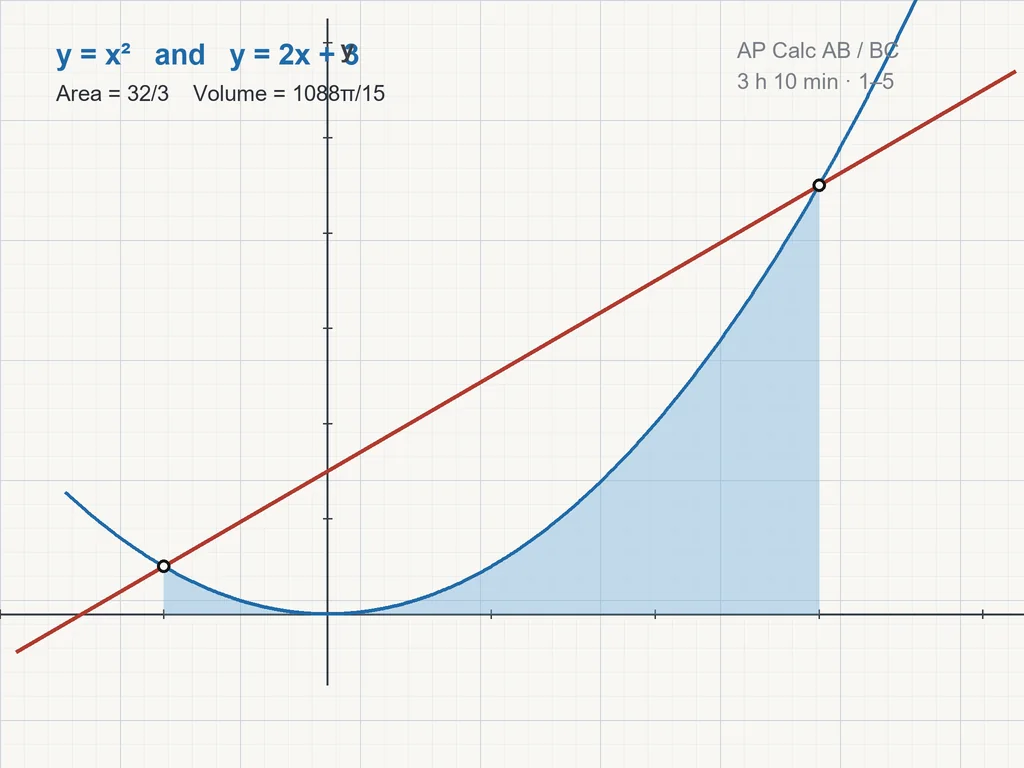
1. The region R is bounded by the curve y = x² and the line y = 2x + 3.
(a) Find the points of intersection. (3 marks)
(b) Find the area of R. (3 marks)
(c) R is rotated about the x-axis. Find the volume of the solid, in terms of π. (3 marks)
2. A spherical balloon is inflated so that its volume increases at 100 cm³/s.
(a) Find dr/dt when the radius r = 5 cm. (5 marks)
(b) At that moment, how fast is the surface area S = 4πr² increasing? (4 marks)
Part B (questions 3–6, no calculator)
3. Given f(x) = 2x³ − 3x² − 12x + 4.
(a) Find f′(x). (2 marks)
(b) Find all critical points and classify each as a maximum or minimum. (4 marks)
(c) Find the equation of the tangent to the curve at x = 0. (2 marks)
(d) State the interval on which f is decreasing. (1 mark)
4. A curve has equation x² + xy + y² = 7.
(a) Use implicit differentiation to find dy/dx. (4 marks)
(b) Evaluate dy/dx at the point (1, 2). (2 marks)
(c) Write the equation of the tangent at that point. (2 marks)
(d) Find the two points on the curve where the tangent is vertical. (1 mark)
5. Define F(x) = ∫₁x (t² − 4) dt.
(a) Find F′(x). (2 marks)
(b) Locate the extremum of F on the real line and classify it. (3 marks)
(c) Find F(2). (2 marks)
(d) How many solutions does F(x) = 0 have on [1, 5]? Justify your answer. (2 marks)
6. (a) Solve the differential equation dy/dx = 2xy given that y(0) = 3. (6 marks)
(b) Find y(0.5). (3 marks)
BC extension (optional, 1 question)
7. (BC) (a) Write the first four terms of the Maclaurin series for f(x) = e−x². (4 marks)
(b) Use the series to estimate ∫₀0.5 e−x² dx to 4 decimal places. (3 marks)
(c) Determine whether Σn=1∞ 1/(n·3n) converges, and state the test you use. (2 marks)
1. Cancel the factor: the expression becomes lim (x + 3) = 6.
2. Product rule: 3x²·ln x + x³·(1/x) = x²(3 ln x + 1).
3. x³ − x² + x + C (integrate term by term).
4. f′(x) = 3x² − 12x + 9 = 3(x − 1)(x − 3), so x = 1 or x = 3.
5. Use 1 − cos x ≈ x²/2 (or l'Hôpital twice): the limit is 1/2.
6. y′ = 2cos 2x, so y′(π/6) = 2cos(π/3) = 1.
7. [4x − x³/3]₀² = 8 − 8/3 = 16/3 ≈ 5.333.
8. Average rate = (f(4) − f(1))/(4 − 1) = (16 − 1)/3 = 5.
9. The Riemann sum is ∫₀¹ x² dx = 1/3.
10. f″ < 0 ⇒ (x − 2)(x + 1) < 0 ⇒ −1 < x < 2.
11. (f⁻¹)′(5) = 1/f′(2) = 1/3.
12. Implicit differentiation: 4x + 6y·y′ = 0 ⇒ y′ = −2x/(3y) ⇒ at (3, 2), −1.
13. Average value = (1/(2 − 0))∫₀² x³ dx = (1/2)(4) = 2.
14. Intersections x = 0 and x = 2; area = ∫₀² (2x − x²) dx = 4 − 8/3 = 4/3 ≈ 1.333.
15. s(3) = 3 + ∫₁³ (6t − 4) dt = 3 + [3t² − 4t]₁³ = 3 + (15 + 1) = 19.
16. V = π∫₀⁴ (√x)² dx = π[x²/2]₀⁴ = 8π ≈ 25.133.
17. 100e0.05t = 200 ⇒ t = ln 2 / 0.05 ≈ 13.863.
18. A′(t) = 500(1.02)t ln 1.02, so A′(10) ≈ 12.070 per year.
1. (a) 3 marks: x² = 2x + 3 ⇒ x² − 2x − 3 = 0 ⇒ (x − 3)(x + 1) = 0, so x = −1 and x = 3 (points (−1, 1) and (3, 9)). (b) 3 marks: area = ∫₋₁³ (2x + 3 − x²) dx = [x² + 3x − x³/3]₋₁³ = 9 − (−5/3) = 32/3 ≈ 10.667. (c) 3 marks: V = π∫₋₁³ [(2x + 3)² − (x²)²] dx = π(364/3 − 244/5) = 1088π/15 ≈ 227.87. Writing V = π∫(R² − r²) dx is required for the method marks.
2. (a) 5 marks: V = (4/3)πr³ ⇒ dV/dt = 4πr²·dr/dt (3); 100 = 4π(25)·dr/dt ⇒ dr/dt = 1/π ≈ 0.318 cm/s (2). (b) 4 marks: S = 4πr² ⇒ dS/dt = 8πr·dr/dt (2) = 8π(5)(1/π) = 40 cm²/s (2).
3. (a) 2 marks: f′(x) = 6x² − 6x − 12. (b) 4 marks: 6x² − 6x − 12 = 0 ⇒ 6(x − 2)(x + 1) = 0 ⇒ x = 2 or −1 (2); f″(x) = 12x − 6, so at x = −1, f″ = −18 < 0 giving a maximum at (−1, 11), and at x = 2, f″ = 18 > 0 giving a minimum at (2, −16) (2). (c) 2 marks: f(0) = 4 and f′(0) = −12, so the tangent is y = −12x + 4. (d) 1 mark: f′ < 0 on −1 < x < 2.
4. (a) 4 marks: 2x + y + xy′ + 2yy′ = 0 (3) ⇒ y′ = −(2x + y)/(x + 2y) (1). (b) 2 marks: at (1, 2): −(2 + 2)/(1 + 4) = −4/5. (c) 2 marks: y − 2 = −(4/5)(x − 1), i.e. y = −(4/5)x + 14/5. (d) 1 mark: a vertical tangent needs x + 2y = 0; substituting gives 3y² = 7, so the points are (−2√(7/3), √(7/3)) and (2√(7/3), −√(7/3)) (about (−3.055, 1.528) and (3.055, −1.528)).
5. (a) 2 marks: by the Fundamental Theorem, F′(x) = x² − 4. (b) 3 marks: F′ = 0 at x = ±2; x = −2 is a maximum (F′ changes from + to −) and x = 2 is a minimum (from − to +). (c) 2 marks: F(2) = [t³/3 − 4t]₁² = (8/3 − 8) − (1/3 − 4) = −5/3 ≈ −1.667. (d) 2 marks: two solutions — F(1) = 0, and since F decreases to −5/3 and F(5) = [t³/3 − 4t]₁⁵ = 76/3 > 0, there is exactly one more solution in (2, 5).
6. (a) 6 marks: separate the variables: dy/y = 2x dx (2); ln|y| = x² + C (2); y = 3ex² after using y(0) = 3 (2). (b) 3 marks: y(0.5) = 3e0.25 ≈ 3.852.
7. (BC) (a) 4 marks: using eu = 1 + u + u²/2 + u³/6 + … with u = −x²: 1 − x² + x⁴/2 − x⁶/6. (b) 3 marks: integrate term by term: 0.5 − 0.5³/3 + 0.5⁵/10 − 0.5⁷/42 ≈ 0.4613. (c) 2 marks: it converges by the ratio test, since an+1/an = n/(3(n + 1)) → 1/3 < 1; a comparison with the convergent Σ1/3n also works because n·3n ≥ 3n.
| Topic | AB | BC only |
|---|---|---|
| Limits and continuity | Limit definitions, one-sided limits, continuity, squeeze theorem | l'Hôpital's rule for indeterminate forms; improper integrals |
| Differentiation | Definitions, power/product/quotient/chain rules, implicit differentiation, related rates | Parametric and vector-valued differentiation, arc length, area with polar curves |
| Applications of derivatives | Mean value theorem, extrema and concavity, optimisation, rates of change | Logistic models, Euler's method |
| Integration | Riemann sums, Fundamental Theorem, substitution, applications (area, volume, accumulation) | Integration by parts, partial fractions, improper integrals, arc length |
| Differential equations | Separation of variables, slope fields, exponential growth and decay | Logistic differential equations, Euler's method |
| Sequences and series | Not examined | Convergence and divergence, ratio/comparison/integral/alternating tests, Taylor and Maclaurin series, error bounds |
| Weeks | Content | Practice focus |
|---|---|---|
| 1–2 | Limits, continuity, the derivative definition | Algebraic limit techniques; no-calculator limit questions |
| 3–4 | Differentiation rules, implicit differentiation | Ten hand-written derivatives a day, including product and chain |
| 5 | Applications: extrema, concavity, mean value theorem | Always write the justification, not just the answer |
| 6 | Related rates and optimisation | Write the model equation first, then differentiate with respect to time |
| 7–8 | Riemann sums, Fundamental Theorem, substitution | Convert limit-of-sum expressions into definite integrals |
| 9 | Area, volume, accumulation functions | Sketch to fix the limits; write R² − r² for washer questions |
| 10 | Differential equations and slope fields | Separation of variables; exponential growth models |
| 11 | Timed Section I: Part A (62 min) then Part B (38 min) | About 2 minutes per question in the no-calculator part |
| 12 | Timed full Section II (1 h 30, 2 + 4 questions) | About 15 minutes per question; write the scoring formula first |
| BC: add 2 weeks | Series convergence tests, Taylor series, parametric and polar | Twenty questions each on ratio, comparison and alternating tests |
Can I take AB and BC in the same year?
No. The College Board does not allow a candidate to take both AP Calculus AB and AP Calculus BC in the same year.
Is BC simply "AB plus one topic"?
BC covers all of AB and adds parametric, polar and vector functions, integration by parts and partial fractions, improper integrals, Euler's method, arc length and sequences and series including Taylor polynomials — which is why BC candidates typically need about a third more preparation time.
Which calculator may I use?
An approved graphing calculator from the College Board list, in the two calculator-permitted parts; phones, computers and unapproved models are not allowed. Check the official AP calculator policy.
Are the free-response answers typed or handwritten?
The questions are displayed in the Bluebook app, but answers are handwritten in paper booklets, which are collected and scored by the College Board.
How is the score calculated?
Multiple choice and free response each count 50%, combined statistically into a score of 1–5 (5 is the top). Credit and placement policies vary by university.
How does this mock paper differ from official material?
It is an original practice paper written against the published exam design. The multiple choice here is a representative subset (18 of the official 42), while all six free-response questions are included, plus one BC extension. Use it alongside the official free-response questions and scoring guidelines.
| Source | What to use it for |
|---|---|
| AP Calculus AB — College Board | Exam format, question counts, timing, weightings and exam dates |
| AP Calculus BC — College Board | BC-only content and exam design |
| AP Central — Calculus AB exam | Official statement of the section structure and calculator rules |
| AP Central — Calculus BC exam | Official BC section structure and calculator rules |
See also: A Level Mathematics 9709 Paper 1 mock paper, IB Mathematics AA SL mock paper, IGCSE Mathematics 0580 mock paper and exam practice questions. Looking for AP Calculus tuition? Start with the subject guides and then match with a tutor.