TutorZone(www.tutorzone.com.hk)原創模擬試題 · 非考評局官方試題
Quick answer: Hong Kong has no territory-wide public mathematics examination in primary school — P6 maths results come from school-based assessments (the internal assessment used for secondary school places, which each school designs itself). The Pre-Secondary 1 Hong Kong Attainment Test (HKAT) is administered by secondary schools before S1 begins and is used for class allocation and for moderating the places allocation; the papers, timing and marks are published by the Education Bureau and arranged by schools. So P6 preparation means learning the school curriculum and computing accurately: whole numbers, fractions and decimals, percentages and ratio, measures and unit conversion, shape and space (area and volume), data handling (charts and averages) and clear multi-step working. This paper has 21 questions and 120 marks: Section A, 15 short questions (4 marks each) plus Section B, 6 problem-solving questions (10 marks each), with full answers and marking points.
| Item | Arrangement |
|---|---|
| Curriculum | Education Bureau Mathematics Education Key Learning Area: primary content covers number and operations, fractions/decimals/percentages, measures and units, shape and space, data handling and problem solving |
| School-based assessment | Designed by each primary school; the results feed the school-based assessment used in secondary school places allocation — the paper format and marks are set by the school |
| Pre-S1 HKAT | Administered by secondary schools before S1 starts, for class allocation and moderation of places allocation; papers, timing and marks are published by the Education Bureau and arranged by schools, so this paper quotes no unverified official numbers |
| Where marks are won | Method marks (state the formula, set up the equation, substitute) + computational accuracy + units and final answer sentences |
For parents: most lost marks in P6 maths come from missing steps, wrong or missing units and skipped arithmetic — not from not knowing the topic. The marking points below deliberately separate the method marks so students get used to how marks are awarded.
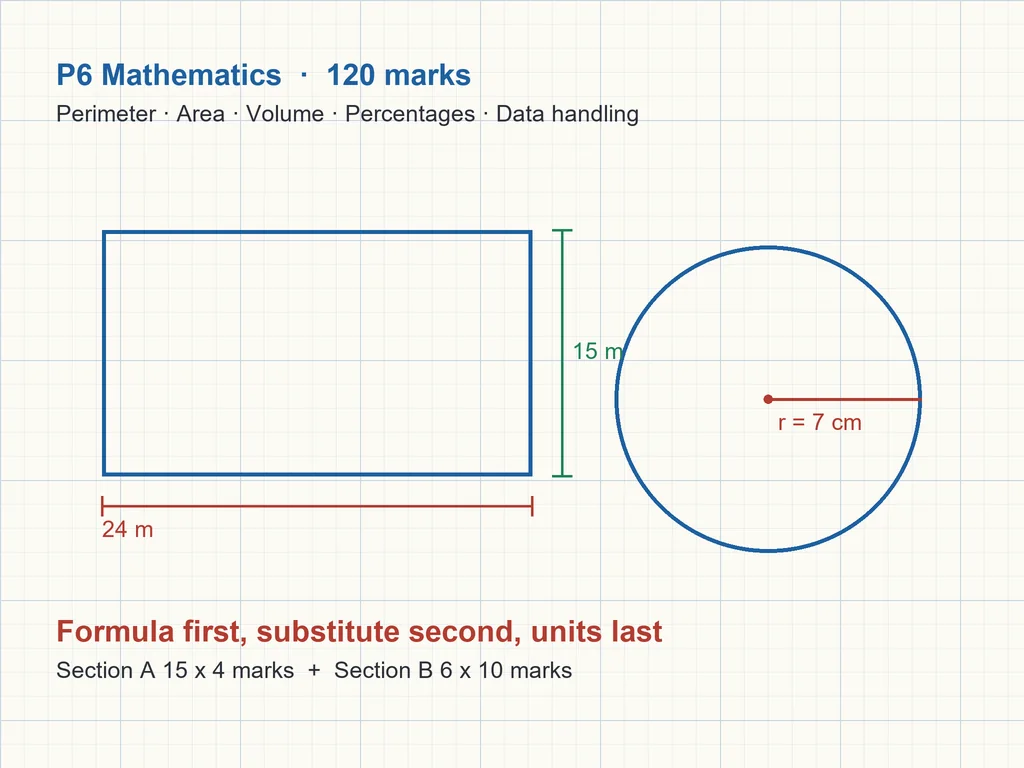
This paper was written by the TutorZone tutor team against the publicly published Hong Kong primary mathematics curriculum. It is not an official paper, a school paper or a past paper, and it does not represent any school's internal examination or an actual Pre-S1 HKAT question. Every question, answer and marking point is original, every numerical answer has been recalculated and verified, and the mark split (21 questions, 120 marks) is our own. Unless stated otherwise, use π = 22/7 or 3.14 as indicated in the question.
1. Work out 3/4 + 5/6, giving your answer as a mixed number.
2. Work out 2.4 × 0.35.
3. Find 20% of 45.
4. Simplify the ratio 24 : 36 into its simplest integer form.
5. Convert 3.5 km into metres.
6. Convert 2 hours 45 minutes into minutes.
7. A parallelogram has base 12 cm and height 5 cm. Find its area.
8. A trapezium has parallel sides 6 cm and 10 cm and height 4 cm. Find its area.
9. A circle has radius 7 cm (take π = 22/7). Find (a) the circumference; (b) the area.
10. A cuboid measures 8 cm × 5 cm × 3 cm. Find (a) its volume; (b) its total surface area.
11. For 12 and 18, find (a) the HCF; (b) the LCM.
12. Solve the equation 3x + 7 = 25.
13. A car travels 150 km in 2 hours. Find its average speed in km/h.
14. The mean of 5 numbers is 12. Find their total.
15. How many minutes are there from 3:40 pm to 5:05 pm?
16. A toy has a marked price of $480. A shop sells it at 20% off, and then takes a further 10% off the sale price.
(a) Find the final selling price. (6 marks)
(b) Find the total percentage discount on the marked price. (4 marks)
17. A rectangular garden is 24 m long and 15 m wide and is to be fenced all round.
(a) Find the perimeter. (3 marks)
(b) Find the area. (3 marks)
(c) If fencing costs $85 per metre, find the total cost of the fencing. (4 marks)
18. A bag of rice weighs 60 kg. First 1/4 of the total is used, then 1/3 of what remains is used.
(a) How much is used the first time? (5 marks)
(b) How much remains at the end? (5 marks)
19. Ming walks 1.2 km at 60 m/min.
(a) How many minutes does the walk take? (5 marks)
(b) If he raises his speed to 80 m/min, how much time does he save? (5 marks)
20. A student's reading times (in minutes) over six days are 30, 45, 25, 60, 40 and 50.
(a) Find the mean, correct to 2 decimal places. (4 marks)
(b) Find the median. (4 marks)
(c) Is there a mode? If so, state it. (2 marks)
21. A toy costs $250 to make and is sold for $300.
(a) Find the profit. (4 marks)
(b) Find the profit percentage. (6 marks)
1. Common denominator: 3/4 = 9/12 and 5/6 = 10/12 (2); 9/12 + 10/12 = 19/12 = 1 7/12 (2). Losing a mark for leaving an improper or unreduced fraction.
2. 24 × 35 = 840 (2); three decimal places in total, so 0.84 (2).
3. 45 × 20% = 45 × 0.2 (2) = 9 (2).
4. Divide both by 12: 2 : 3 (4; only 2 marks if not fully simplified).
5. 1 km = 1000 m (2), so 3.5 × 1000 = 3500 m (2).
6. 2 × 60 + 45 (2) = 165 minutes (2).
7. Area = base × height (2) = 12 × 5 = 60 cm² (2). Units are worth a mark.
8. Area = (a + b) × h ÷ 2 (2) = (6 + 10) × 4 ÷ 2 = 32 cm² (2).
9. (a) Circumference = 2πr (1) = 2 × 22/7 × 7 = 44 cm (1); (b) area = πr² (1) = 22/7 × 49 = 154 cm² (1).
10. (a) Volume = 8 × 5 × 3 = 120 cm³ (2); (b) surface area = 2 × (40 + 24 + 15) = 158 cm² (2).
11. (a) HCF = 6 (2); (b) LCM = 36 (2).
12. 3x = 25 − 7 = 18 (2), so x = 6 (2).
13. Speed = distance ÷ time (2) = 150 ÷ 2 = 75 km/h (2).
14. Total = mean × number (2) = 12 × 5 = 60 (2).
15. 5:05 pm = 305 minutes and 3:40 pm = 220 minutes (2); 305 − 220 = 85 minutes (2).
16. (a) 6 marks: 480 × 0.8 = 384 (3); 384 × 0.9 = $345.60 (3). (b) 4 marks: 1 − 0.8 × 0.9 = 0.28 (2), so 28% (2). Adding 20% + 10% = 30% is a conceptual error and scores nothing.
17. (a) 3 marks: perimeter = 2 × (24 + 15) = 78 m (1 for the statement, 1 for the value, 1 for the unit). (b) 3 marks: area = 24 × 15 = 360 m². (c) 4 marks: 78 × 85 (3) = $6,630 (1). Perimeter in m and area in m² — mixing these units is the most common loss.
18. (a) 5 marks: 60 × 1/4 (3) = 15 kg (2). (b) 5 marks: 60 − 15 = 45 kg left (2); 45 × 1/3 = 15 kg used (2); 45 − 15 = 30 kg remains (1). The second fraction applies to the 45 kg remainder, not to 60 kg; using 60 × 1/3 = 20 kg scores nothing.
19. (a) 5 marks: 1.2 km = 1200 m (2); 1200 ÷ 60 = 20 minutes (3). (b) 5 marks: 1200 ÷ 80 = 15 minutes (3); 20 − 15 = 5 minutes saved (2).
20. (a) 4 marks: total = 250 (2); 250 ÷ 6 = 41.67 minutes (2, to 2 d.p.). (b) 4 marks: ordered 25, 30, 40, 45, 50, 60 (2); median = (40 + 45) ÷ 2 = 42.5 minutes (2). (c) 2 marks: no mode — every value appears once.
21. (a) 4 marks: profit = 300 − 250 = $50 (2 for the statement, 2 for the value). (b) 6 marks: profit % = profit ÷ cost × 100% (3) = 50 ÷ 250 × 100 = 20% (3). Dividing by the selling price instead of the cost is a common error and scores nothing.
| Weeks | Content | Daily practice |
|---|---|---|
| 1–2 | Whole-number operations, brackets and order of operations, factors and multiples | 10 mental questions + 5 written |
| 3–4 | Fractions: common denominators, four operations, mixed and improper fractions | 8 fraction questions, all with working |
| 5 | Decimals and unit conversion (length, weight, capacity, time) | 10 conversion questions |
| 6 | Percentages, discounts and profit percentage | 5 word problems |
| 7 | Ratio and proportion, simple equations | 5 equations + 5 ratio questions |
| 8 | Measures: perimeter and area (rectangle, triangle, parallelogram, trapezium, circle) | 2 questions per shape |
| 9 | Volume and surface area (cuboid and cube) | 5 questions with a sketch and statement |
| 10 | Data handling: mean, median, mode and charts | 5 chart-reading questions |
| 11 | Speed, time and distance problems | 5 word problems |
| 12 | Timed full paper (120 marks in about 75 minutes) + redo every wrong question | Redo all corrections once |
Is there a territory-wide P6 mathematics examination?
No. P6 mathematics results come from school-based assessments, and the internal assessment used for secondary school places is designed by each primary school, so the paper format, timing and marks vary from school to school.
What is the Pre-S1 HKAT?
It is an attainment test taken after students enter Secondary 1, administered by the secondary school before the year begins; results are used for class allocation and for moderating the places allocation. Papers, timing and content are published by the Education Bureau and arranged by schools, so this paper quotes no unverified official numbers — ask your primary school or the allocated secondary school for the details.
Which year group is this paper for?
Mainly P5 (second term) to P6, and it also works as a summer bridging paper before S1. If fractions and percentages are new, work through weeks 1–6 of the plan before attempting the full timed paper.
Should my child use a calculator?
No — primary arithmetic (fractions, decimals, percentages, unit conversion) should be done by hand; calculators weaken both computation and estimation.
How should wrong answers be followed up?
Sort every error into three causes: (1) concept errors (wrong formula or definition); (2) computation errors (carrying, decimal places, simplification); (3) reading errors (missing "of the remainder", mismatched units). Each needs a different fix — relearn, drill against the clock, or underline key words.
| Source | What to use it for |
|---|---|
| Education Bureau — Mathematics Education | Primary mathematics curriculum content, curriculum guides and teaching resources |
| Education Bureau — school places allocation | Official explanation of the secondary places allocation and school-based assessment |
| Education Bureau | Latest curriculum and assessment announcements |
| HKEAA | Territory-wide System Assessment (TSA) and other public assessment information |
Information here is for guidance only; curriculum and assessment arrangements are governed by the latest Education Bureau and school publications. See also: IGCSE Mathematics 0580 mock paper, A Level Mathematics 9709 mock paper and exam practice questions. Looking for primary maths tuition? Start with the subject guides and then match with a tutor.