 中文(繁體)
 中文(簡體)
 English



Hong Kong Primary School Pinyin Enhancement Course: A Detailed Overview
@keyframes tzPulseO { 0%,100% { box-shadow: 0 0 0 0 rgba(255,140,0,.55); transform: scale(1); } 50% { box-shadow: 0 0 0 14px rgba(255,140,0,0); transform: scale(1.04); } }
@keyframes tzPulseN { 0%,100% { box-shadow: 0 0 0 0 rgba(2,30,64,.5); transform: scale(1); } 50% { box-shadow: 0 0 0 12px rgba(2,30,64,0); transform: scale(1.04); } }
.tz-blink-o { animation: tzPulseO 1.6s ease-in-out infinite; }
.tz-blink-n { animation: tzPulseN 1.6s ease-in-out infinite .35s; }
TUTORZONE SUBJECT GUIDE · Hong Kong Primary School Pinyin Enhancement
A complete walkthrough of the Hong Kong primary school Pinyin Enhancement Course — how it helps Cantonese-speaking students master Mandarin pronunciation, tones and practical language skills through graded training, innovative methods and a three-dimensional assessment system.
Direct Answer:What is the Hong Kong Primary School Pinyin Enhancement Course?
The Pinyin Enhancement Course is a Mandarin phonetics programme designed for Cantonese-speaking primary school students in Hong Kong. It targets the pronunciation differences between Cantonese and Mandarin — initials, finals and tones — through systematic drills that build accurate pinyin skills and smooth the transition to secondary Chinese studies. It runs as part of the school curriculum or as an after-school class, supported by formal assessment and parent involvement.

Hong Kong Primary School Pinyin Enhancement: Course Positioning and Objectives
The Pinyin Enhancement Course is specially designed for primary schools in Hong Kong to strengthen foundational Chinese language skills. Its main goals are to:
Overcome Pronunciation Challenges
Focus on resolving Mandarin pronunciation difficulties faced by Cantonese-speaking students.
Early Preparation for Secondary School
Establish a strong phonetic foundation for classical Chinese studies in secondary education.
Digital Learning Integration
Combine smart tools to improve learning efficiency.
Course Structure and Design
Graded Teaching Syllabus
The course follows a step-by-step syllabus, building pronunciation skills through clearly graded stages.
Core Training Contents
- Initial and Final Sounds Strengthening System
- Targeted Contrast Training: address difficult sound pairs.
- Rhyme Recognition Cards: for example, anterior/posterior nasal finals such as an–ang and en–eng.
- Tone Correction Program
- Five-level Visual Marking Method: teach tones visually.
- Gesture-assisted Teaching:
- Level tone: horizontal palm movement.
- Rising tone: upward finger slide.
- Practical Tone Sandhi and Speech Flow
- Tone change rules practice.
- Light tone vocabulary list.
Innovative Teaching Methods
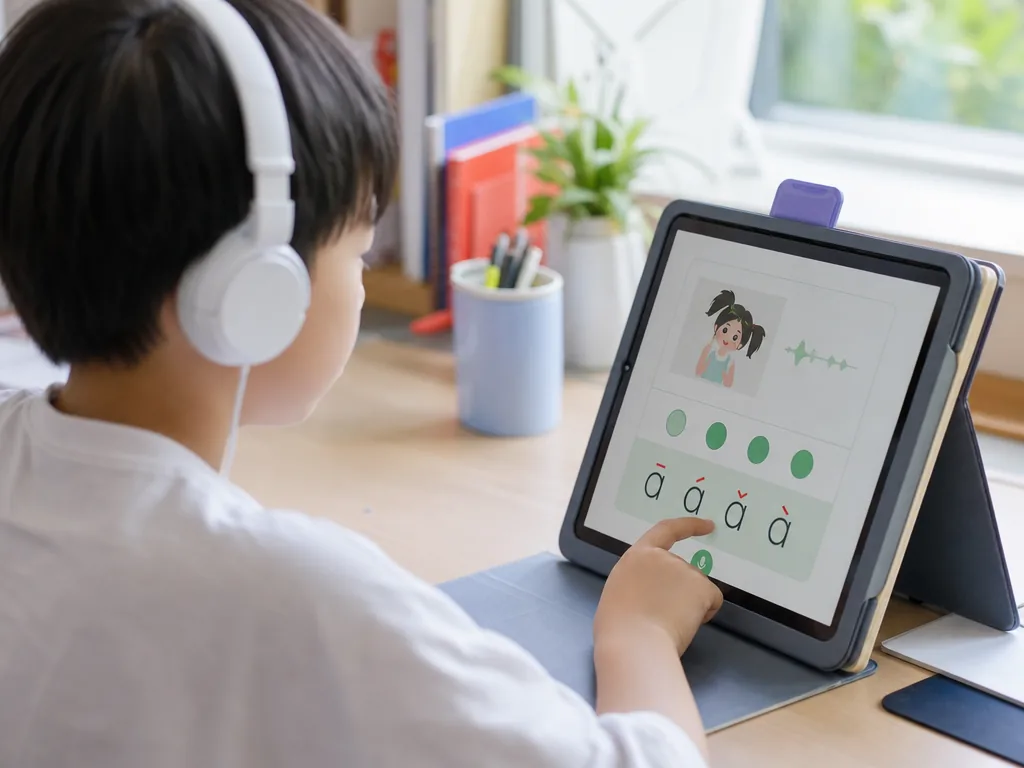
- Technology-assisted Tools——for enhanced learning.
- School-based Special Activities——the Pinyin Ambassador Program, in which older students mentor younger peers.
- Cross-subject Integration——to enrich the learning context.
Assessment System
Three-dimensional Evaluation Criteria
| Criterion | Weight | What is assessed |
|---|---|---|
| Accuracy | 40% | Correct pronunciation of individual words; fluency in phrase linking. |
| Application Ability | 30% | Writing Chinese characters from pinyin; listening to sentences and marking tones. |
| Learning Attitude | 30% | Record of self-practice; peer group evaluations. |
Common Challenges and Solutions
- Solutions for pronunciation difficulties.
- Parental guidance handbook.
Suggested Family Practice
- Daily 10-minute targeted training sessions.
- Practical resource packs such as:
- Education Bureau’s Cantonese–Mandarin Contrast Manual.
- RTHK’s Mandarin One Minute program.
Professional Support for Teachers
- Popular training courses:
- Basic Phonetics Certificate Course.
- Gamified Pinyin Teaching Workshop.
- Key points for school-based lesson preparation.
Course Effectiveness Data
Based on a 2023 study by the University of Hong Kong Faculty of Education:
Faster Reading
Increase in pinyin reading speed among participants.
Better Accuracy
Improvement in pronunciation accuracy.
Higher Pass Rates
Increase in pass rates for Mandarin speaking assessments.
Future Development Directions
- AI Personalized Learning: intelligent practice recommendations based on individual error patterns.
- VR Situational Training: simulated real-life conversational environments.
- Cross-border Exchange: a “Cloud Pinyin Competition” with schools in Mainland China.
Hong Kong primary school pinyin enhancement is evolving from mere pronunciation correction to cultivating pragmatic language skills.
The course now focuses on three-dimensional goals — pitch accuracy, language sense and cultural understanding — and four core competencies — listening discrimination, imitation, application and creativity.
Schools that need sample teaching videos or school-based curriculum materials for specific grades can request more detailed resources.
Frequently Asked Questions (FAQ)
Q: Why do Cantonese-speaking students find Mandarin pronunciation difficult?
Cantonese and Mandarin differ in their initial and final sounds as well as in tone patterns. The course tackles this with targeted contrast training and rhyme recognition cards, for example the anterior/posterior nasal finals an–ang and en–eng.
Q: How are the four Mandarin tones taught?
Through the five-level visual marking method plus gesture-assisted teaching — a horizontal palm movement for the level tone and an upward finger slide for the rising tone.
Q: How is student progress assessed?
Using three-dimensional evaluation criteria: accuracy (40%), application ability (30%) and learning attitude (30%).
Q: How can parents support practice at home?
Set aside a daily 10-minute targeted training session and use practical resources such as the Education Bureau’s Cantonese–Mandarin Contrast Manual and RTHK’s Mandarin One Minute program.
Further Resources & Next Steps
- Official Resources——the Education Bureau’s Cantonese–Mandarin Contrast Manual and RTHK’s Mandarin One Minute programme.
- Further Reading——the Basic Phonetics Certificate Course and the Gamified Pinyin Teaching Workshop for teachers.
- Parent Tips——keep a short daily routine of rhyme recognition cards and tone gestures to reinforce what children learn in class.
Note: The information above is for reference only. Please consult professional education institutions for details.
This article was initially drafted and organised with AI. Editor / Professor Chan Kwok-wai; Managing Editor / Kong Yee-leung
Act Now: Find a Tutor / Register as a Tutor
For parents & students: looking for a home or online tutor for this subject? Click the button below to post a free tuition case (subject, level and preferred time) — TutorZone will match you with suitable tutors:
For tutors: do you teach this subject? Click the button below to register for free and receive more suitable cases — you pay only when a match is made: