
 中文(繁體)
 中文(簡體)
 English



A-Level Chemistry: What You Need to Know About This Challenging but Rewarding Subject
TUTORZONE SUBJECT GUIDE · A-LEVELS
A-level Chemistry is a rigorous and intellectually stimulating subject that builds a deep understanding of chemical principles, laboratory skills and scientific reasoning — a strong foundation for further study in medicine, engineering, pharmaceuticals and environmental science.
Direct Answer:What is A-level Chemistry?
A-level Chemistry is a rigorous subject covering chemical principles, laboratory skills, and scientific reasoning, forming a foundation for medicin。

What Does the A-Level Chemistry Curriculum Cover?
The A-level Chemistry course is structured around several core areas, combining both theoretical knowledge and hands-on lab experience. Here’s a breakdown of the major topics you will study:
Atomic Structure and Chemical Bonding
Students begin by exploring the structure of the atom, including protons, neutrons, and electrons, and how these subatomic particles determine chemical behaviour. You’ll also study:
- The periodic table and periodic trends
- Ionic, covalent, and metallic bonding
- Intermolecular forces and how bonding affects physical properties
This section forms the basis for understanding how and why substances interact.
Chemical Reactions and Kinetics
In this unit, students learn various types of chemical reactions, such as:
- Acid-base neutralisation
- Redox reactions
- Precipitation reactions
You’ll also explore reaction kinetics, examining how factors like temperature, pressure, and concentration influence the rate of chemical reactions. This includes calculating rate constants and interpreting experimental data.
Thermochemistry and Energy Changes
This topic focuses on how energy is absorbed or released during chemical reactions:
- Enthalpy changes (ΔH)
- Exothermic vs endothermic reactions
- Hess’s Law and energy cycles
- Gibbs Free Energy and spontaneity of reactions
Understanding thermochemistry is essential for analysing industrial processes and natural systems.
Chemical Equilibrium
Learn about reversible reactions and how they reach equilibrium. Topics include:
- Le Chatelier’s Principle
- The effect of external changes on equilibrium
- Calculating equilibrium constants (Kc and Kp)
- Applications in industrial and biological systems
Organic Chemistry
This area introduces the chemistry of carbon-containing compounds:
- Structure and naming of hydrocarbons, alcohols, acids, esters, and more
- Functional groups and reaction mechanisms (e.g., substitution, addition, elimination)
- Synthesis and isomerism in organic compounds
Organic Chemistry is especially crucial for students aiming for careers in medicine, pharmacy, and biochemistry.
Analytical Chemistry and Molecular Structure
Students are introduced to a variety of modern analytical techniques, including:
- Infrared spectroscopy (IR)
- Mass spectrometry (MS)
- Nuclear magnetic resonance (NMR)
- Chromatography
- Titration and qualitative analysis
These tools help determine the identity and structure of chemical substances, a skill highly valued in laboratory and research careers.
Practical Chemistry Skills
A-level Chemistry places strong emphasis on hands-on experimental work. Students learn:
- How to plan and carry out scientific experiments
- Data collection and error analysis
- How to write comprehensive lab reports
- Safe use of laboratory equipment
Mastering practical chemistry not only reinforces theoretical knowledge but also prepares students for real-world scientific work.
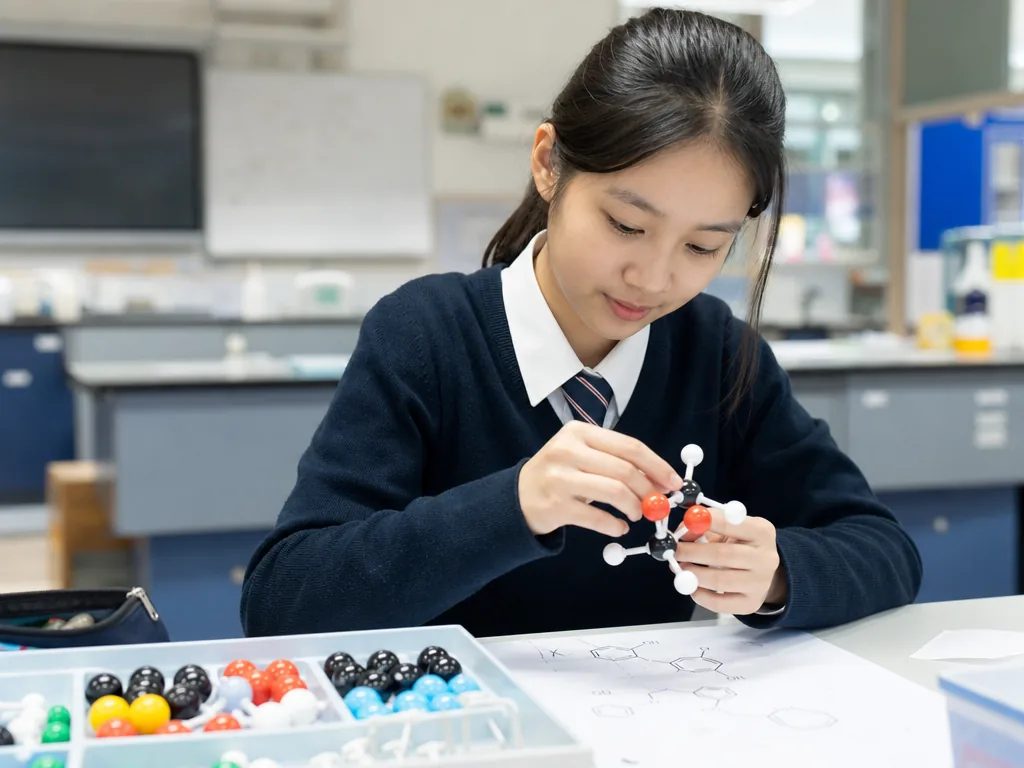
How Is A-Level Chemistry Assessed?
Written Examinations
Most of the final grade is based on formal exams that include:
- Multiple-choice questions
- Structured short answers
- Long-answer application and calculation problems
Exams cover all areas of the course, assessing both knowledge and critical thinking.
Practical Assessment
In addition to written exams, students must complete a series of practical experiments. These tasks are designed to evaluate:
- Lab skills and accuracy
- Data interpretation and analysis
- Understanding of the scientific method
Students will also submit lab reports that form part of their overall practical endorsement.
Learning Objectives of A-Level Chemistry
A-level Chemistry aims to:
Grasp Core Principles
Understand key chemical principles and reaction mechanisms.
Investigate & Analyse
Carry out scientific investigations and analyse data effectively.
Think Critically
Develop logical thinking, scientific writing, and problem-solving skills.
These objectives prepare students not just for university-level science, but for decision-making roles in any science-driven industry.
Career and University Pathways After A-Level Chemistry
A-level Chemistry opens the door to a wide range of university programs and career paths, including:
- Medicine, Dentistry, Veterinary Science
- Pharmacy and Pharmacology
- Biochemistry and Molecular Biology
- Chemical and Environmental Engineering
- Food Science, Forensics, and Materials Science
In fact, many top-tier science and medical degrees require A-level Chemistry as a prerequisite.
Final Thoughts
A-level Chemistry is a challenging yet rewarding subject that helps students build a strong scientific foundation.
By combining theory, practical skills, and critical thinking, it prepares learners for both academic success and impactful careers in science and technology.
If you’re passionate about understanding how the world works at a molecular level — and are ready to apply yourself through experiments and analysis — A-level Chemistry could be the perfect choice for your sixth form studies.
Frequently Asked Questions (FAQ)
Q: Is A-level Chemistry harder than other A-level subjects?
It is widely regarded as one of the more demanding A-levels because it combines abstract theory, mathematical calculation and precise practical work. With consistent revision and regular problem practice, most well-prepared students find it very manageable and highly rewarding.
Q: Do I need A-level Chemistry to study medicine?
Most medical and dental schools require A-level Chemistry, often alongside Biology, as a core entry requirement. It is also a common prerequisite for pharmacy, biochemistry and many biomedical science courses, so it keeps a wide range of options open.
Q: How much practical work does the course involve?
Practical work is a significant and compulsory part of the qualification. You will carry out a series of experiments across the two years and complete lab reports that contribute to a separate practical endorsement alongside your written exams.
Q: What maths skills do I need for A-level Chemistry?
You should be comfortable with basic algebra, rearranging equations, ratios and interpreting graphs. Around a fifth of the marks involve mathematical work such as mole calculations, so solid numeracy gives you a clear advantage.
Further Resources & Next Steps
- Official Resources——Cambridge International AS & A Level Chemistry (9701) syllabus and past papers.
- Further Reading——a Cambridge-endorsed A-level Chemistry coursebook covering the full syllabus and worked examples.
- Parent Tips——encourage regular past-paper practice and hands-on experiments to build confidence alongside textbook study.
Note: The information above is for reference only. Please consult professional education institutions for details.
This article was initially drafted and organised with AI. Editor / Professor Chan Kwok-wai; Managing Editor / Kong Yee-leung
Act Now: Find a Tutor / Register as a Tutor
For parents & students: looking for a home or online tutor for this subject? Click the button below to post a free tuition case (subject, level and preferred time) — TutorZone will match you with suitable tutors:
For tutors: do you teach this subject? Click the button below to register for free and receive more suitable cases — you pay only when a match is made: