 中文(繁體)
 中文(簡體)
 English



A-Level Physics: Course Guide, Topics, Skills & Future Opportunities
TUTORZONE SUBJECT GUIDE · A-LEVELS
A-level Physics is a rigorous and rewarding subject in the UK education system, designed to give students a deep understanding of the fundamental laws of physics and their real-world applications. This advanced science course is ideal for students interested in engineering, mathematics, astrophysics, medicine, and other STEM-related disciplines.
Direct Answer:What is A-Level Physics?
A-Level Physics is an advanced science qualification in the UK education system, covering mechanics, waves, electromagnetism, thermodynamics and atomic physics while building experimental, data-analysis and scientific-reasoning skills. It is assessed mainly through written exams over the AS and A2 years and is widely accepted by universities — a strong route into engineering, physics, astronomy or medicine.
What Is A-Level Physics?
In this guide, we explore the core content of A-level Physics, how it is assessed, and why it is a valuable subject for future academic and career success.
A-level Physics equips students with theoretical knowledge and practical skills to understand the physical world. From mechanics and electromagnetism to quantum physics and thermodynamics, the course blends scientific theory with experimental work, data analysis, and critical thinking.
This course is suitable for students who:
- Are curious about how the universe works
- Enjoy problem-solving and scientific investigation
- Plan to pursue degrees in physics, engineering, computer science, or medicine
Key Topics in A-Level Physics
A-level Physics covers a wide range of topics. Below is an overview of the major subject areas:
1. Mechanics
Students learn about forces, motion, and energy, including Newton’s Laws of Motion, gravity, friction, and dynamics.
Key concepts include:
- Free fall and projectile motion
- Circular motion
- Work, energy, and conservation of energy
2. Waves and Oscillations
This topic focuses on the behavior of waves and the physics of vibrations.
Students explore:
- Wave properties: wavelength, frequency, amplitude, and speed
- Types of waves: sound, light, and electromagnetic waves
- Phenomena such as interference, diffraction, and resonance
- Simple harmonic motion in springs and pendulums
3. Electromagnetism
Electromagnetism is a crucial area in modern physics, with practical applications in electronics, communication, and power systems.
Topics include:
- Electric fields and Coulomb’s Law
- Magnetic fields and electromagnetic induction (Faraday’s and Ampere’s Laws)
- Ohm’s Law and electrical circuits (series and parallel)
- Calculating current, voltage, resistance, and electrical power
4. Thermodynamics
Students explore how heat and energy interact in physical systems.
Covered concepts:
- Heat transfer: conduction, convection, radiation
- Internal energy, temperature, and specific heat capacity
- The laws of thermodynamics
- Entropy and the Carnot cycle
5. Atomic and Particle Physics
This unit dives into the microscopic world of atoms and subatomic particles.
Topics include:
- Atomic structure and energy levels
- Radioactive decay and nuclear reactions
- Particle accelerators and collisions
- The Standard Model of particle physics
6. Quantum Physics
Quantum mechanics introduces students to the physics of the very small.
Students will study:
- Wave-particle duality
- Quantum states and the uncertainty principle
- Quantum tunneling and entanglement
This section provides the foundation for understanding modern technologies such as semiconductors, lasers, and quantum computing.
7. Practical Skills and Data Analysis
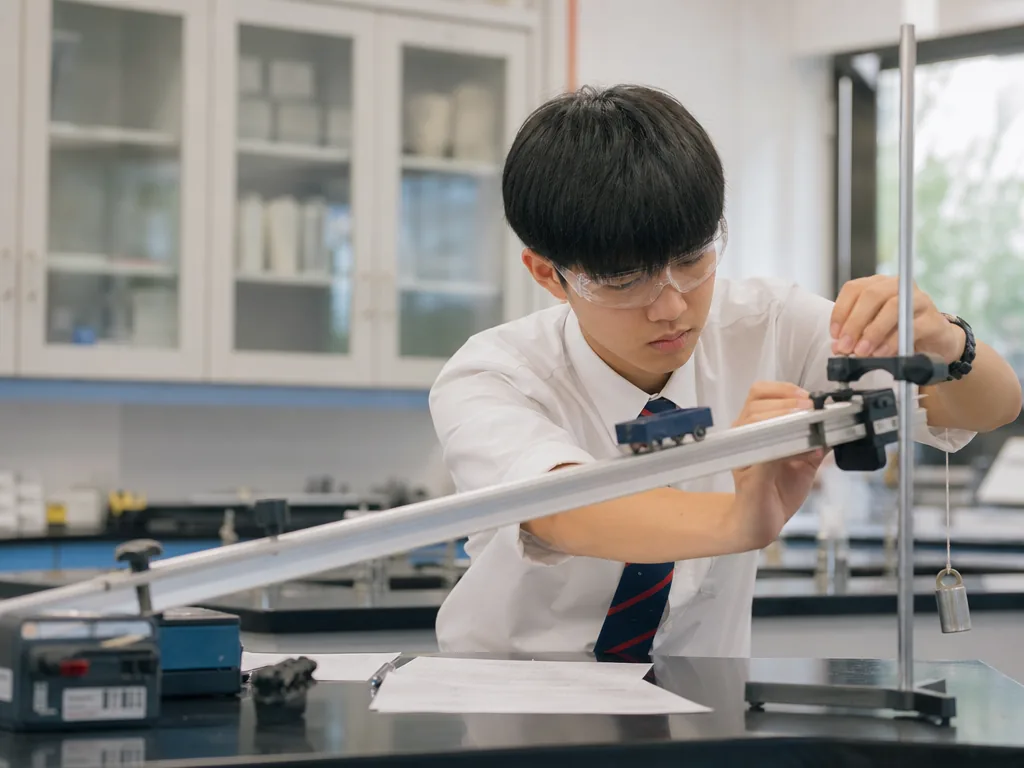
Hands-on experiments are a vital part of A-level Physics.
Students will:
- Conduct and design experiments
- Use instruments like oscilloscopes, photometers, and force sensors
- Collect and analyze data
- Apply scientific methods and evaluate findings
How A-Level Physics Is Assessed
1. Written Examinations
The majority of the assessment comes from written exams. These typically include:
- Multiple-choice questions
- Structured short-answer questions
- Extended response/problem-solving questions
Exams assess understanding across all core topics, from fundamental principles to applied physics.
2. Practical Assessment
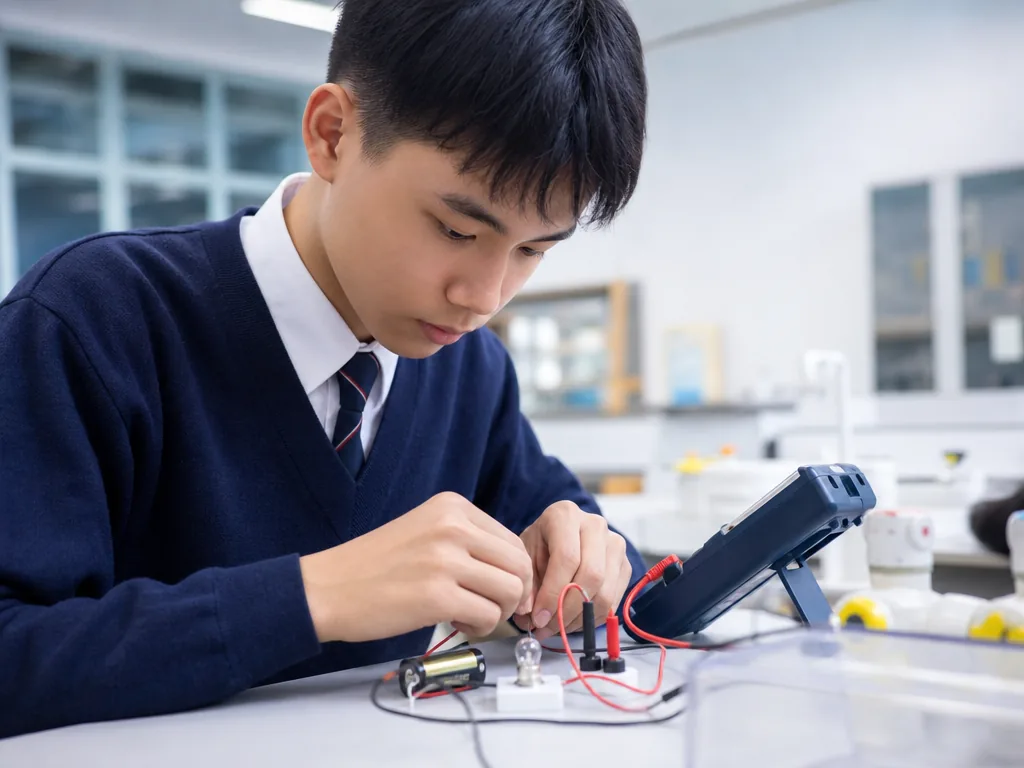
Students must complete a series of required practicals and write lab reports. These assess:
- Experimental design
- Equipment use and data accuracy
- Analysis and interpretation of results
Although practicals are not usually graded separately, they are essential for developing skills and may be indirectly assessed through exam questions.
Learning Objectives of A-Level Physics
The A-level Physics curriculum aims to help students:
- Understand Core Principles——Gain in-depth knowledge of physical laws and how they govern natural phenomena.
- Develop Experimental Skills——Learn how to use scientific tools, conduct experiments, and analyze data.
- Improve Scientific Thinking——Strengthen analytical and problem-solving abilities using a scientific approach.
- Apply Physics to Real Life——Use physics concepts to solve practical problems in technology, engineering, and medicine.
What Can You Do with A-Level Physics?
A-level Physics opens doors to a wide range of degree programs and careers, such as:
- Physics, Astrophysics, and Theoretical Physics
- Engineering (Mechanical, Civil, Electrical, Aerospace)
- Computer Science and Artificial Intelligence
- Medicine and Medical Imaging
- Nuclear Science and Energy
- Mathematics and Data Science
- Electronics and Telecommunications
The skills you gain from studying physics — such as logical reasoning, quantitative analysis, and scientific investigation — are highly valued in both academic and professional settings.
Final Thoughts
A-level Physics is more than a subject — it’s a gateway to understanding the universe and unlocking future opportunities in science and technology.
Whether you’re fascinated by the cosmos, passionate about innovation, or aiming for a career in engineering or medicine, this course provides a strong scientific foundation.
With its blend of theoretical depth and hands-on experience, A-level Physics equips students with the knowledge and skills needed to thrive in our increasingly technical and complex world.
Frequently Asked Questions (FAQ)
Q: Do I need to be strong at mathematics to study A-level Physics?
Yes — a solid grasp of mathematics is essential. Physical laws are expressed quantitatively, so algebra, trigonometry, and basic calculus are used throughout the course, and mathematical fluency makes both the theory and the problem-solving far more manageable.
Q: Which exam boards offer A-level Physics?
The qualification is offered by several awarding bodies, including Cambridge International (AS & A Level Physics 9702), AQA, Edexcel, and OCR. Topic coverage is broadly similar, but always confirm the exact syllabus and assessment format with your school or tutor.
Q: Is the practical work graded separately?
Required practicals are not usually awarded a standalone grade. However, the skills they build — experimental design, accurate data handling, and analysis — are tested through exam questions and are essential for success on the written papers.
Q: What degrees can I pursue after A-level Physics?
The subject is a gateway to physics, astrophysics, engineering, computer science, mathematics, and data science, as well as medicine and medical imaging. Its blend of quantitative reasoning and scientific investigation is valued across STEM and beyond.
Further Resources & Next Steps
- Official Resources——Consult the Cambridge International AS and A Level Physics (9702) syllabus and specification for the full topic list and assessment details.
- Further Reading——Reinforce your understanding with a trusted A-level Physics textbook and past-paper practice, which are the most effective ways to master exam technique.
- Parent Tips——Encourage consistent practice and revision of the mathematical foundations alongside the physics content, and support regular hands-on experiment practice where possible.
Note: The information above is for reference only. Please consult professional education institutions for details.
This article was initially drafted and organised with AI. Editor / Professor Chan Kwok-wai; Managing Editor / Kong Yee-leung
Act Now: Find a Tutor / Register as a Tutor
For parents & students: looking for a home or online tutor for this subject? Click the button below to post a free tuition case (subject, level and preferred time) — TutorZone will match you with suitable tutors:
For tutors: do you teach this subject? Click the button below to register for free and receive more suitable cases — you pay only when a match is made: