
 中文(繁體)
 中文(簡體)
 English




DSE Geography Syllabus: Compulsory Topics, Electives and Exam Structure
TUTORZONE SUBJECT GUIDE · DSE GEOGRAPHY SYLLABUS
The DSE Geography Syllabus is made up of a Compulsory Part and an Elective Part, planned at about 250 hours: the Compulsory Part takes up roughly 68% of lesson time (about 170 hours) and covers seven geographical issues and problems — Opportunities and Risks, Managing River and Coastal Environments, Changing Industrial Location, Building a Sustainable City, Combating Famine, Disappearing Green Canopy and Global Warming — and every candidate must take it; the Elective Part takes up about 20% (about 50 hours), and candidates must choose two of the four units Dynamic Earth: the Formation of Hong Kong’s Geology and Landforms, Weather and Climate, Transport Development, Planning and Management, and Regional Study of Zhujiang (Pearl River) Delta; the remaining hours go to geographical skills, spatial data enquiry and fieldwork, which are infused into the learning and teaching of both parts. This guide, compiled from the Education Bureau’s Geography Curriculum and Assessment Guide (Secondary 4–6) and the Hong Kong Examinations and Assessment Authority’s Geography assessment framework, sets out the seven compulsory issues and their learning focus, the content of the four elective units, the assessment design and mark weightings of Paper 1 and Paper 2, the fieldwork requirements and the optimisation from 2027 onwards, and a practical plan for revision and exam strategy.
Direct Answer:What parts does the DSE Geography Syllabus include?
The DSE Geography Syllabus is made up of a Compulsory Part and an Elective Part, planned at about 250 hours. The Compulsory Part takes up about 68% of lesson time (roughly 170 hours) and covers seven geographical issues and problems — Opportunities and Risks, Managing River and Coastal Environments, Changing Industrial Location, Building a Sustainable City, Combating Famine, Disappearing Green Canopy and Global Warming — all of which every candidate must study; the Elective Part takes up about 20% (roughly 50 hours) and offers four units — Dynamic Earth, Weather and Climate, Transport Development, Planning and Management, and Regional Study of Zhujiang (Pearl River) Delta — of which candidates must choose two; the remaining hours go to geographical skills, spatial data enquiry and fieldwork. The public assessment consists of two papers with no School-based Assessment: Paper 1 examines the Compulsory Part, accounts for 75% of the subject over 2 hours 45 minutes, and is divided into Part A multiple-choice questions (20%), Part B a compulsory fieldwork-based question (15%), Part C data-based / skills-based / structured questions (30%) and Part D short essay questions (10%); Paper 2 examines the Elective Part, accounts for 25% over 1 hour 15 minutes, and is divided into Part E (15%) and Part F (10%).

What Is the DSE Geography Syllabus?
Geography is one of the elective subjects of the Personal, Social and Humanities Education key learning area in senior secondary education, and its public assessment is built on the Geography Curriculum and Assessment Guide (Secondary 4–6) jointly prepared by the Curriculum Development Council and the Hong Kong Examinations and Assessment Authority. Candidates are expected to have the general knowledge of junior secondary Geography and of the Personal, Social and Humanities Education curriculum; the map-reading and data-analysis skills the subject requires build on the geographical skills training of secondary schooling. The DSE Geography Syllabus is designed precisely to connect three scales — the natural environment, the human environment and global challenges.
In terms of structure, Geography is planned at about 250 hours and divided into three parts: the Compulsory Part (about 68% of lesson time, roughly 170 hours) covers seven geographical issues and problems and is taken by every candidate; the Elective Part (about 20%, roughly 50 hours) offers four elective units of which candidates must take two; and the geographical skills and spatial data enquiry infused into the learning and teaching of both parts, including fieldwork.
The Compulsory Part is known for its issue-based design: every topic is introduced by a geographical question, such as “Is it wise to live in areas prone to hazards?”, “Can technology solve the problem of food shortage?” or “Is it fact or fiction?”. This approach asks students not only to remember landforms and phenomena but to use evidence, weigh competing standpoints and reach a supported judgement — which is precisely what separates Geography from subjects that can be passed by memorising facts.
It is worth noting that the public assessment of Geography has no School-based Assessment, and all marks come from the public examination. From the 2027 DSE onwards, the Education Bureau’s optimisation measures change the arrangement for Paper 1 Part B (the compulsory fieldwork-based question) from “choose one out of three” to “choose one out of two”, and the Supplementary Notes to the Geography Curriculum and Assessment Guide (2025) explain more clearly the fieldwork skills the DSE will involve; the Supplementary Notes apply to all senior secondary levels from the 2025/26 school year.
Geography’s most distinctive difficulty is that it demands three languages at once: the language of maps and spatial data, the scientific language of natural processes, and the humanistic language of issue-based argument. Memorising the textbook while missing any one of the three leaves a student stuck on a particular type of question, making no progress.
The Compulsory Part: Seven Geographical Issues and Their Learning Focus
The Compulsory Part contains seven issues and problems in total, taking up about 68% of lesson time (roughly 170 hours) and moving from the natural environment all the way to the human environment and global challenges. The Guide makes clear that there is no fixed teaching order for the seven compulsory units and that schools may arrange them according to their own circumstances; the assessment scope of the public examination, however, does not change. The core learning focus of each issue is set out below, so that parents and students can check whether their own notes are complete.
Opportunities and RisksIs it wise to live in areas prone to hazards?
- Tectonic hazards — the causes, distribution and impact of earthquakes, volcanic eruptions and tsunamis
- Climatic and hydrological hazards — the causes and consequences of tropical cyclones, floods and landslides
- Hazard risk assessment, and strategies for hazard mitigation, response and management
Managing River and Coastal EnvironmentsA continuing challenge
- The processes and forms of river and coastal landform systems
- The impact of human activities on river and coastal environments
- Comparing and evaluating management strategies (hard and soft engineering, integrated coastal management)
Changing Industrial LocationHow and why does it change over time and space?
- Locational factors of industry and the spatial distribution of industrial activity
- Changes in industrial production, the growth of transnational corporations, and the shift from manufacturing to a knowledge-based economy
- The impact of locational change on regional development and employment structure
Building a Sustainable CityAre environmental conservation and urban development mutually exclusive?
- Urban growth, urban form and urban problems
- The concept of a sustainable city, and urban renewal and urban redevelopment
- The tension and the balance between environmental conservation and urban development
Combating FamineCan technology solve the problem of food shortage?
- Farming systems, the distribution of agricultural types and food production
- The causes of food shortage, and the contribution and limitations of biotechnology and the “Green Revolution”
- Strategies for sustainable agriculture and food security
Disappearing Green CanopyWho should pay for the large-scale felling of the rainforest?
- The distribution, structure and ecological functions of tropical rainforest
- The causes and consequences of deforestation, and the multiple perspectives at the ecological, economic and social levels
- Approaches to, and controversies over, conservation and sustainable development
Global WarmingIs it fact or fiction?
- The evidence, causes and mechanisms of global warming
- The impact of global warming on the natural environment and on human activities
- Mitigation and adaptation strategies, and the responsibilities of different stakeholders
The Elective Part: Two Units Out of Four
The Elective Part takes up about 20% of lesson time (roughly 50 hours), and candidates must study and sit two of the following four units (about 25 hours each). Before choosing, check which units your own school actually offers — some schools run only two or three of them, and Paper 2 examines only the two units a candidate has chosen.
Dynamic Earth: the Formation of Hong Kong’s Geology and LandformsBringing geological processes home to Hong Kong
- The rock cycle and the geology of Hong Kong
- Hong Kong’s landform landscapes and how they were formed
- Management of geological and landform resources, and related hazards such as landslides
Weather and ClimateFrom the world’s climate system to Hong Kong’s weather
- World climate types and climate systems
- Hong Kong’s monsoon and weather systems
- Extreme weather and climatic hazards, and issues related to climate change
Transport Development, Planning and ManagementThe elective closest to everyday city life
- Transport systems, transport patterns and transport networks
- Urban transport problems and sustainable transport
- Evaluating transport planning and management strategies
Regional Study of Zhujiang (Pearl River) DeltaDevelopment and environment seen at the regional scale
- The location and regional characteristics of the Zhujiang Delta
- Economic development, urbanisation and environmental challenges
- Regional cooperation and competition, and the impact of cross-boundary infrastructure
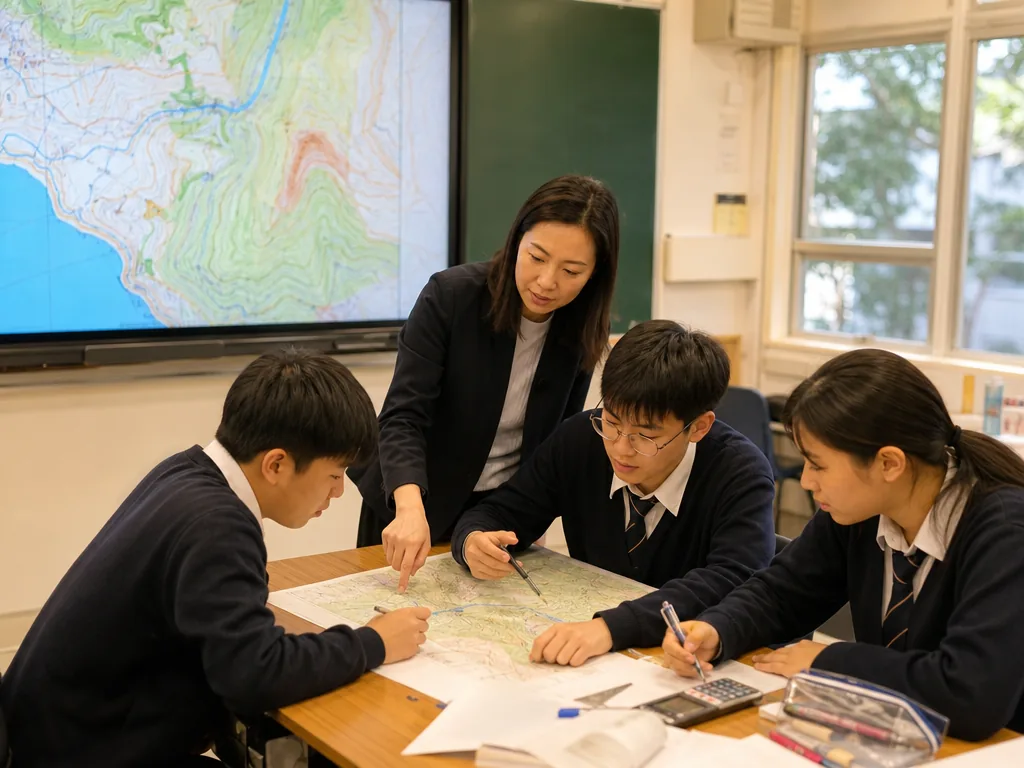
Exam Format and Mark Weightings
The public assessment of Geography consists of two papers, with the public examination accounting for 100% and no School-based Assessment. Paper 1 examines the Compulsory Part and accounts for 75% of the subject, lasting 2 hours 45 minutes; Paper 2 examines the Elective Part and accounts for 25% of the subject, lasting 1 hour 15 minutes. According to the HKEAA’s latest Geography assessment framework, these weightings remain unchanged.
| Part (paper) | Assessment scope | Question format | Weighting |
|---|---|---|---|
| Part A (Paper 1) | Compulsory Part | Multiple-choice questions drawn from any topic in the Compulsory Part, all to be attempted (about 30 minutes) | 20% |
| Part B (Paper 1) | Compulsory Part | Compulsory fieldwork-based question (about 45 minutes) | 15% |
| Part C (Paper 1) | Compulsory Part | Data-based / skills-based / structured questions, four in total, answer two (about 30 minutes each) | 30% |
| Part D (Paper 1) | Compulsory Part | Short essay questions, three in total, answer one (about 30 minutes each) | 10% |
| Part E (Paper 2) | Elective Part | Data-based / skills-based / structured questions, four in total, answer one | 15% |
| Part F (Paper 2) | Elective Part | Short essay questions, four in total, answer one | 10% |
Paper 1 is divided into Parts A, B, C and D: Part A consists of multiple-choice questions drawn from any topic in the Compulsory Part, all of which must be attempted, with a suggested time of about 30 minutes; Part B is one compulsory fieldwork-based question, with a suggested time of about 45 minutes; Part C sets four data-based / skills-based / structured questions, of which candidates answer two; and Part D sets three short essay questions, of which candidates answer one. Candidates may also distribute their answering time freely among the four parts according to their own judgement.
Paper 2 is divided into Parts E and F, and the questions come from the Elective Part: each part sets four questions and candidates must answer one from each part, and the two questions answered may come from the same elective unit or from different ones. Both papers may set map interpretation questions based on Hong Kong topographical maps (1:20,000 / 1:5,000) and/or simplified maps, so map-reading skills must be thoroughly practised.
Fieldwork, Map Reading and Spatial Data Enquiry
A distinctive feature of Geography is that fieldwork is not a separate assessment component: it runs through the learning and teaching of both the Compulsory and the Elective Parts, and is examined directly in Paper 1. Geographical skills and spatial data enquiry are infused into the teaching of every unit, and candidates must be able to apply techniques of sampling, measurement and data interpretation.
The Compulsory Fieldwork-based QuestionPaper 1 Part B, 15% of the subject
- Part B is one compulsory fieldwork-based question, with a suggested time of about 45 minutes
- It assesses fieldwork skills, including data collection methods, sampling techniques, the use of instruments and data interpretation
- The 2026 DSE requires a candidate’s fieldwork experience to cover three compulsory units: Climate Change, Changing Industrial Location and Managing Coastal Environments
The Optimisation from 2027 OnwardsFrom “choose one out of three” to “choose one out of two”
- From the 2027 DSE onwards, the arrangement for Paper 1 Part B changes from “choose one out of three” to “choose one out of two”
- The Supplementary Notes to the Geography Curriculum and Assessment Guide (2025) explain more clearly the fieldwork skills that the DSE will involve
- The Supplementary Notes apply to all senior secondary levels from the 2025/26 school year; candidates should ask their own subject teacher about the latest fieldwork arrangements
Map Reading and Spatial DataA skill requirement common to both papers
- Both Paper 1 and Paper 2 may set map interpretation questions based on Hong Kong topographical maps (1:20,000 / 1:5,000) and/or simplified maps
- Spatial data enquiry and the use of Geographic Information Systems (GIS) are important skills in this subject
- Combining map-reading technique with the specific context of each unit is the key to scoring
Assessment Objectives and Question-Type Strategy
Geography questions can broadly be divided into three sets of abilities: knowledge and understanding, application and skills, and evaluation and argument. The three require different ways of revising, and dividing time equally among them often wastes half the effort.
Knowledge and UnderstandingMainly multiple-choice and short questions
- Mastering geographical concepts, spatial patterns and geographical terminology, and using them accurately
- Understanding the interaction between natural and human processes, and how they form geographical patterns at different scales
- This is the part most easily improved by practice; the key is to write the definitions and keywords of every topic into a one-page note of your own
Application and SkillsMainly data-based / skills-based / structured questions
- Applying geographical knowledge and skills to familiar and unfamiliar contexts, and identifying, analysing and interpreting geographical information
- Interpreting maps, photographs, graphs and statistical data is the core of Parts C and E
- For any question involving data, read the question requirements carefully first, then decide which topic’s concepts to bring in
Evaluation and ArgumentMainly short essay questions
- Evaluating geographical issues, and offering supported arguments and recommendations on different standpoints
- Parts D and F are both short essay questions; the organisation of the answer and the structure of the argument are themselves scoring points
- Issue-based questions should cover different angles — natural, economic, social, environmental and political
Finally come the short essay and explanation questions. Markers have always valued a complete chain of cause and effect: state the cause first, then the mechanism, and finally the result or the impact. When explaining why a place has a high hazard risk, for example, you should set out the natural factors (such as geology and climate), the human factors (such as population density and land use) and the management factors in turn, and only then give an overall judgement of the risk; leaving out any one link loses key marks. For questions involving “sustainable development”, it is advisable to cover the environmental, economic and social dimensions at the same time.
Why Study Geography? Further Study and Careers
Geography is both knowledge and evidence of ability. The three points below are the practical considerations parents and students discuss most often when choosing subjects.
Articulation to University Programmes
Geography, urban studies, environmental science, earth system science, and surveying and geomatics programmes at local and overseas universities commonly require, or give priority to, a candidate’s results in relevant elective subjects; many social science and planning programmes also value the training that Geography provides. The spatial, environmental and economic perspectives of Geography are exactly the common language of these disciplines.
Spatial Thinking and Data Literacy
Reading maps, interpreting spatial data and weighing different standpoints against evidence are the core training of Geography. This way of thinking — observe, interpret, argue — is useful in urban planning, environmental management, logistics and transport, and geospatial analysis.
Flexible Combinations with Other Electives
Geography can be combined flexibly with Economics, History, Biology, Chemistry and other subjects, covering both the scientific side of the natural environment and humanistic and social issues, so that students can adjust their subject strategy to suit their own direction of further study.
Revision Strategy and the Marks Most Often Lost
The differences in Geography results rarely come from how clever a student is; most come from method. The four points below are the marks most often lost that our tutors see in tuition, together with the matching strategy.
Fluency in Map ReadingA skill required in both papers
- Being familiar with contour lines, scale, direction, grid references and land-use symbols
- When you look at a topographical map, ask three questions first: what is the relief like? Where are the settlements? How is the land used?
- Combine map-reading technique with the context of the topic, rather than memorising the legend
Case Studies and Both Sides of an IssueA core requirement of an issue-based curriculum
- Prepare one or two concrete cases for each topic (for example river or coastal management in Hong Kong, urban redevelopment, or local agriculture)
- Issue-based questions require arguments on both sides, supported by evidence, rather than a single standpoint
- Linking textbook concepts to real cases is the key to pulling ahead of the field
Presenting Data and GraphsA main scoring area in Parts C and E
- For data questions, use three steps: describe the trend, explain the cause, infer the impact
- When quoting data, give the year, the unit and the specific value — that scores better than vague description
- Watch whether the question asks you to “describe” or to “explain”; the depth of the answer required differs
Preparing Fieldwork SkillsPart B accounts for 15% of the subject
- Be familiar with sampling methods, the use of instruments and the handling of errors, and be able to describe the procedure in geographical language
- During fieldwork, record the purpose, method, data and conclusions clearly; looking back at your own records before the exam is the most effective revision
- For the specific fieldwork arrangements, always follow the guidance of your own subject teacher
Frequently Asked Questions (FAQ)
Q: Does the DSE Geography Syllabus include School-based Assessment?
No. The public assessment of Geography consists of two papers, the public examination accounts for 100% and there is no School-based Assessment. Fieldwork is not a separate assessment component: it is assessed through the compulsory fieldwork-based question in Paper 1 Part B (15% of the subject), and it is infused into the learning and teaching of both the Compulsory and the Elective Parts.
Q: How many papers does DSE Geography have, and how are the marks weighted?
There are two papers. Paper 1 examines the Compulsory Part, lasts 2 hours 45 minutes and accounts for 75% of the subject, divided into Part A multiple-choice questions (20%), Part B a compulsory fieldwork-based question (15%), Part C data-based / skills-based / structured questions (30%) and Part D short essay questions (10%); Paper 2 examines the Elective Part, lasts 1 hour 15 minutes and accounts for 25% of the subject, divided into Part E (15%) and Part F (10%). The two papers total 100%.
Q: How many elective units have to be taken?
Candidates study and sit two of the four elective units, taking up about 20% of lesson time (roughly 50 hours). Parts E and F of Paper 2 each set four questions and candidates must answer one from each part; the two questions answered may come from the same elective unit or from different ones. When choosing, check which units your school actually offers.
Q: What changes to the Geography examination start in 2027?
From the 2027 DSE onwards, the arrangement for Paper 1 Part B (the compulsory fieldwork-based question) changes from “choose one out of three” to “choose one out of two”; at the same time, the Education Bureau has published the Supplementary Notes to the Geography Curriculum and Assessment Guide (2025), which explain more clearly the fieldwork skills that the DSE will involve and apply to all senior secondary levels from the 2025/26 school year. The overall structure of Paper 1 (75%) and Paper 2 (25%) remains unchanged.
Further Resources and Next Steps
- Official resources—the Education Bureau’s Geography Curriculum and Assessment Guide (Secondary 4–6) and the Supplementary Notes (2025) (jointly prepared by the Curriculum Development Council and the Hong Kong Examinations and Assessment Authority); and the HKEAA’s Geography assessment framework and its Examination Report (with marking scheme and comments on candidates’ performance). Curriculum documents and assessment frameworks are always more reliable than notes circulating online.
- Further reading—articles in our Geography and social science series: DSE Geography Past Paper Drilling Guide, DSE Economics Syllabus, and DSE Mathematics Syllabus.
- Tip for parents—in Geography, marks are lost far more often because students are unwilling to write evidence than because they do not understand the concepts. Encourage your child to follow local geographical issues in Hong Kong (such as climate action, urban renewal and coastal management in the news) and to link textbook concepts with real cases — far more effective than working blindly through supplementary exercises.
Note: The information above is for reference only. Please consult professional education institutions for details.
This article was initially drafted and organised with AI. Editor / Professor Chan Kwok-wai,
Act Now: Find a Tutor / Register as a Tutor
For parents & students: looking for a home or online tutor for this subject? Click the button below to post a free tuition case (subject, level and preferred time) — TutorZone will match you with suitable tutors:
For tutors: do you teach this subject? Click the button below to register for free and receive more suitable cases — you pay only when a match is made:
Managing Editor / Kong Yee-leung
Direct Answer:How many papers does DSE Geography have, and how are the marks weighted?
The subject has two public papers. Paper 1 examines the Compulsory Part over 2 hours 45 minutes and accounts for 75% of the subject, divided into Part A multiple-choice questions (drawn from any topic in the Compulsory Part, all to be attempted, 20%), Part B a compulsory fieldwork-based question (15%), Part C data-based / skills-based / structured questions (four in total, answer two, 30%) and Part D short essay questions (three in total, answer one, 10%); Paper 2 examines the Elective Part over 1 hour 15 minutes and accounts for 25% of the subject, with Parts E and F each setting four questions of which candidates answer one, Part E accounting for 15% and Part F for 10%. The two papers total 100% and there is no School-based Assessment.
Direct Answer:How should the elective units be chosen?
The four elective units are Dynamic Earth: the Formation of Hong Kong’s Geology and Landforms, Weather and Climate, Transport Development, Planning and Management, and Regional Study of Zhujiang (Pearl River) Delta. Each unit takes about 25 hours, and candidates need study and sit only two of them, about 50 hours in total and roughly 20% of lesson time. Three points are worth considering together when choosing: which units your school actually offers; your own direction of further study (for example Transport Development, Planning and Management if you are interested in cities and transport, or Dynamic Earth or Weather and Climate if you are interested in the natural environment); and how the unit is taught and assessed in your school. Paper 2 examines only the two units a candidate has chosen, and accounts for 25% of the subject — a substantial weighting.
