 Chinese (Traditional)
 Chinese (Simplified)
 English

Complete Guide to Junior Secondary Physics in Hong Kong
TUTORZONE SUBJECT GUIDE · LOCAL SECONDARY SCHOOL
Physics tuition, curriculum overview, key concepts, assessment & STEM integration — a complete guide to Hong Kong’s S1–S3 Physics, from the seven core units and their experiments through to assessment weighting and at-home support.
Direct Answer:What is Junior Secondary Physics in Hong Kong?
Junior Secondary Physics (S1–S3) in Hong Kong covers seven core units with experiments, assessment weighting, and STEM integration.
What Is Junior Secondary Physics?
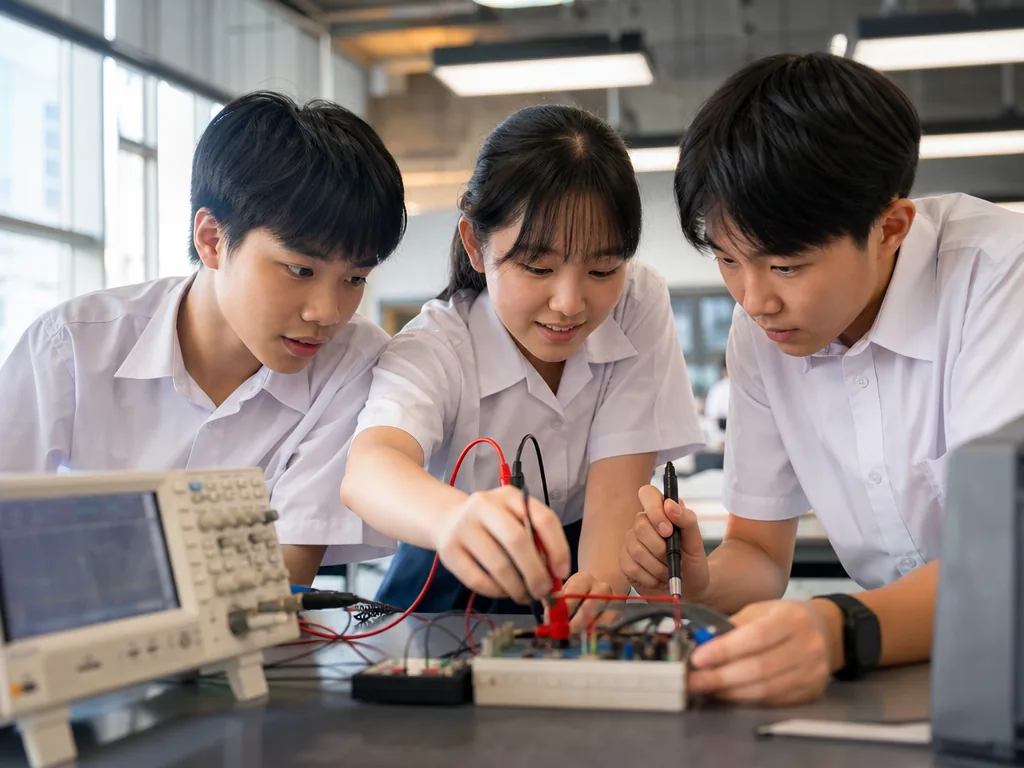
Junior Secondary Physics (S1–S3) in Hong Kong introduces students to scientific thinking through the “Observe–Model–Verify” method. The curriculum aims to cultivate students’ physical intuition, logical reasoning, and hands-on experimental skills — laying a strong foundation for future STEM education and HKDSE Physics.
As an essential part of Hong Kong’s science education, the course aims to:
- Build core physics concepts——from natural phenomena
- Enhance inquiry and experimentation——through lab work
- Develop real-world problem-solving skills
- Prepare students for HKDSE Physics——and other science subjects
Course Structure: The 7 Core Units
1. Force and Motion
- Fundamental Concepts
- Speed and acceleration calculations
- Newton’s Laws (e.g. air track experiments)
- Everyday Applications
- Design of seatbelts
- Starting stance of sprinters
2. Energy and Power
Energy Transformations:
| Type of Conversion | Example Experiment |
|---|---|
| Kinetic → Potential | Pendulum motion |
| Light → Electrical | Solar-powered car model |
- Energy Topics
- Renewable energy in Hong Kong
- Household energy-saving strategies
3. Thermal Physics
- Heat Transfer
- Compare conduction, convection, and radiation
- Thermos flask structure analysis
- Temperature & Heat
- Specific heat capacity experiment with metal blocks
4. Optics
- Light Behavior
- Verify reflection law
- Explore refraction (e.g. glass of water experiment)
- Optical Instruments
- Build a simple telescope
- Understand how cameras form images
5. Acoustics
- Sound Properties
- Use oscilloscope to visualize sound waves
- Test different sound-absorbing materials
- Practical Applications
- Acoustic design in concert halls
- Use of ultrasound technology
6. Electricity
Circuit Basics:
[Battery] — [Switch] — [Bulb] — [Resistor] — [Battery]
- Compare series vs parallel circuits
- Ohm’s Law experiment
- Home Electricity Use
- Calculate electricity bills
- Safety guidelines for household circuits
7. Magnetism & Electromagnetism
- Magnetic Fields
- Iron filings to show field lines
- Electromagnet building competition
- Electromagnetic Induction
- Hand-crank generator experiment
- Transformer model demonstration
Innovative Teaching Approaches
Inquiry-Based Learning
Case study: design an “egg protection device” using momentum concepts.
Technology-Enhanced Lessons
Use the Phyphox App for motion tracking and Arduino sensors to measure light intensity.
Real-Life Contexts
Analyze the physics of MTR braking systems and estimate typhoon wind levels using real data.
Lab Safety Guidelines
Hands-on experiments are central to the course, so every student learns essential lab safety before practical work begins, including these emergency procedures:
- Electric shock response
- First aid for chemical burns
Assessment Breakdown
School-Based Assessment (60%)
- Lab Reports
- Data accuracy (30%)
- Depth of error analysis (20%)
- Logical conclusions (50%)
- STEM Projects
- e.g. “Design the Most Earthquake-Resistant Building Model”
Public Assessment (40%)
| Question Type | Weight | Example |
|---|---|---|
| Multiple Choice | 30% | Ray path in mirrors |
| Calculations | 40% | Solve motion-related problems |
| Essay Questions | 30% | Evaluate energy policies |
Learning Resources & Digital Tools
Digital Tools
- Algodoo——Physics Simulation
- Vernier——data collection systems
Hands-On Kits
- Mechanics car sets
- Optics experiment kits
Curriculum Articulation
With Primary School
- Move from qualitative observation to quantitative measurement
- From simple machines to full mechanics systems
Preparing for DSE
- Introduce vectors in S3
- Foundational calculus concepts
Latest Developments in Physics Education
STEM Integration
- Build water rockets to study projectile motion
- Solar-powered smart house design competition
AI & Data Science
- Use machine learning for experiment analysis
- Build sensor networks for environmental monitoring
Parental Support & Activities
At-Home Experiments
- Use a smartphone to measure gravitational acceleration
- Compare heat conduction using kitchen tools
Science Engagement
- Visit Hong Kong Science Museum physics exhibits
- Join “Junior Physicist” programs
Learning Resources
- Conceptual Physics book series
- Veritasium science YouTube channel
2024 Education Statistics (Hong Kong)
| Statistic | 2024 Figure |
|---|---|
| Physics Lab Availability in Schools | 89% |
| Average Annual Lab Hours | 40 hours |
| HKDSE Physics Participation Rate | 62% of science stream students |
Frequently Asked Questions (FAQ)
Q: Is Junior Secondary Physics difficult for most students?
It builds upward from concrete, everyday phenomena to abstract models, so most students find it manageable with steady practice — the heavy emphasis on hands-on experiments turns abstract ideas into something visible and testable.
Q: How can I help my child prepare for HKDSE Physics?
Encourage consistent lab-report habits and curiosity about everyday physics. The junior curriculum already introduces vectors and foundational calculus concepts in S3, which form the bridge to senior Physics.
Q: What equipment do we need for at-home experiments?
Very little — most experiments reuse household items. A smartphone can measure gravitational acceleration, and kitchen tools can compare heat conduction; for structured work, hands-on kits such as mechanics car sets and optics experiment kits are widely available.
Q: How is the subject assessed?
Assessment is split between school-based work (60%) — lab reports and STEM projects — and a public assessment (40%) made up of multiple-choice, calculation, and essay questions.
Further Resources & Next Steps
- Official Resources——For official guidelines and curriculum updates, visit the Hong Kong Education Bureau at www.edb.gov.hk.
- Further Reading——The Conceptual Physics book series and the Veritasium science YouTube channel.
- Parent Tips——Visit the Hong Kong Science Museum physics exhibits and join “Junior Physicist” programs.
Note: The information above is for reference only. Please consult professional education institutions for details.
This article was initially drafted and organised with AI. Editor / Professor Chan Kwok-wai; Managing Editor / Kong Yee-leung
Act Now: Find a Tutor / Register as a Tutor
For parents & students: looking for a home or online tutor for this subject? Click the button below to post a free tuition case (subject, level and preferred time) — TutorZone will match you with suitable tutors:
For tutors: do you teach this subject? Click the button below to register for free and receive more suitable cases — you pay only when a match is made: