
 Chinese (Traditional)
 Chinese (Simplified)
 English



DSE Chemistry: Comprehensive Guide, Course Details, Exam Tips, and Career Pathways
TUTORZONE SUBJECT GUIDE · DSE
A complete guide to HKDSE Chemistry — covering the course structure, assessment and grading, effective study strategies, common difficulties, and the academic and career pathways the subject can open up.
Direct Answer:What is DSE Chemistry?
DSE Chemistry blends theoretical understanding, calculation, and hands-on laboratory skills, covering course structure, assessment, and career path。
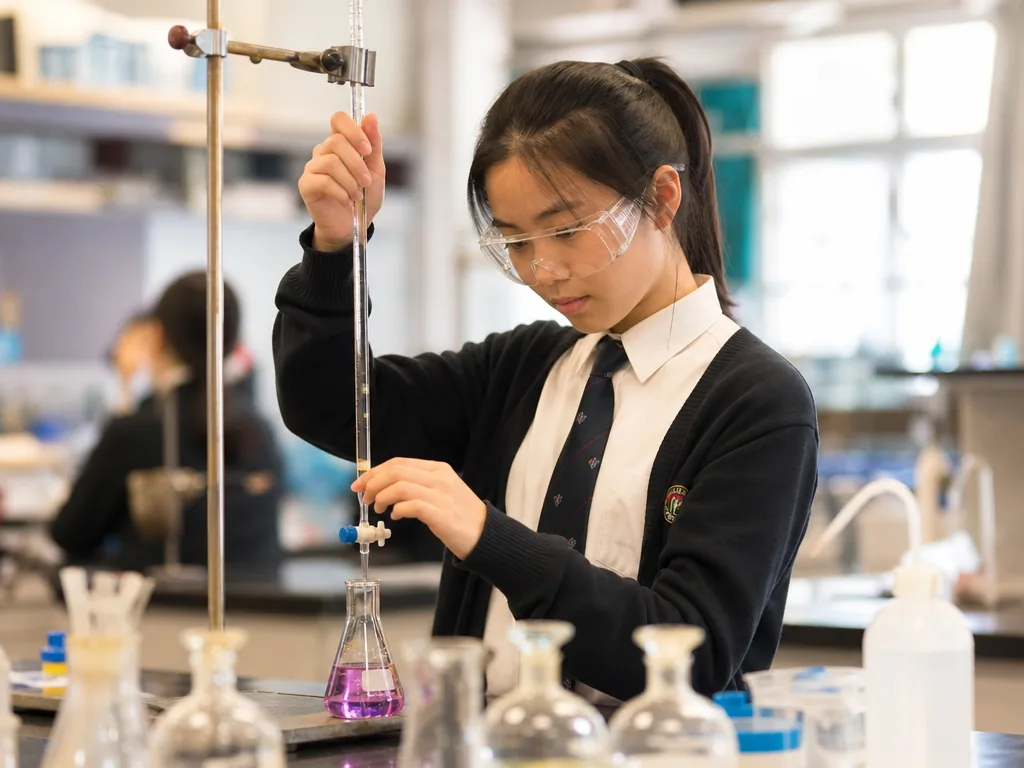
Course Overview & Key Features
DSE Chemistry is a senior secondary science subject that builds a balanced foundation in theory, calculation, and practical application for the HKDSE examination.
- Balanced Focus on Theory and Practice — links chemical principles to hands-on experiments.
- Integration of Calculation and Concepts — quantitative reasoning is woven into every topic.
- Real-World Applications — concepts are framed through everyday and industrial examples.
- Assessment — Written Exam (80%) + School-Based Assessment (SBA, 20%).
Course Structure (2024 Latest Version)
Compulsory Section
Topics include:
- Particles & Atomic Structure
- Chemical Reactions
- Energy & Reaction Rates
- Equilibrium & Electrochemistry
Elective Section (Choose One)
Options:
- Industrial Chemistry
- Materials Chemistry
- Analytical Chemistry
Assessment & Grading
Public Examination (80%)
- Paper 1 — Multiple choice (30%).
- Paper 2 — Structured & long questions (50%).
School-Based Assessment (SBA, 20%)
- 2–3 experiment reports — completed during the course.
- Includes — data collection, error analysis, and improvements.
Effective Study Strategies
Mole Calculation Techniques
- Three-Step Method — a systematic approach to convert between mass, moles, and concentration.
- Common Pitfalls — watch for unit mismatches and misread equations.
Improving Experiment Skills
- Titration Mnemonic — use a memory aid to recall the end-point steps in order.
Elective Module Key Points
- Example: Haber Process in Industrial Chemistry — understand the conditions, catalyst, and yield trade-offs.
Essential Tools & Resources
- Textbooks — DSE Chemistry 5* Guide.
- Past Papers — 2012–2023.
- Simulation — PhET Chemistry Simulations, interactive tools for visualizing reactions and molecular structures.
- SBA Reference — HK Chemistry Experiment Guide.
Common Difficulties & Solutions
Equilibrium Calculations
Use an ICE table to track initial, change, and equilibrium concentrations.
Electrochemistry Confusion
Use a battery mnemonic to keep oxidation and reduction straight.
Error Analysis in SBA
Use an error type table to classify systematic and random errors.

Grading Breakdown & High-Score Examples
A high-scoring worked example: the reaction between chlorine and sodium hydroxide.
- Balanced equation — write and balance the full equation correctly.
- Oxidation states — assign and explain the oxidation states of each species.
- Application in bleach production — link the reaction to its industrial use.
Academic & Career Pathways
University Pathways
- Degree options — Chemistry, Chemical Engineering, Pharmacy.
- Programmes — HKU and HKUST programmes.
Career Paths
- Careers — Researcher, Chemical Engineer, Chemistry Teacher.
Exam Time Management
- Paper 1 — spend no more than 1.5 minutes per question.
- Paper 2 — reserve 1 hour for the long questions.
- Weekly practice and revision — keep a consistent routine to build speed and accuracy.
Frequently Asked Questions (FAQ)
Q: How is DSE Chemistry assessed?
A public written examination worth 80% (Paper 1 multiple choice 30% and Paper 2 structured and long questions 50%) plus a School-Based Assessment worth 20% based on 2–3 experiment reports.
Q: Which elective module should I choose?
Industrial, Materials, or Analytical Chemistry. Pick the one that best matches your interests and intended university pathway — all three carry equal weight.
Q: How can I improve my DSE Chemistry scores?
Practise past papers (2012–2023), master mole calculations with the three-step method, and stick to a weekly revision and time-management routine.
Q: What careers can DSE Chemistry lead to?
Researcher, chemical engineer, pharmacist, and chemistry teacher, with university programmes available at HKU and HKUST.
Further Resources & Next Steps
- Official Resources — visit the Hong Kong Education Bureau (www.edb.gov.hk) and the HKEAA for the latest syllabus and policies.
- Further Reading — the DSE Chemistry 5* Guide textbook and the HK Chemistry Experiment Guide.
- Parent Tips — encourage regular past-paper practice and early hands-on experiment exposure.
Note: The information above is for reference only. Please consult professional education institutions for details.
This article was initially drafted and organised with AI. Editor / Professor Chan Kwok-wai; Managing Editor / Kong Yee-leung
Act Now: Find a Tutor / Register as a Tutor
For parents & students: looking for a home or online tutor for this subject? Click the button below to post a free tuition case (subject, level and preferred time) — TutorZone will match you with suitable tutors:
For tutors: do you teach this subject? Click the button below to register for free and receive more suitable cases — you pay only when a match is made:
