 Chinese (Traditional)
 Chinese (Simplified)
 English



Understanding Guqin Grading Levels: A Complete Guide for Beginners and Advanced Learners
TUTORZONE SUBJECT GUIDE · PLUCKED STRING INSTRUMENTS
A plain-English walkthrough of the 10-level guqin grading system — what each grade expects in technique, repertoire, and musical understanding, from first finger exercises to the Performance Level.
Direct Answer:What are the guqin grading levels?
Ten-level ladder from first finger techniques to Performance Level, covering technique, repertoire, and musical understanding.
Purpose of the Guqin Grading System
The guqin is one of the oldest traditional Chinese instruments, with a history spanning over 3,000 years. Known for its subtle tone, profound cultural roots, and deep connection to Chinese philosophy, the guqin has become increasingly popular in recent years. As more people begin their guqin journey, one common question arises: What are the grading levels in guqin learning, and how do they work?
In this guide, we explain the guqin grading system from beginner to advanced levels, and provide insight into what each level means in terms of skills, repertoire, and expectations.
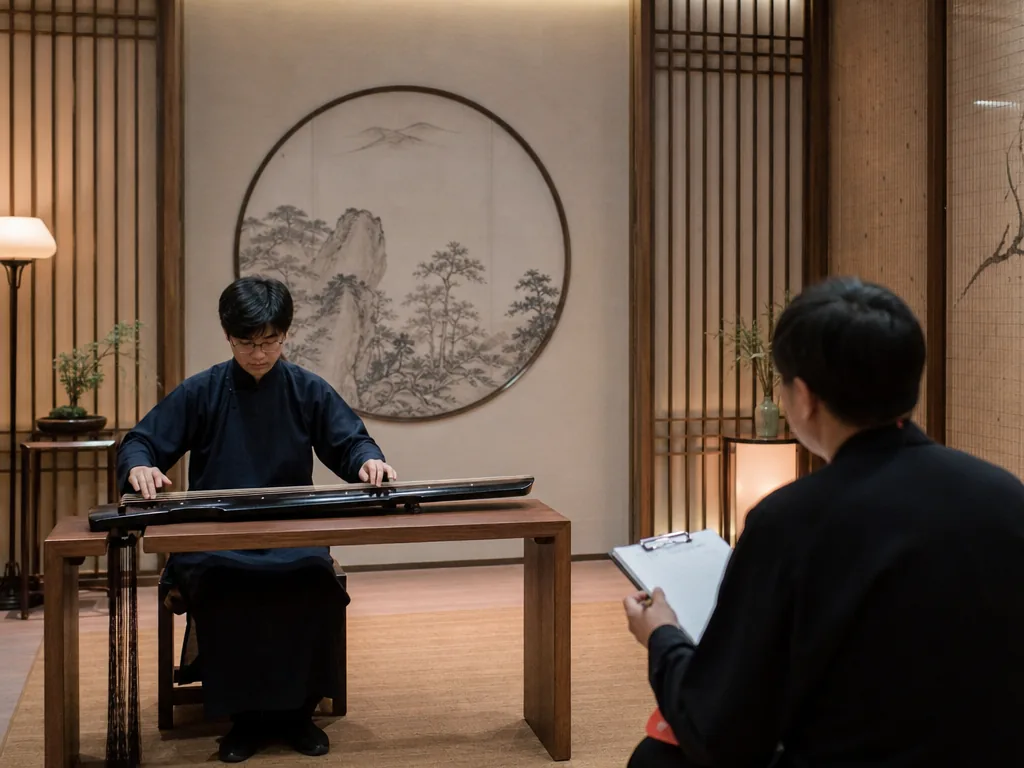
The grading system exists to provide a standardized structure for evaluating proficiency in technique, interpretation, and musical understanding. Most commonly, the system consists of 10 levels (Grades 1–10), with an optional Performance Level (sometimes called Professional Level) for those pursuing mastery or a teaching career.
This structure is recognized by various institutions in mainland China, including the Chinese Musicians Association (CMA) and the Central Conservatory of Music, as well as guqin societies around the world.
Breakdown of Guqin Grading Levels
Beginner Level (Grades 1–3)
Target Learners: Complete beginners, children, or adults with little to no prior experience.
Skills Expected:
- Understanding the basic parts of the guqin and how to tune it.
- Mastery of fundamental finger techniques such as gou, mo, tiao, and cuo.
- Ability to play simple pieces like “Xianweng Cao” and “Qiufeng Ci”.
Focus: Building finger dexterity and rhythm awareness.
Intermediate Level (Grades 4–6)
Target Learners: Those with 1–2 years of structured guqin lessons.
Skills Expected:
- Fluency in techniques like harmonics, stopped notes, and sliding tones.
- Ability to read and interpret jianzipu, the traditional guqin notation.
- Performing more complete works such as “Guanshan Yue”.
Focus: Strengthening musical expression and expanding technique.
Advanced Level (Grades 7–9)
Target Learners: Learners preparing for music college entrance or performing in public.
Skills Expected:
- Confident performance of technically and emotionally challenging pieces like “Yangguan Sandie” and “Pingsha Luoyan”.
- Deeper understanding of musical phrasing and stylistic interpretation across different guqin schools.
Focus: Artistic refinement and historical understanding of the repertoire.
Grade 10 and Performance Level
Target Learners: Aspiring professionals, instructors, or performers.
Skills Expected:
- Mastery of long and complex works such as “Guangling San” and “Youlan”.
- Strong interpretative depth and personal expression.
- Ability to teach, present, and discuss guqin theory and aesthetics.
Focus: Professional stage performance and intellectual engagement with guqin philosophy and heritage.
Guqin Exams and Certification
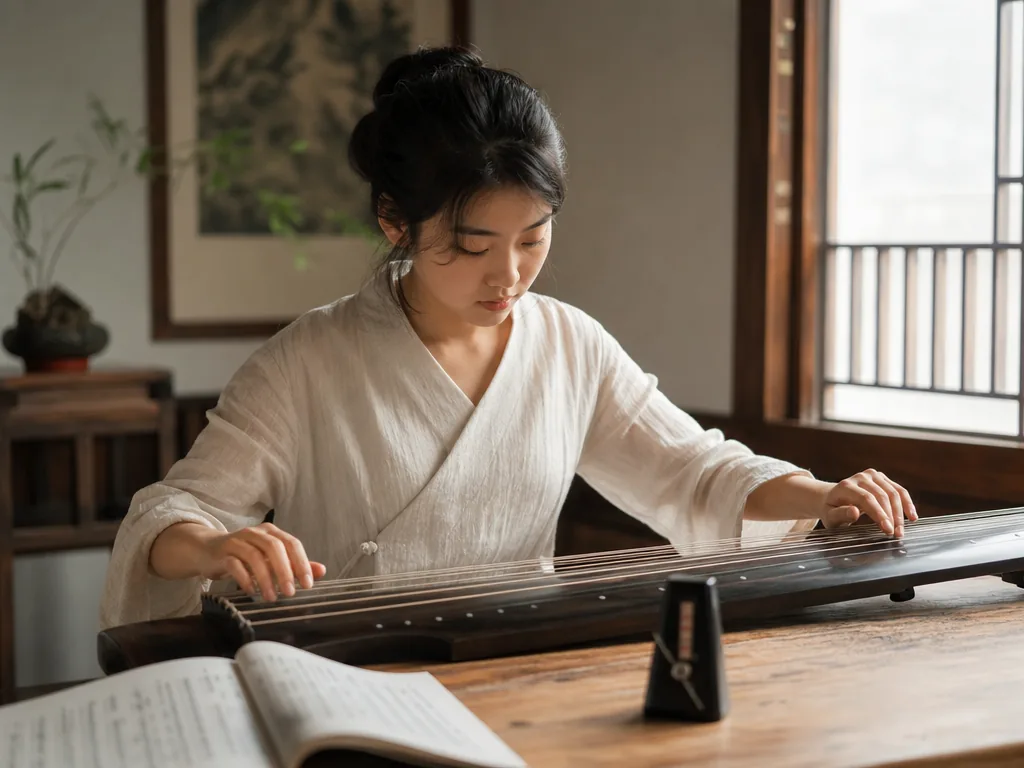
Guqin exams are offered by several national organizations, such as:
- Chinese Musicians Association (CMA) — a national body for music grading and certification.
- Central Conservatory of Music — one of China’s leading music institutions.
- China Nationalities Orchestra Society — a society dedicated to traditional Chinese instrumental music.
Candidates typically must prepare required pieces and demonstrate theoretical knowledge, sometimes including oral or written components. Certification provides a credible benchmark for progress and may be useful for those pursuing teaching or professional guqin performance.
Certification provides a credible benchmark for progress.
Tips for Learning Guqin by Level
Whatever your current grade, a few habits make the whole journey smoother.
Start with a qualified teacher
Personalized feedback prevents bad habits.
Set clear goals
Use the grading system to map your learning journey.
Practice consistently
Mastery of guqin comes from mindfulness and long-term dedication.
Frequently Asked Questions (FAQ)
Q: How long does it take to progress from Grade 1 to Grade 10 in guqin?
Progress varies by learner. Beginner to intermediate stages typically take one to two years each with consistent, structured lessons, and reaching Grade 10 or the Performance Level usually requires several years of dedicated study.
Q: Do I have to pass every grade in order, or can I skip levels?
Many exam bodies allow candidates to enter at a higher grade if they can demonstrate the required repertoire and theoretical knowledge, but building the foundations in sequence is generally the most reliable path.
Q: Are guqin grading certificates recognized internationally?
Certificates from bodies such as the CMA and the Central Conservatory of Music are recognized in mainland China and by many guqin societies abroad, but recognition varies by institution — check with your target school or employer.
Q: Is the guqin suitable for complete beginners with no music background?
Yes. Grades 1–3 are designed for complete beginners and focus on tuning, basic finger techniques, and simple pieces, so no prior musical experience is required.
Further Resources & Next Steps
- Official Resources — The Chinese Musicians Association (CMA), the Central Conservatory of Music, and the China Nationalities Orchestra Society publish exam syllabi, registration details, and grade requirements.
- Further Reading — Look for jianzipu (reduced-character notation) guides and graded repertoire anthologies that cover pieces from “Xianweng Cao” through to “Guangling San”.
- Parent Tips — Encourage short, regular practice sessions and find a qualified teacher early to prevent bad habits from forming.
Note: The information above is for reference only. Please consult professional education institutions for details.
This article was initially drafted and organised with AI. Editor / Professor Chan Kwok-wai; Managing Editor / Kong Yee-leung
Act Now: Find a Tutor / Register as a Tutor
For parents & students: looking for a home or online tutor for this subject? Click the button below to post a free tuition case (subject, level and preferred time) — TutorZone will match you with suitable tutors:
For tutors: do you teach this subject? Click the button below to register for free and receive more suitable cases — you pay only when a match is made: