
 Chinese (Traditional)
 Chinese (Simplified)
 English



IB Physics HL tutor
TUTORZONE SUBJECT GUIDE · IB
IB Physics HL is the International Baccalaureate’s advanced higher-level physics course, designed for students aiming at university study or careers in physics, engineering, and research. This guide walks through the syllabus, assessment structure, study strategies, and career pathways in one place.
Direct Answer:What is IB Physics HL?
IB Physics HL is the International Baccalaureate’s advanced higher-level physics course for students aiming at university study or careers in physi。
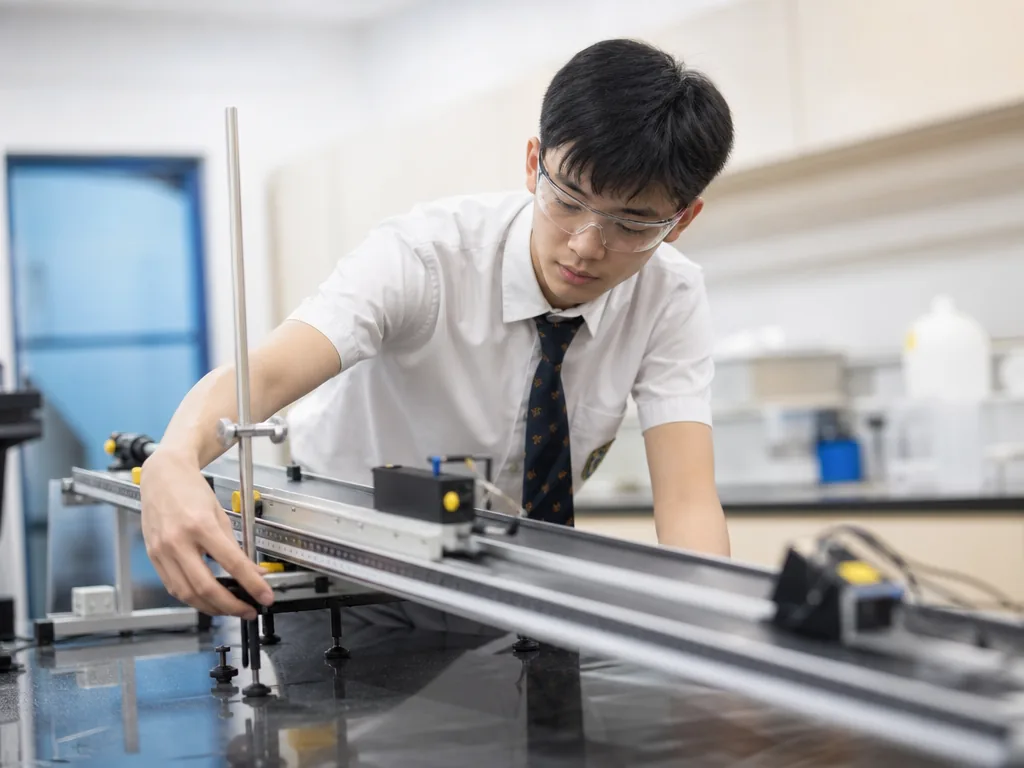
What Is IB Physics HL?
IB Physics HL (Higher Level) is an advanced physics course within the International Baccalaureate (IB) program, specifically designed for students who aim to pursue in-depth physics studies at university or in their future careers. Compared to SL (Standard Level), HL covers more advanced content, a broader range of topics, and requires students to not only understand the fundamental concepts of physics but also apply mathematical tools to analyze complex physical phenomena. The course spans several areas, from classical mechanics to modern physics, emphasizing the integration of theory and practice to enhance students’ overall understanding of physics and lay the foundation for future research or engineering fields.
Core Learning Content
The course covers multiple areas such as mechanics, thermodynamics, electromagnetism, waves and vibrations, and modern physics. Students will learn how physical laws explain various natural phenomena and how to use mathematical tools to model and analyze real-world problems.
Course Objectives
The course requires students to master physics knowledge while also emphasizing scientific methods, experimental design, and data analysis. Students will learn how to observe phenomena through experiments, analyze data, and use scientific theories to explain these phenomena.
Master Physics Knowledge
Build a thorough command of core physics concepts and their underlying physical meaning.
Scientific Methods & Experiment
Design experiments, observe phenomena, and collect reliable data.
Data Analysis & Theory
Analyze data and use scientific theories to explain the results.
Assessment Overview
Throughout the course, students are assessed through a mix of ongoing and end-of-term work:
- Class assignments——regular work that reinforces each topic.
- Laboratory reports——written accounts of experimental work.
- Mid-term exams——progress checks across the syllabus.
- Final exams——the externally assessed papers.
- Personal Investigation (IA)——an independent research project.
Course Composition
Compulsory Sections
The Higher Level syllabus is built around five compulsory areas, each deepening students’ ability to model and analyze the physical world.
1. Classical Mechanics
- Kinematics: Learn how to describe the motion of objects, including concepts like position, velocity, and acceleration, and use motion equations to solve related problems.
- Newton’s Laws of Motion: Students will study Newton’s three laws of motion and learn how to apply these laws to explain object movement.
- Energy and Work: In-depth exploration of kinetic energy, potential energy, and the law of conservation of energy, including calculations and energy transformations.
2. Thermodynamics
- Heat and Temperature: Learn how heat energy is transferred (e.g., conduction, convection, radiation) and understand the fundamental laws of thermodynamics, such as the law of energy conservation.
- Gas Laws: Understand the behavior of gases, including the differences between ideal and real gases, and use gas laws for calculations.
3. Electromagnetism
- Electrostatics and Electric Fields: Learn the basic concepts of charge, electric fields, and electric potential, including Coulomb’s law and its real-world applications.
- Current and Magnetic Fields: Study the definition of electric current, the relationship between current and voltage, and key magnetic field concepts, such as Ampère’s law and Faraday’s law of electromagnetic induction.
4. Waves and Vibrations
- Mechanical Waves and Light Waves: Gain a deeper understanding of wave properties like wavelength, frequency, and amplitude, and learn about wave interference and diffraction phenomena.
- Sound Waves and Optics: Study the transmission properties of sound and light, including how waves propagate through different media and the principles of reflection, refraction, and diffraction of light.
5. Modern Physics
- Relativity: Study Einstein’s theory of special relativity, including the principle of constant light speed and effects like time dilation and length contraction.
- Quantum Physics: Introduce the fundamental concepts of quantum mechanics, such as quantum states and wave-particle duality, and learn how to explain microscopic phenomena using quantum theory.

Extension Topics
HL students will explore more challenging content not necessarily covered in SL courses, aimed at enhancing analytical and reasoning skills. Topics include a deeper investigation into the second law of thermodynamics and additional knowledge of particle physics and nuclear reactions.
Grading Standards & Assessment Methods
1. Final Exam (Externally Assessed, 75%)
- Paper 1 (40%): Multiple-choice and short-answer questions covering the basic knowledge and concepts from all areas of physics, testing students’ ability to calculate quickly and accurately.
- Paper 2 (35%): Extended questions and data analysis tasks, assessing students’ problem-solving skills in complex physics scenarios and their ability to apply physical laws to interpret real-world situations.
2. Internal Assessment (IA, 20%)
- Students choose a physics topic for an in-depth investigation and write a report. The IA evaluates research and experimental design skills and how students validate physical theories through experimentation.
3. Internal Assessment (5%)
- Includes class assignments, regular quizzes, and group projects that help students maintain their understanding and mastery of course content throughout the semester.
Effective Study Strategies
4.1 In-Depth Understanding of Theoretical Knowledge
- Mastering Formulas and Theorems: Memorizing and understanding various formulas and theorems is foundational in HL physics. Students need to grasp the physical meaning behind each formula.
- Practice Analytical Problems: Since HL problems often require complex reasoning, students should practice such problems to sharpen their analytical skills.
4.2 Improving Experimental Skills
- Focus on the Experimental Process: Each experiment should not only include data collection but also reflection and analysis to understand potential errors and improvements.
- Integrate Data with Theory: During investigations, students must combine theoretical concepts with data to ensure each physical phenomenon is supported by experimental results.
4.3 Integrated Application and Calculation Skills
- Master Mathematical Tools: HL physics requires proficiency in advanced mathematics, such as calculus and vector operations. Strengthening mathematical foundations is essential for success in the course.
- Modeling and Analysis: Learn how to translate physical phenomena into mathematical models and derive conclusions. This ability is vital not just in physics but also in engineering and scientific research.
Common Challenges & Solutions
6.1 Difficulty with Advanced Mathematics
- Solution: Through systematic learning of calculus and vector operations, and applying these methods to physics problems, students can improve their fluency in solving problems.
6.2 Weak Connection Between Theory and Experiment
- Solution: Validate theories through experiments and engage in discussions with teachers and classmates to understand the underlying physical logic behind theories.
6.3 Solving Complex Problems
- Solution: Practice integrated problems to train problem-solving skills. Break down problems into simpler steps and analyze them gradually.
University & Career Pathways
8.1 University Programs Related to Physics HL
Physics, Engineering, Material Science, Astronomy, Mathematics, and Computer Science.
8.2 Career Paths
- Research: Physicist, Research Engineer.
- Technology & Engineering: Mechanical Engineer, Electrical Engineer, Aerospace Engineer.
- Finance & Data Analysis: Financial Engineer, Data Analyst.
- Medicine & Healthcare: Radiologist, Medical Physicist.
Exam Time Management
Study Time Allocation
- Theoretical Learning: Dedicate time every day to deepen your understanding of physics concepts, especially those requiring advanced mathematical skills. Use weekends for mock exams.
- Experiments and IA: Set aside time each month for experimental lessons and IA writing.
Frequently Asked Questions (FAQ)
Q: How is IB Physics HL different from SL?
HL covers more advanced content and a broader range of topics, and it demands a stronger command of mathematical tools to model and analyze complex physical phenomena. HL also includes extension topics, such as a deeper treatment of the second law of thermodynamics and extra material in particle physics and nuclear reactions.
Q: What mathematics do I need for HL Physics?
You should be comfortable with advanced mathematics, including calculus and vector operations. Strengthening these mathematical foundations early makes the analytical and problem-solving demands of the course much easier to handle.
Q: How is the final grade calculated?
The final exam is externally assessed and worth 75% (Paper 1 at 40% and Paper 2 at 35%), the Internal Assessment (IA) is worth 20%, and the remaining 5% comes from internal components such as class assignments, quizzes, and group projects.
Q: How should I prepare for the Internal Assessment (IA)?
Choose a physics topic you can investigate in depth, then design experiments and write a report that validates physical theories through real data. Combine theoretical concepts with your experimental results and reflect carefully on sources of error and possible improvements.
Further Resources & Next Steps
- Official Resources——The IB official website (www.ibo.org) for the latest syllabus and assessment guidance.
- Further Reading——The official IB Physics subject guide and a trusted HL Physics textbook for structured practice.
- Parent Tips——Encourage consistent daily practice with past-paper questions and support early planning of the Internal Assessment.
Note: The information above is for reference only. Please consult professional education institutions for details.
This article was initially drafted and organised with AI. Editor / Professor Chan Kwok-wai; Managing Editor / Kong Yee-leung
Act Now: Find a Tutor / Register as a Tutor
For parents & students: looking for a home or online tutor for this subject? Click the button below to post a free tuition case (subject, level and preferred time) — TutorZone will match you with suitable tutors:
For tutors: do you teach this subject? Click the button below to register for free and receive more suitable cases — you pay only when a match is made: