 Chinese (Traditional)
 Chinese (Simplified)
 English



Hong Kong Junior Secondary Integrated Science: Complete Curriculum Guide
@keyframes tzPulseO { 0%,100% { box-shadow: 0 0 0 0 rgba(255,140,0,.55); transform: scale(1); } 50% { box-shadow: 0 0 0 14px rgba(255,140,0,0); transform: scale(1.04); } }
@keyframes tzPulseN { 0%,100% { box-shadow: 0 0 0 0 rgba(2,30,64,.5); transform: scale(1); } 50% { box-shadow: 0 0 0 12px rgba(2,30,64,0); transform: scale(1.04); } }
.tz-blink-o { animation: tzPulseO 1.6s ease-in-out infinite; }
.tz-blink-n { animation: tzPulseN 1.6s ease-in-out infinite .35s; }
TUTORZONE SUBJECT GUIDE · integrated science
Integrated Science is Hong Kong’s junior secondary (S1–S3) subject that brings together Physics, Chemistry, Biology and Earth Science into one broad, hands-on course — building the scientific thinking, experimental skills and cross-disciplinary understanding students need for senior secondary STEM subjects and everyday life.
Direct Answer:What is Integrated Science in Hong Kong junior secondary?
Hong Kong’s S1–S3 Integrated Science combines Physics, Chemistry, Biology, and Earth Science into one hands-on course.
What Is Integrated Science?
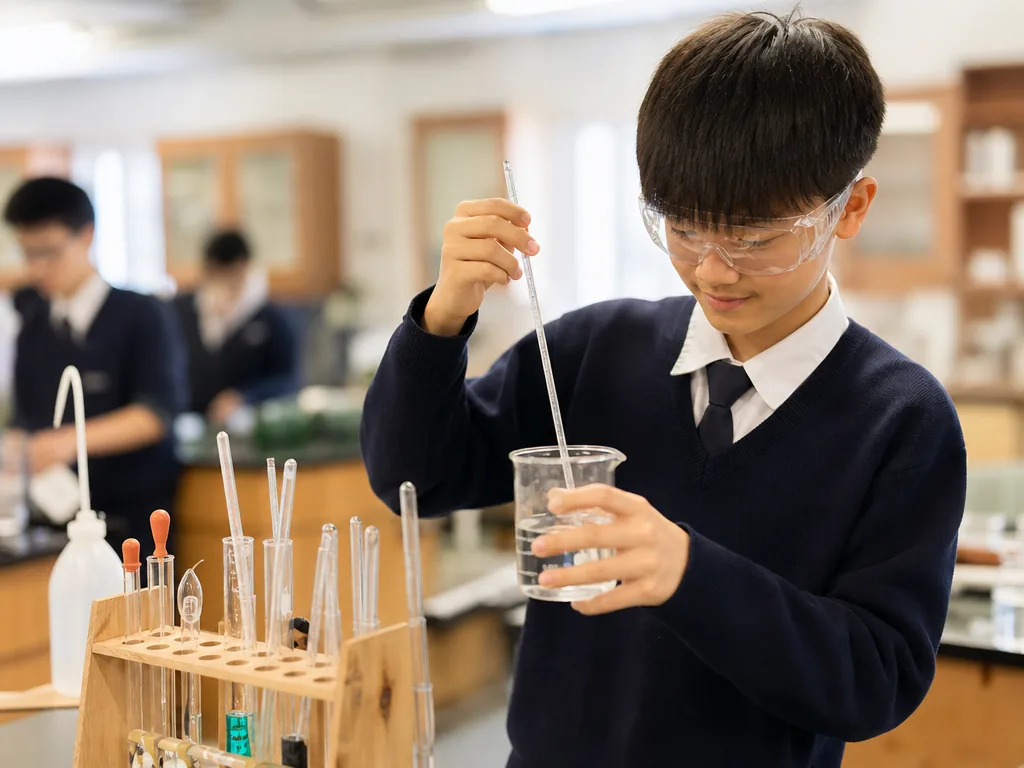
Integrated Science is a multidisciplinary subject in Hong Kong’s junior secondary curriculum (S1–S3). It provides students with a broad understanding of core concepts in Physics, Chemistry, Biology, and Earth Science, emphasizing scientific inquiry and practical experimentation.
Through Integrated Science, students gain foundational knowledge, enhance their problem-solving skills, and develop scientific thinking for both academic advancement and everyday life.
Course Objectives
Understand Core Principles
Understand core scientific principles across multiple disciplines.
Apply the Scientific Method
Apply the scientific method: observe, experiment, analyze.
Build Cross-Disciplinary Links
Build cross-disciplinary connections between science subjects.
Prepare for Senior STEM
Prepare for senior secondary STEM subjects like Physics, Chemistry, Biology, and Environmental Science.
Core Learning Topics
Physics Fundamentals
- Forces & Motion — Learn how forces affect objects and how to describe motion using speed, acceleration, and force diagrams.
- Energy & Work — Explore different forms of energy (kinetic, potential) and how energy is transferred and conserved in systems.
Chemistry Fundamentals
- Properties & Changes of Matter — Understand physical and chemical properties, and how substances change during chemical reactions.
- Acids and Bases — Study acid-base reactions, learn how to use the pH scale, and interpret real-world examples (e.g. household cleaners, stomach acid).
Biology Fundamentals
- Cell Structure & Function — Discover how cells — the basic units of life — carry out essential functions like respiration and protein synthesis.
- Life Processes — Examine how living organisms grow, reproduce, obtain energy, and perform metabolism.
Earth & Environmental Science
- Earth’s Structure — Learn about the layers of the Earth — crust, mantle, core — and geological processes.
- Weather & Climate — Understand weather systems, climate change causes, and their environmental impacts.
Interdisciplinary Learning
The Integrated Science curriculum emphasizes cross-subject integration, helping students understand how concepts in one science domain (e.g. energy) apply to others (e.g. ecosystems, motion, or chemistry). This holistic approach strengthens overall scientific literacy.
Assessment & Grading Breakdown
1. Classwork & Quizzes
Evaluate understanding of basic scientific concepts and ability to apply them in daily situations.
2. Lab Reports
Students conduct experiments and write structured reports including:
- Purpose
- Procedure
- Observations
- Data analysis
- Scientific explanation
3. Final Exam
Combines theory and practical sections to test overall content mastery and scientific problem-solving skills.
Effective Study Strategies
Strengthening Theory Knowledge
- Build Conceptual Frameworks — Connect ideas across disciplines (e.g. chemical reactions and energy changes in physics).
- Understand the “Why” Behind Formulas — Don’t just memorize — understand the logic behind scientific laws and principles.
Improving Practical Skills
- Experiment Design Practice — Learn to formulate hypotheses, design experiments, and identify variables.
- Reflect on Outcomes — Analyze errors and refine procedures after each experiment.
Enhancing Problem-Solving Abilities
- Regular Practice — Solve past exam papers and integrated science problems.
- Group Work — Collaborate with peers to explore different approaches to complex science questions.
Common Learning Challenges & Solutions
| Challenge | Suggested Solution |
|---|---|
| Difficulty integrating knowledge across subjects | Focus on core scientific principles that appear in multiple fields (e.g. energy, systems, structure). |
| Complicated lab procedures | Repeated hands-on practice and careful review of each experiment. |
| Struggling with abstract theories | Use real-life examples, visual aids, models, and simulations for better understanding. |
Academic & Career Pathways
Senior Secondary & University Subjects
- Biology
- Physics
- Chemistry
- Environmental Science
- Medicine
- Engineering
Career Opportunities
- Research & Development — Lab technician, scientific researcher.
- Environmental Sector — Environmental scientist, energy engineer.
- Healthcare — Doctor, pharmacist, biomedical researcher.
- Technology & Engineering — Mechanical engineer, computer scientist.
Exam Time Management Tips
Study Time Allocation
- Theory — Focus daily on a single science subject (e.g. physics or biology). Use weekly reviews and self-tests.
- Experiments — Conduct one hands-on lab per month and write full reports to master scientific documentation.
Action Plan
- Join science competitions to boost your knowledge and confidence.
- Attend public science lectures or visit science museums/institutes to stay inspired and informed.
Why Integrated Science Matters
Hong Kong’s Junior Secondary Integrated Science curriculum helps students:
- Develop a broad-based understanding of scientific disciplines.
- Enhance critical thinking and experimental skills.
- Learn how to connect concepts and solve real-world problems.
It lays a strong foundation for senior secondary education and future careers in science, technology, healthcare, and engineering.
Frequently Asked Questions (FAQ)
Q: What subjects make up Integrated Science?
Integrated Science brings together four core disciplines — Physics, Chemistry, Biology, and Earth Science — taught as one broad, inquiry-based subject across S1–S3.
Q: How is Integrated Science assessed?
Assessment typically combines classwork and quizzes, structured lab reports, and a final exam that tests both theory and practical problem-solving skills.
Q: How can I improve my Integrated Science grades?
Build conceptual frameworks that link ideas across subjects, practise past papers regularly, and refine your experiment-design and lab-report skills after every hands-on activity.
Q: Why is Integrated Science important for my future?
It lays the foundation for senior secondary STEM subjects (Physics, Chemistry, Biology, Environmental Science) and future careers in science, technology, healthcare, and engineering.
Further Resources & Next Steps
- Official Resources — For the official curriculum and latest updates, visit the Hong Kong Education Bureau at www.edb.gov.hk.
- Further Reading — Review past exam papers and school textbooks, and try online simulations and visual aids to reinforce abstract concepts.
- Parent Tips — Encourage simple at-home experiments and visits to science museums or public science lectures to keep your child curious and engaged.
Note: The information above is for reference only. Please consult professional education institutions for details.
This article was initially drafted and organised with AI. Editor / Professor Chan Kwok-wai; Managing Editor / Kong Yee-leung
Act Now: Find a Tutor / Register as a Tutor
For parents & students: looking for a home or online tutor for this subject? Click the button below to post a free tuition case (subject, level and preferred time) — TutorZone will match you with suitable tutors:
For tutors: do you teach this subject? Click the button below to register for free and receive more suitable cases — you pay only when a match is made: