 Chinese (Traditional)
 Chinese (Simplified)
 English



English Language Curriculum in Hong Kong Junior Secondary Schools: Overview & Guide
@keyframes tzPulseO { 0%,100% { box-shadow: 0 0 0 0 rgba(255,140,0,.55); transform: scale(1); } 50% { box-shadow: 0 0 0 14px rgba(255,140,0,0); transform: scale(1.04); } }
@keyframes tzPulseN { 0%,100% { box-shadow: 0 0 0 0 rgba(2,30,64,.5); transform: scale(1); } 50% { box-shadow: 0 0 0 12px rgba(2,30,64,0); transform: scale(1.04); } }
.tz-blink-o { animation: tzPulseO 1.6s ease-in-out infinite; }
.tz-blink-n { animation: tzPulseN 1.6s ease-in-out infinite .35s; }
TUTORZONE SUBJECT GUIDE · English Language Curriculum
English Language is a core subject in Hong Kong junior secondary schools, built around four skills — listening, speaking, reading and writing — together with language thinking and cross-cultural understanding. This guide maps the S1–S3 curriculum, assessment weighting, and the study strategies that carry students toward DSE success.
Direct Answer:What is the English Language curriculum in Hong Kong junior secondary?
Hong Kong junior secondary English is a core subject focused on listening, speaking, reading, writing, and cross-cultural understanding.

English Language Curriculum: Course Overview and Key Features
English Language is a core subject in Hong Kong’s junior secondary school education. The course focuses on developing four essential language skills: Listening, Speaking, Reading, and Writing. It also emphasizes the development of language thinking and cross-cultural understanding.
Context-Based Learning
Enhance practical language use through thematic units.
Language + Thinking Integration
Encourage commentary, analysis, and creativity to boost logical and critical thinking.
Cultural Comparison
Explore texts and topics from various cultural backgrounds to broaden perspectives.
Balanced Expression Training
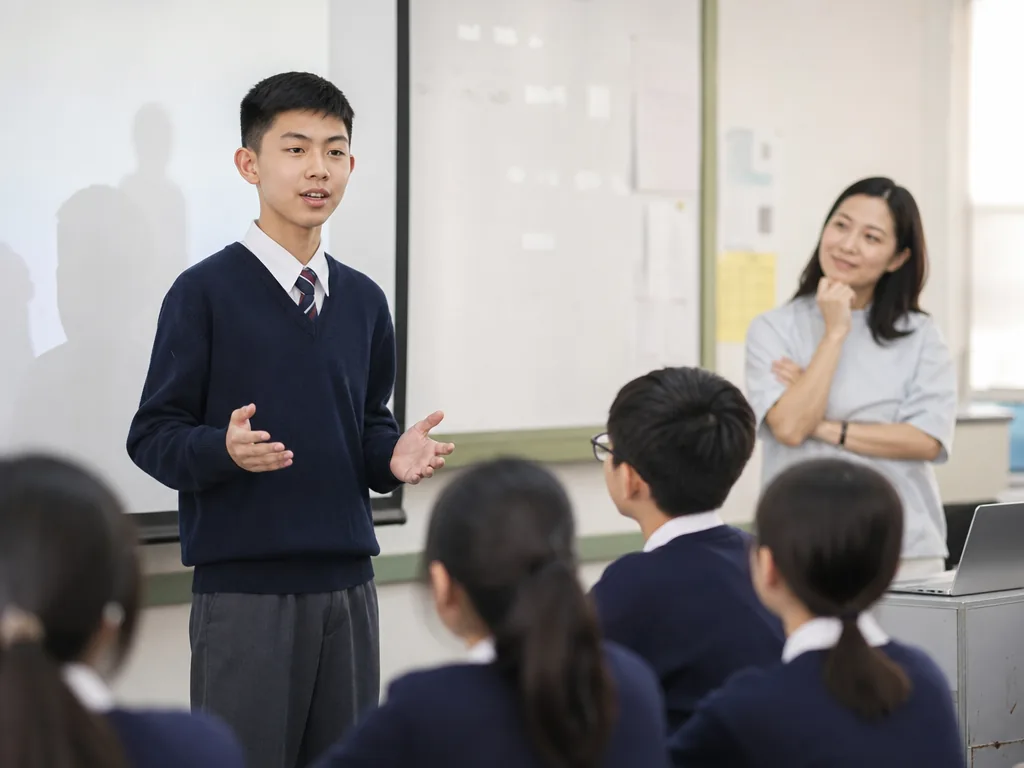
Strengthen skills in public speaking, discussions, and role-playing.
Curriculum Structure (S1–S3)
The junior secondary English curriculum is organised into thematic units that build core language skills through suggested tasks and activities.
| Grade | Thematic Units | Core Language Skills & Objectives | Suggested Tasks & Activities |
|---|---|---|---|
| S1 | Self & Identity | Introduce third-person descriptions, adjectives, and question formation | Create a “Self-Introduction” poster or record a podcast clip |
| S1 | Animals & the Environment | Descriptive writing, environmental vocabulary, simple-to-complex sentence transformation | Write an advocacy letter to protect endangered animals |
| S2 | Culture & Festivals | Comparative sentence structures, short reading, cultural vocabulary | Group presentation on holiday customs in different countries |
| S2 | Social Media & Communication | Opinion expression, supporting examples, understanding internet slang | Write a formal email responding to a complaint |
| S3 | Science & Innovation | Science reading, informative writing, passive voice usage | Write a report on future technologies |
| S3 | Global Citizenship | Critical thinking, essay structure, comparative writing | Debate: “Should single-use plastics be banned?” |
Assessment & Weighting
| Assessment Item | Weight | Focus of Assessment |
|---|---|---|
| Reading | 25% | Main idea understanding, contextual vocabulary, inference analysis, information extraction |
| Writing | 30% | Structure, grammar accuracy, word choice, creativity, and persuasiveness |
| Listening | 20% | Key point extraction, detail understanding, logical inference |
| Speaking | 25% | Pronunciation, intonation, grammar accuracy, content organization, interactive response skills |
Effective Learning Strategies
Four-Step English Reading Method (R-P-I-E)
The RPIE Strategy turns passive reading into an active, structured process:
- Read — quickly skim the text to identify the main idea.
- Predict — guess word meanings and predict next content.
- Identify — find key details and text structure.
- Express — summarise and reflect (write or speak).
Three-Tier English Writing Practice
Follow Plan → Draft → Edit to build stronger written work:
- Plan — use a mind map to list points and examples.
- Draft — follow the PEEL structure (Point-Example-Explain-Link).
- Edit — check subject-verb agreement, sentence length variation, and transitions.
Common Challenges & Solutions
| Challenge | Recommended Strategies & Tools |
|---|---|
| Limited Vocabulary | Use the daily 10 vocabulary flashcard method with example sentences and synonyms/antonyms |
| Struggling with Writing | Build a universal writing framework (e.g., letters, argumentative essays, expository writing) |
| Difficulty Keeping Up with Listening Speed | Practice with TED-Ed or VoiceTube at a slower pace, alongside dictation exercises |
| Fluency in Speaking | Conduct 2-minute English impromptu speaking sessions weekly and record for self-assessment |
Extended Resources & Extracurricular Applications
Resource Platforms & Their Uses
- BBC Learning English — short grammar lessons, speaking practice, cultural insights.
- ReadTheory / Newsela — graded reading materials with comprehension questions.
- Duolingo / Quizlet — vocabulary memorization practice, customizable quizzes.
- VoiceTube / ESL Fast — listening and speaking training videos with subtitles and audio exercises.
Monthly Tasks Suggestions
- Read a teen novel (e.g., Holes / Wonder) and write a book review.
- Write an English diary or blog sharing school life or travel experiences.
- Create a 2-minute English video about “My Life Habits” and share it on the school platform.
Connections to Further Studies & Career Development
High School Pathways
- DSE English — deepen the four skills for the Hong Kong Diploma of Secondary Education (DSE) exam.
- IGCSE / IB MYP — English Language and Literature.
- Elective Courses — English Drama & Speech (Speech & Drama).
Career Pathways
- Language-Related Jobs — editor, translator, copywriter.
- Public Relations & Marketing — PR assistant, marketing communications assistant.
- International Volunteering & Exchanges — coordinator, exchange group leader.
Key Statistics
According to the 2023 Education Bureau Survey:
- Junior secondary students engage in English for an average of 12 hours per week (including classwork and extracurricular activities).
- 65% of schools have “English Days” (where English is the only language spoken).
- DSE English results: 52.1% of students attained Level 3 or higher in the 2023 exam.
Frequently Asked Questions (FAQ)
Q: What are the four core skills in junior secondary English?
The four skills are Listening, Speaking, Reading, and Writing. The course also develops language thinking and cross-cultural understanding through thematic units and cultural comparison.
Q: How is junior secondary English assessed?
A typical weighting is Reading 25%, Writing 30%, Listening 20%, and Speaking 25%. Weightings may vary slightly by school, so check your own school’s scheme of work.
Q: What is the R-P-I-E reading method?
It is a four-step active reading strategy: Read (skim for the main idea), Predict (guess word meanings and what comes next), Identify (locate key details and structure), and Express (summarise and reflect in writing or speech).
Q: How can students improve their speaking fluency?
Run a weekly 2-minute impromptu speaking session and record it for self-assessment. Role-plays, discussions, and public-speaking practice — along with tools like VoiceTube — also build pronunciation, intonation, and interactive response skills.
Further Resources & Next Steps
- Official Resources — the Hong Kong Education Bureau website (www.edb.gov.hk) for the latest curriculum and assessment updates.
- Further Reading — BBC Learning English for daily lessons, and graded teen novels such as Holes or Wonder to build reading stamina.
- Parent Tips — encourage a short weekly English “speaking session” at home and watch English-language videos with subtitles together to support listening practice.
Note: The information above is for reference only. Please consult professional education institutions for details.
This article was initially drafted and organised with AI. Editor / Professor Chan Kwok-wai; Managing Editor / Kong Yee-leung
Act Now: Find a Tutor / Register as a Tutor
For parents & students: looking for a home or online tutor for this subject? Click the button below to post a free tuition case (subject, level and preferred time) — TutorZone will match you with suitable tutors:
For tutors: do you teach this subject? Click the button below to register for free and receive more suitable cases — you pay only when a match is made: