 Chinese (Traditional)
 Chinese (Simplified)
 English


Mathematics in Hong Kong Primary Schools: Curriculum Goals and Teaching Methods
TUTORZONE SUBJECT GUIDE · LOCAL PRIMARY SCHOOL
Mathematics is a core subject in the Hong Kong primary school curriculum, with a strong focus on foundational skills and practical application. The curriculum progresses from concrete concepts to abstract thinking and is designed to foster logical reasoning, while schools increasingly integrate STEM concepts and digital tools to equip students for a tech-driven future.
Direct Answer:What are the goals of Hong Kong primary mathematics?
Mathematics in Hong Kong primary schools focuses on foundational skills, practical application, and logical reasoning, progressing from concrete to。
Curriculum Objectives
The main goals of the Mathematics curriculum are to:
Master Basic Operations
Addition, subtraction, multiplication, and division.
Understand Shapes and Space
Explore the properties of geometric figures and measurement.
Process Data
Learn statistics basics, such as charts and averages.
Develop Logical Thinking
Build critical reasoning and problem-solving skills.
Prepare for Secondary School
Create a solid foundation for Mathematics and STEM subjects.
The curriculum progresses from concrete concepts to abstract thinking and is designed to foster logical reasoning.
Curriculum Content by Grade Level
Lower Primary (P1–P3)
Number & Algebra
- Basic arithmetic——up to 20 in P1, with multiplication and division introduced in P2–P3
- Fractions——basic understanding (e.g. ½, ¼)
- Time and money——read clocks and calculate with Hong Kong dollars
Shape & Space
- 2D and 3D shapes——recognise squares and circles, cubes and spheres
- Symmetry and patterns——explore symmetry and simple patterns
Measures
- Units of measure——compare units of length, weight, and capacity (e.g. cm, kg, L)
Upper Primary (P4–P6)
Number & Algebra
- Large numbers——work with millions, and convert between decimals and percentages
- Mixed operations——e.g. 12 + 3 × 4
- Simple algebra——basic equations (e.g. x + 5 = 10)
Shape & Space
- Angles and shapes——identify acute and obtuse angles, and classify triangles and quadrilaterals
- Perimeter, area, and volume——e.g. area of a rectangle = length × width
Data Handling
- Graphs——read and interpret bar charts and line graphs
- Probability——understand basic probability (e.g. using terms like “likely” and “impossible”)
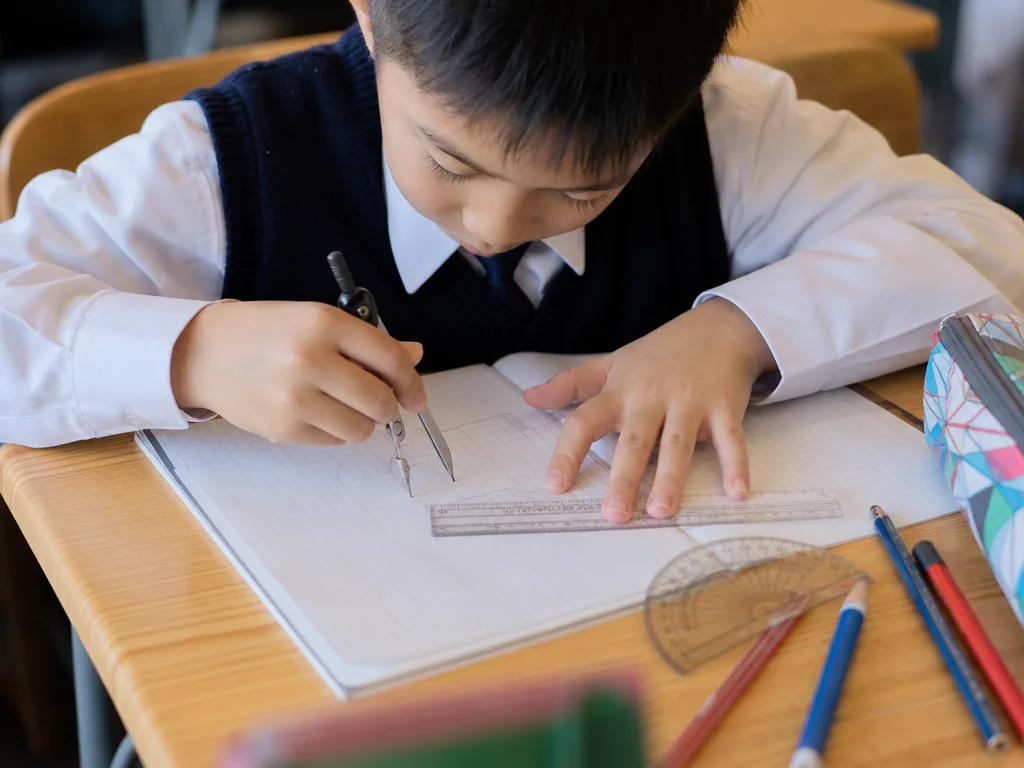
Teaching Approaches
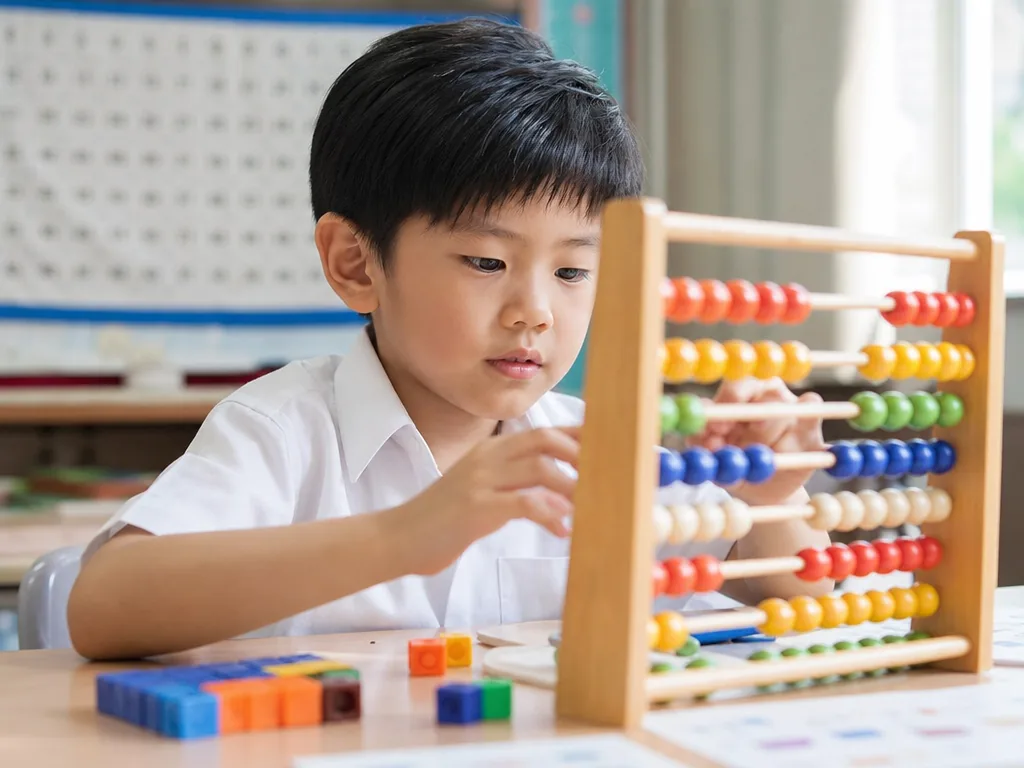
- Hands-on learning——use physical objects like blocks and balance scales
- Real-life contexts——embed math in daily life (e.g. shopping, travel planning)
- Inquiry-based learning——discover concepts through exploration (e.g. origami for symmetry)
- Digital tools——calculators, math software (e.g. GeoGebra), and interactive platforms
Assessment Methods
Internal School Assessments
| Type | Description |
|---|---|
| Written Tests | Include multiple choice, short answers, and word problems |
| Practical Tasks | Measure classroom objects, draw graphs, etc. |
| Project Work | Group tasks solving open-ended problems (e.g. “Design a party with the lowest budget”) |
Territory-Wide Assessment (TSA)
- Primary 3 and Primary 6——administered at these two levels
- Core math skills——assessed across schools
Learning Materials & Resources
Textbooks commonly used:
- Modern Mathematics——Modern Educational Research Society
- New Century Mathematics——Oxford
- Happy Learning Mathematics——Educational Publishing House
Additional resources:
- Daily practice books——“10 Questions a Day”
- Olympiad math training——for advanced learners
- Online platforms——EDB Mathland and Khan Academy (Chinese version)
Bridging to Secondary School
- Arithmetic Extension——from whole numbers and fractions to exponents and roots
- Geometry Development——transition to the Pythagorean theorem and trigonometry
- Algebra Progression——from basic equations to linear equations, quadratics, and functions
Educational Reform & Challenges
STEM Integration
- Cross-subject links——link math with science and technology
- Programming tools——use tools such as Scratch for coordinate geometry
- 3D printing——explore 3D shapes via 3D printing projects
Real-World Application
- Practical problems——solve problems such as analysing environmental data or planning budgets
Learning Diversity
- Differentiated instruction——offered in some schools
- Small group tutorials——for remedial support or enrichment
How Parents Can Help
Simple ways to support at home:
- Everyday practice——compare prices at the supermarket and measure ingredients while cooking
- Math games——use board games (e.g. Monopoly) for calculation skills, and Sudoku for logic
- Avoid over-drilling——focus on conceptual understanding, not just repetitive practice
Final Thoughts
The Mathematics curriculum in Hong Kong primary schools is designed to develop core numeracy, foster problem-solving, and prepare students for future learning in STEM fields. With a growing emphasis on logical thinking, data literacy, and cross-subject learning, math is more relevant and engaging than ever.
Frequently Asked Questions (FAQ)
Q: When do Hong Kong primary students start learning multiplication?
Multiplication and division are introduced in P2–P3, after children master counting up to 20 in P1.
Q: What is the TSA and when is it taken?
The Territory-wide System Assessment is administered in Primary 3 and Primary 6 to assess core math skills across schools.
Q: How can I help my child with math without over-drilling?
Use everyday contexts — compare prices at the supermarket, measure ingredients while cooking, and play board games such as Monopoly or Sudoku. Focus on conceptual understanding rather than repetitive practice.
Q: Which textbooks are commonly used in Hong Kong primary schools?
Common choices include Modern Mathematics (Modern Educational Research Society), New Century Mathematics (Oxford), and Happy Learning Mathematics (Educational Publishing House).
Further Resources & Next Steps
- Official Resources——the Education Bureau website and EDB Mathland for curriculum details.
- Further Reading——daily practice books such as “10 Questions a Day” and Olympiad math training for advanced learners.
- Parent Tips——build confidence with everyday math, board games, and conceptual understanding rather than drills.
Note: The information above is for reference only. Please consult professional education institutions for details.
This article was initially drafted and organised with AI. Editor / Professor Chan Kwok-wai; Managing Editor / Kong Yee-leung
Act Now: Find a Tutor / Register as a Tutor
For parents & students: looking for a home or online tutor for this subject? Click the button below to post a free tuition case (subject, level and preferred time) — TutorZone will match you with suitable tutors:
For tutors: do you teach this subject? Click the button below to register for free and receive more suitable cases — you pay only when a match is made: