 Chinese (Traditional)
 Chinese (Simplified)
 English



Core English Grammar in Hong Kong Primary Schools
@keyframes tzPulseO { 0%,100% { box-shadow: 0 0 0 0 rgba(255,140,0,.55); transform: scale(1); } 50% { box-shadow: 0 0 0 14px rgba(255,140,0,0); transform: scale(1.04); } }
@keyframes tzPulseN { 0%,100% { box-shadow: 0 0 0 0 rgba(2,30,64,.5); transform: scale(1); } 50% { box-shadow: 0 0 0 12px rgba(2,30,64,0); transform: scale(1.04); } }
.tz-blink-o { animation: tzPulseO 1.6s ease-in-out infinite; }
.tz-blink-n { animation: tzPulseN 1.6s ease-in-out infinite .35s; }
TUTORZONE SUBJECT GUIDE · Core English Grammar in HK Primary
Core English Grammar in HK Primary: English grammar in Hong Kong primary schools builds a solid foundation in sentence construction, parts of speech and tense usage — skills every child needs to read, write and speak with confidence.
Direct Answer:What does English grammar in Hong Kong primary schools cover?
It builds a solid foundation in sentence construction, parts of speech, and tense usage for reading, writing, and speaking confidence.
Core English Grammar in HK Primary: Key Grammar Topics Taught in Hong Kong Primary Schools
English grammar in Hong Kong’s primary curriculum focuses on building a solid foundation in sentence construction, parts of speech, and tense usage. Below is an overview of the core grammar elements students are expected to master.
Parts of Speech
Students are introduced to the eight parts of speech, each playing a unique role in sentence structure:
- Nouns——names of people, places, things, or ideas (e.g. dog, book, Hong Kong).
- Pronouns——words that replace nouns (e.g. I, you, he, she, it, we, they).
- Verbs——describe actions or states (e.g. run, eat, is, have).
- Adjectives——describe or modify nouns (e.g. happy, big, red).
- Adverbs——modify verbs, adjectives, or other adverbs (e.g. quickly, very, well).
- Prepositions——indicate time, place, or direction (e.g. in, on, at, under).
- Conjunctions——connect words or clauses (e.g. and, but, because).
- Interjections——express strong emotions (e.g. Wow!, Oh no!).
Basic Sentence Structures
Grammar instruction begins with simple sentence construction, helping students understand the building blocks of English:
- S + V (Subject + Verb)——e.g. I run.
- S + V + O (Subject + Verb + Object)——e.g. She eats an apple.
- S + V + C (Subject + Verb + Complement)——e.g. He is happy.
Basic Tenses
Primary students are taught the three basic tenses:
- Present Simple Tense——used for habits or facts (e.g. I go to school every day). With He/She/It, add -s/-es to the verb (e.g. She likes ice cream).
- Past Simple Tense——used for completed actions. Regular verbs add -ed; irregular verbs are memorised separately (e.g. I played football yesterday; e.g. She ate a sandwich).
- Future Simple Tense——used for actions that will happen. Use will or be going to (e.g. I will visit my grandma; e.g. They are going to have a test).
Questions and Negative Sentences
Students also learn how to form interrogative and negative sentences:
- Yes/No Questions——use Do/Does/Did or Be verbs (e.g. Do you like pizza? e.g. Is she a teacher?).
- Wh- Questions——e.g. What is your name? e.g. Where do you live?
- Negative Sentences——use do not / does not / did not or Be + not (e.g. I do not like spiders; e.g. She is not happy).
Common Grammar Rules
- Articles: a / an / the——a before consonants (a book), an before vowels (an apple), the for specific things (the sun).
- There is / There are——e.g. There is a cat. e.g. There are three dogs.
- Have / Has——e.g. I have a pen. e.g. She has a brother.
How Grammar Is Taught in Hong Kong Primary Schools
Interactive Exercises
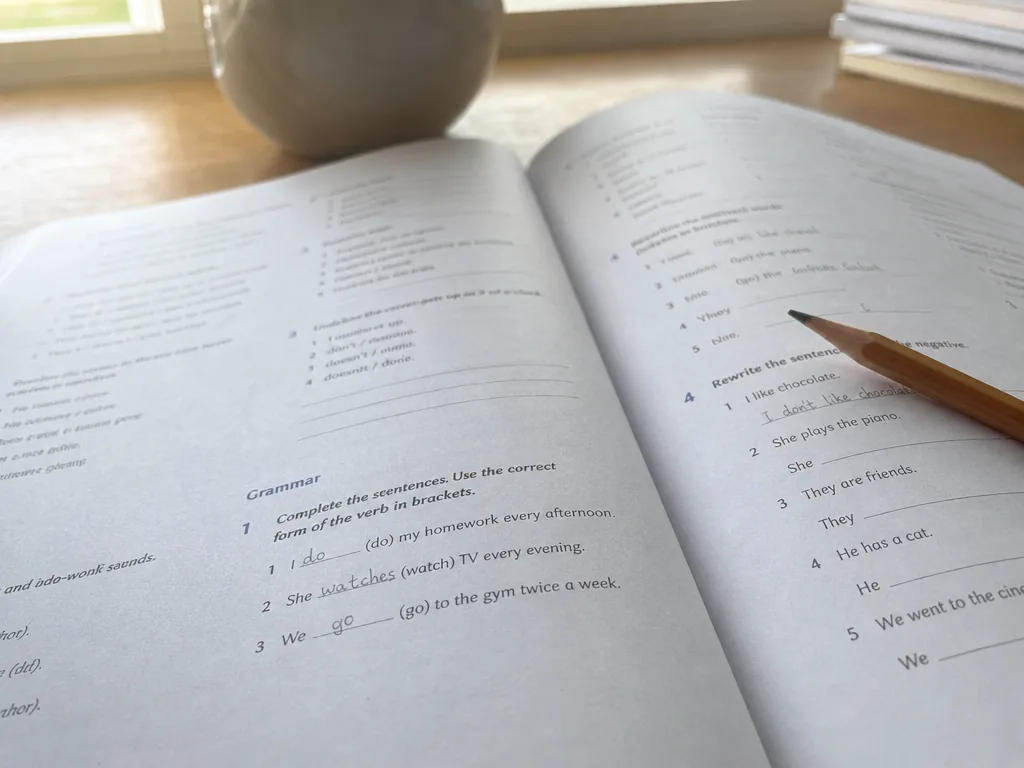
- Fill-in-the-blank questions
- Jumbled sentence activities
- Matching words to images
Contextual Learning
Grammar is taught through stories and dialogues:
Teacher: “What did you do last weekend?”
Student: “I went to the park.”
Charts and Mnemonics
- Verb tense tables——for quick reference:
| Base Verb | Past Tense |
|---|---|
| eat | ate |
| go | went |
- Mnemonics for rules——“He, She, It — Verb adds s!”
Writing Practice
Students apply grammar in short sentences, diaries, or stories:
“Yesterday, I played football with my friends. It was fun!”
How Parents Can Support Grammar Learning at Home
- Daily short sentence writing——encourage your child to write a sentence a day (e.g. use the past tense to describe yesterday).
- Regular storybook reading——read English storybooks regularly to reinforce sentence patterns naturally.
- Grammar-based games——play games like the “sentence building challenge”.
- Grammar learning apps——use apps like Grammarly Kids or English Grammar in Use.
Common Grammar Mistakes and Corrections
Third-person singular
Incorrect: “She go to school.”
Correct: “She goes to school.” (add -s for third-person singular)
Mixing Be verbs and base verbs
Incorrect: “I am eat breakfast.”
Correct: “I eat breakfast.” OR “I am eating breakfast.” (avoid mixing Be verbs and base verbs)
Building a Strong Grammar Foundation
English grammar in Hong Kong primary schools focuses on parts of speech, sentence patterns, and tense mastery. Through interactive, context-based learning, students naturally build grammatical skills. Parents can support this journey through daily conversations, games, and storytelling to strengthen their child’s English foundation.
Through interactive, context-based learning, students naturally build grammatical skills — and parents can reinforce them at home through conversation, games and storytelling.
Frequently Asked Questions (FAQ)
Q: When should my child start learning English grammar?
In Hong Kong, grammar is introduced from the early primary years — beginning with simple sentence construction, then building up to parts of speech and tense usage as students progress.
Q: Which grammar topics matter most for primary students?
The core areas are the eight parts of speech, basic sentence structures (S + V, S + V + O, S + V + C), and the three basic tenses — present, past and future simple.
Q: How can I help my child remember irregular past-tense verbs?
Use verb tense charts, mnemonics and daily short-sentence writing — for example, ask your child to describe yesterday’s activities in the past tense.
Q: Should I correct every grammar mistake my child makes?
Not every mistake. Gentle correction through games and story-reading builds confidence better than constant correction, which can discourage young learners.
Further Resources & Next Steps
- Official Resources——the Hong Kong Education Bureau (EDB) curriculum information at www.edb.gov.hk.
- Further Reading——English Grammar in Use and story-based grammar readers for primary learners.
- Parent Tips——read English storybooks together and play a daily “sentence building challenge” to keep grammar practice light and consistent.
Note: The information above is for reference only. Please consult professional education institutions for details.
This article was initially drafted and organised with AI. Editor / Professor Chan Kwok-wai; Managing Editor / Kong Yee-leung
Act Now: Find a Tutor / Register as a Tutor
For parents & students: looking for a home or online tutor for this subject? Click the button below to post a free tuition case (subject, level and preferred time) — TutorZone will match you with suitable tutors:
For tutors: do you teach this subject? Click the button below to register for free and receive more suitable cases — you pay only when a match is made: