 中文(繁體)
 中文(简体)
 English



ABRSM Violin Grade Exams: Complete Guide to the 2024 Syllabus, with Mock Aural Tests, Sight-Reading Drills and a 12-Week Plan
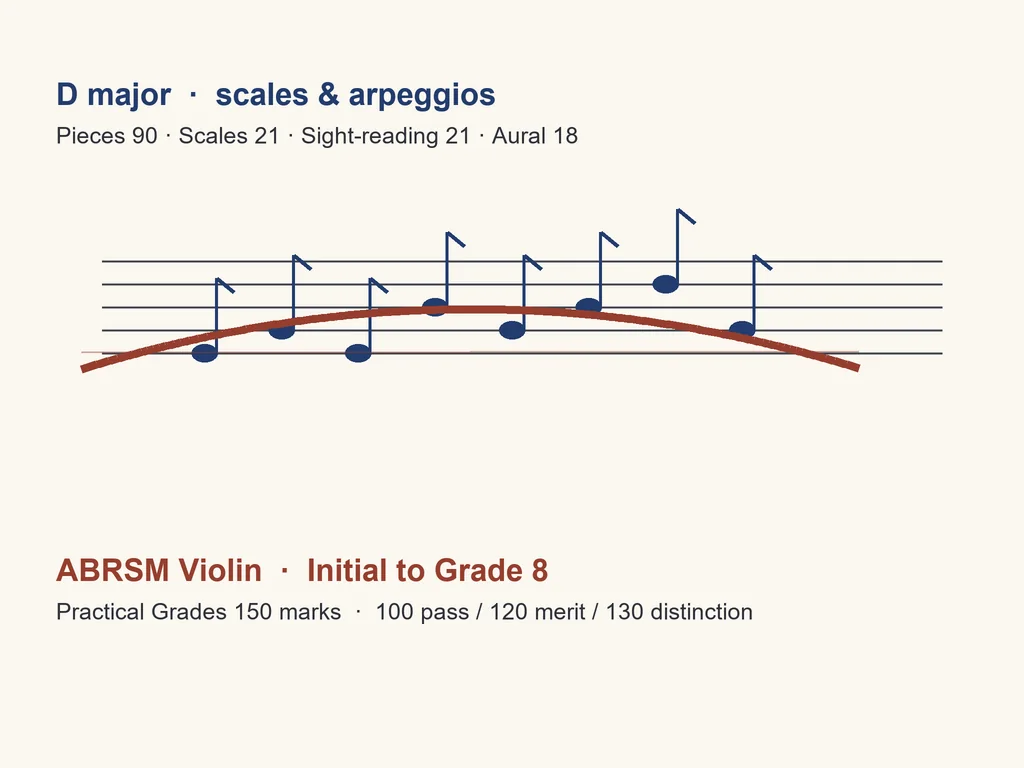
Quick answer: ABRSM violin grades run from Initial Grade to Grade 8 and currently use the “from 2024” syllabus, in effect from 1 January 2024 until further notice; the repertoire lists were refreshed, while scales and arpeggios, sight-reading and aural tests are unchanged. Practical Grades are face-to-face exams: you perform three pieces, play scales and arpeggios, and take sight-reading and aural tests, for 150 marks — pieces 90 (3 × 30), scales and arpeggios 21, sight-reading 21, aural 18; 100 pass, 120 merit, 130 distinction. Before booking Grades 6–8 you must already have passed Grade 5 Music Theory (or Grade 5 Practical Musicianship / an accepted jazz exam). Candidates who prefer not to be tested on scales and sight-reading can take the filmed Performance Grades instead: four pieces, three from the syllabus lists plus one own-choice.
Download and print (free, no registration)
The whole paper — questions, model answers and marking scheme — is laid out for A4 printing: Download the PDF | Open the print view (opens the print dialogue)
The print dialogue opens automatically; choose “Save as PDF” to keep a copy.
Exam at a glance: ABRSM violin (from 2024 syllabus)
| Section | Content | Marks | Share |
|---|---|---|---|
| Three pieces | One from each of Lists A, B and C in the syllabus; piano accompaniment required from Grade 1 | 90 (30 each) | 60% |
| Scales and arpeggios | By grade: major and minor scales, arpeggios, dominant and diminished sevenths, chromatic scales; double stops at the higher grades | 21 | 14% |
| Sight-reading | An unseen melody, with a short preparation time | 21 | 14% |
| Aural tests | Played or sung by the examiner; you respond by clapping, singing back or identifying features | 18 | 12% |
| Total | 150 | 100% | |
| Grade awarded | Marks | UCAS tariff (Grades 6–8) |
|---|---|---|
| Distinction | 130–150 | According to the official UCAS points published for each grade |
| Merit | 120–129 | |
| Pass | 100–119 | |
| Below pass | under 100 | No grade awarded |
Four rules worth memorising: ① the syllabus is the “from 2024” version — in force from 1 January 2024 until further notice; ② the repertoire lists changed, but scales, sight-reading and aural content did not, so that practice carries over; ③ Grades 6–8 require a pass in Grade 5 Music Theory (or Grade 5 Practical Musicianship, or an accepted jazz exam) before booking; ④ Practical Grades and filmed Performance Grades are different routes — Practical includes scales, sight-reading and aural; Performance is four pieces only.
What the 2024 syllabus changed — and what it did not
| Item | Position from 2024 |
|---|---|
| Effective date | 1 January 2024 for the whole Bowed Strings family (violin, viola, cello, double bass) |
| Validity | Until further notice — there is no fixed expiry date; transitional arrangements for old lists are published by ABRSM |
| Repertoire | Refreshed: Lists A, B and C replaced for every grade |
| Scales and arpeggios | Unchanged — same scales, arpeggios, dominant and diminished sevenths and chromatic scales by grade (double stops at higher grades) |
| Sight-reading | Unchanged — a short unseen melody with a brief preparation period |
| Aural tests | Unchanged — clapping, singing back and identifying features, graded by level |
What it means in practice: you must re-pick your pieces, but your scales, sight-reading and aural routine does not need rebuilding. If you already learned a piece, check it against the current syllabus first — a piece that is no longer listed will not be marked.
How this guide was written — and copyright
This guide was written by the TutorZone tutor team against ABRSM’s published Bowed Strings “from 2024” syllabus, the Practical Grades exam structure and its published mark scheme (pieces 90 / scales and arpeggios 21 / sight-reading 21 / aural 18, total 150, with the 100 / 120 / 130 thresholds). It is not official ABRSM material, a specimen paper or syllabus content; ABRSM, its syllabuses and repertoire lists remain the copyright of The Associated Board of the Royal Schools of Music, and no official repertoire list or question is reproduced here. The practice items, aural examples, sight-reading drills and revision plan below are all original TutorZone material.
Scales and arpeggios (21 marks): drills and the usual traps
| Grade range | Typically examined | Focus |
|---|---|---|
| Initial–Grade 1 | One-octave major scales and arpeggios in first position | Intonation, even bow speed, every note planted |
| Grade 2–3 | Two-octave major and minor (natural, harmonic, melodic) scales, arpeggios, chromatic scales | Prepare the finger before the string change; keep the left thumb relaxed in shifts |
| Grade 4–5 | Three-octave scales, dominant and diminished sevenths, chromatic scales | Bow distribution (upper and lower half); metronome-stable speed first |
| Grade 6–8 | Wider range, double stops (thirds, sixths, octaves), harmonics, more keys | Tune the double stop against the open string; intonation built on slow long notes |
A ten-minute daily routine: ① play through slowly with long bows, listening only for intonation and bow pressure; ② add the metronome from ♩=60 and move up four clicks each clean pass until 10% faster than the exam requirement; ③ isolate the seams — the two notes either side of a shift or string change, which is where marks are lost; ④ finish by playing one section from memory, because scales are performed from memory in the exam.
Mock aural tests (10 items, with answers)
These are original TutorZone practice items modelled on the publicly described aural test tasks (clapping, singing back, identifying features). They are not official ABRSM questions. Play them from a phone or ask a teacher to play them at the piano.
1. (Pulse) The examiner plays a 4/4 phrase; clap its rhythm. (Initial–Grade 1)
2. (Pulse) The examiner plays a 6/8 phrase; clap its rhythm. (Grade 2)
3. (Pitch) Two notes are played in succession; sing the second note. (Initial–Grade 1)
4. (Pitch) A three-note figure is played (e.g. do–mi–sol); sing it back on “lah”. (Grade 1–2)
5. (Recognition) Two chords are played; say whether the second is major or minor. (Grade 2–3)
6. (Recognition) A melody is played; say where it moves from major to minor. (Grade 3–4)
7. (Lower part) A phrase with melody and bass is played; sing the bass line. (Grade 4–5)
8. (Cadence) A phrase ending is played; identify a perfect or an imperfect cadence. (Grade 4–5)
9. (Features) A piece is played; describe its tempo, dynamics and articulation. (Grade 3–5)
10. (Chords) A four-note chord is played; say whether it is major, minor or a dominant seventh. (Grade 5)
Answers and technique: 1. Feel the strong–weak–medium–weak frame and clap the first beat of each bar first. 2. 6/8 is compound time — feel it in two big beats (one-two-three / four-five-six). 3. Hold the first note in your head and judge whether the second is higher or lower before naming anything. 4. Three-note figures are usually a scale fragment: sing the first note, then step up. 5. A minor third sits a semitone lower than a major third — play both from the same root to hear it. 6. Listen for the sharps disappearing, flats appearing, and the sudden darkening of colour. 7. Bass lines are slower and longer; hum the outline first, then pitch it. 8. A perfect cadence ends on the tonic (finished); an imperfect cadence stops on the dominant (unfinished). 9. Give all three — e.g. “moderate tempo, quiet to moderately loud, legato” — one answer is treated as incomplete. 10. The dominant seventh is recognisable by the minor seventh on top that wants to resolve downwards.
Sight-reading (21 marks): the 20-second routine, plus four drills
- First 5 seconds — look at three things: key and time signature, the starting note (which string and position), and the rhythm of the opening phrase.
- Next 10 seconds — prepare hands and bow: walk the left hand through the first phrase in your head; choose the bowing start (usually lower half, for a stable sound).
- Last 5 seconds — set the tempo: count two bars out loud in your head; slow and right beats fast and wrong.
- While playing — never stop: keep going through mistakes; examiners mark the passage as a whole, and a stop costs more than a wrong note.
| Drill | Original content | Target |
|---|---|---|
| Drill 1 | D major, 4/4, crotchets and quavers, 8 bars, first position | Steady pulse and even bowing |
| Drill 2 | G major, 3/4, rests and two-note slurs, 8 bars | Rests that do not rush; clean string crossing in slurs |
| Drill 3 | F major, 4/4, dotted rhythms and semiquavers, 8 bars | Exact dotted and semiquaver values |
| Drill 4 | A minor, 6/8, with simple shifts (first to third position), 8 bars | Intonation and tone unchanged after a shift |
Pieces (90 marks): choosing and preparing
- Pick three different characters: List A is usually technical, List B lyrical and List C rhythmic or stylistically distinctive. Choosing three contrasting pieces shows more of your playing than three showpieces.
- Do not make all three the hardest available: each piece is marked separately out of 30, so one piece that is too hard pulls the whole exam down. Ideally: one stretch piece, two secure ones.
- Piano accompaniment from Grade 1: all three pieces need an accompanist, and rehearsals must be planned into the schedule (at least three sessions).
- Memorise the pieces: they are played from memory; memorise section by section and leave the full run-throughs to the last two weeks.
- Intonation routine: record yourself and listen back for sharp or flat tendencies, working on two or three problem figures at a time rather than the whole piece.
- Tone and bowing: examiners mark tone and bow control as well as notes, so check your recordings for uneven bow speed or too much pressure.
Where violin candidates lose marks
- Drifting intonation unnoticed: there is no feedback in the exam room, so check against open strings as part of every practice session.
- Scales performed from memory but practised from the book: scales are played from memory, and candidates who always read them often stall on the way down.
- Stopping in sight-reading: keep the pulse; a stop prevents the examiner from assessing the passage.
- Tempi beyond your control: a poised, accurate performance usually scores higher than a fast, untidy one.
- Not aligned with the accompanist: agree the openings, transitions and final notes, and record rehearsals to listen back.
- Ignoring bowing and dynamic markings: slurs, staccato and dynamic changes are part of the marking, not decoration.
- Forgetting the entry requirement: Grades 6–8 require a Grade 5 Music Theory pass (or an accepted alternative) before booking.
- Using the wrong syllabus year: choose pieces from the “from 2024” lists; a piece that is no longer listed will not be marked.
12-week preparation plan
| Weeks | Content | Target |
|---|---|---|
| 1–2 | Confirm the grade and choose one piece from each of Lists A, B and C in the “from 2024” syllabus | Pieces finalised; rehearsal dates fixed with the accompanist |
| 3–4 | Slow sectional practice on all three pieces; 10 minutes of scales and arpeggios daily | Each section playable alone; first memory pass on scales |
| 5–6 | Add bowing and dynamics; four sight-reading drills a week | Stable tone; the 20-second routine becomes automatic |
| 7 | Aural focus: ten items a day on pulse, pitch and chords | Reliable marks in the aural section |
| 8–9 | First and second rehearsals with the accompanist; memorise the pieces | Accurate entries and transitions; memorisation complete |
| 10 | Mock exam: full run of three pieces, scales, sight-reading and aural | Identify the weakest area and fix it |
| 11 | Final rehearsal; record and self-assess | Intonation, tempo and presentation locked in |
| 12 | Slow revision and mental preparation; no new material in the last week | Arrive at the exam at your most stable |
FAQ
Which syllabus does the violin exam use now?
The Bowed Strings (violin, viola, cello, double bass) “from 2024” syllabus, in force from 1 January 2024 until further notice. The repertoire lists were refreshed for every grade, while scales and arpeggios, sight-reading and aural tests are unchanged.
Practical Grades or Performance Grades?
Practical Grades are face-to-face: three pieces, scales and arpeggios, sight-reading and aural tests, 150 marks. Performance Grades are filmed: four pieces (three from the syllabus lists plus one own-choice) with no scales, sight-reading or aural. Entry arrangements differ, so choose according to your strengths.
Is a piano accompaniment compulsory?
Yes — the pieces are accompanied at every grade (piano or another accepted instrument). Plan at least three rehearsals and confirm the accompanist is available on the exam date.
What is required for Grades 6–8?
You must already hold a pass in Grade 5 Music Theory, or Grade 5 Practical Musicianship, or an accepted jazz exam, before you can book Grades 6, 7 or 8.
Where do Hong Kong candidates enter?
ABRSM exams in Hong Kong are arranged by the Hong Kong Examinations and Assessment Authority (HKEAA); candidates normally enter through their school, music centre or an examination centre. Check HKEAA and ABRSM for entry periods, exam sessions and fees.
May I use a tuner or an app?
Candidates tune themselves in the exam room (from the examiner’s A); electronic tuners, phones and apps may not be used during the exam, so tuning must become a habit in practice.
Official sources
| Source | What to use it for |
|---|---|
| ABRSM — Violin (Bowed Strings) | Syllabus validity, exam format and the Qualification Specification download |
| ABRSM — syllabus index | Download the violin “from 2024” syllabus and repertoire lists (A, B, C) |
| ABRSM — Practical Grades | Exam structure, mark scheme and marking criteria |
| HKEAA — ABRSM exams in Hong Kong | Entry, exam sessions and centre arrangements |
Information here is for guidance only; exam arrangements and marks are governed by the latest ABRSM and HKEAA publications. See also: ABRSM clarinet grade exams, ABRSM piano grade exams (2027 & 2028 syllabus) and exam practice questions. Looking for violin tuition? Start with the subject guides and then match with a tutor.
- Same series — ABRSM clarinet grade exams, ABRSM piano grade exams (2027 & 2028 syllabus) and exam practice questions.
- Subject guides — curriculum guides across programmes.
- Logistics — Cross-district transport guide: check travel times before arranging lessons.
Note: exam arrangements and marks are governed by the latest ABRSM and HKEAA publications. This is original TutorZone content, not official ABRSM material.
Next step: free violin tuition
Students and parents: pieces carry 90 of the 150 marks, but the other 60 come from scales, sight-reading and aural tests — and candidates who only practise pieces give those marks away. Tell us the grade level and available times and TutorZone will match you with a tutor who knows the ABRSM mark scheme and trains all three sections together:
Tutors: the violin is one of the largest sources of instrumental demand in Hong Kong, and repertoire, scales and sight-reading requirements differ sharply by grade. Register free — you only pay when a match is made: