 Chinese (Traditional)
 Chinese (Simplified)
 English



DSE Physics: A Comprehensive Guide to the Hong Kong Diploma of Secondary Education Physics Course
TUTORZONE SUBJECT GUIDE · DSE
DSE Physics is one of the core science electives in the Hong Kong Diploma of Secondary Education. This guide walks you through what the course covers, how it is assessed, and the study strategies that help students master both its theory and its experiments.
Direct Answer:What is DSE Physics?
DSE Physics is a core science elective in the Hong Kong Diploma of Secondary Education, covering theory, experiments, and study strategies.
What Is DSE Physics?
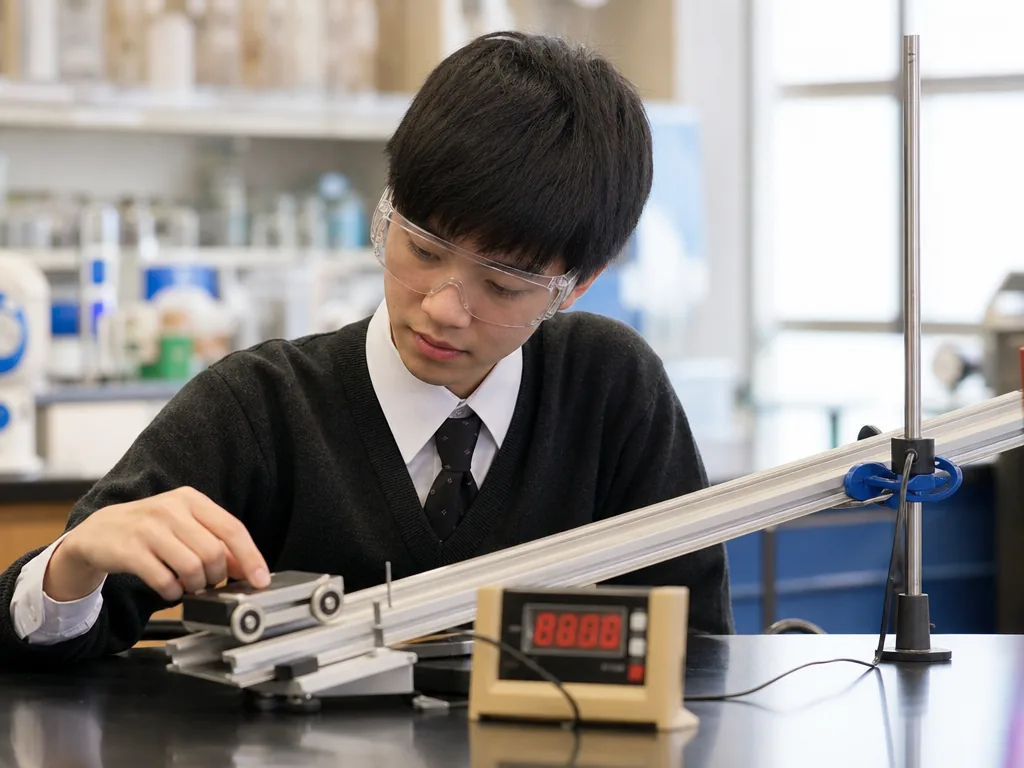
DSE Physics is a crucial science subject within the Hong Kong Diploma of Secondary Education (DSE) that explores fundamental physical principles and the laws governing motion and the natural world. The subject combines both theoretical knowledge and hands-on experiments, providing students with a deep understanding of key physics concepts, laws, and mathematical tools while honing their problem-solving abilities. By learning DSE Physics, students gain the skills necessary to analyze, predict, and interpret physical phenomena, as well as apply this knowledge in daily life, technological advancements, and engineering fields.
Physics is the bridge between abstract theory and the real world — it teaches you to analyse, predict and interpret the phenomena around you.
Key Features of DSE Physics
Balance of Theory and Experiment
DSE Physics not only requires an understanding of physical laws but also emphasises the importance of experimental verification, helping students improve their scientific inquiry skills.
Use of Mathematical Tools
Physics relies heavily on mathematical tools to describe and analyse physical phenomena. Students learn to apply math in solving complex physics problems.
Development of Scientific Thinking
The study of physics encourages logical reasoning, critical thinking, and problem-solving skills, all essential for academic and professional success in scientific fields.
Assessment Structure
DSE Physics is assessed through two channels: the Public Examination (70%) and the School-based Assessment (SBA, 30%). Both are broken down in detail in the assessment section below.
DSE Physics Curriculum Breakdown
Mechanics
- Motion and Force——Study of object motion, velocity, acceleration, and Newton’s laws.
- Kinetic and Potential Energy——Exploration of energy conversions, including the law of conservation of energy.
- Simple Harmonic Motion and Waves——Understanding vibrations and wave phenomena.
Thermodynamics
- Heat and Temperature——Transfer of heat and key thermodynamic laws like energy conservation and transformation.
- Properties of Gases and Thermodynamic Processes——The ideal gas law and principles behind heat engines.
Electricity
- Electrostatics and Electric Fields——Electrostatic forces, electric fields, and potentials.
- Circuit Analysis——Understanding Ohm’s law and Kirchhoff’s laws, along with analysis of DC and AC circuits.
Optics
- Nature of Light——Wave properties of light, reflection, refraction, and interference.
- Applications of Light——Study of optical instruments like microscopes and telescopes.
Modern Physics
- Relativity and Quantum Mechanics——Einstein’s theory of relativity and quantum mechanics concepts such as uncertainty and wave-particle duality.
- Atomic Structure and Nuclear Physics——Atomic structure, nuclear reactions, and applications of nuclear energy.
Assessment Methods and Grading
Public Examination (70%)
| Paper | Weighting | What It Tests |
|---|---|---|
| Paper 1 — Physics Knowledge and Calculations | Approx. 35% | Multiple-choice, short-answer, and calculation problems testing understanding of physical concepts and laws. |
| Paper 2 — Comprehensive and Application Questions | Approx. 35% | Long-answer questions and case studies assessing application of knowledge to real-world problems. |
School-based Assessment (SBA, 30%)
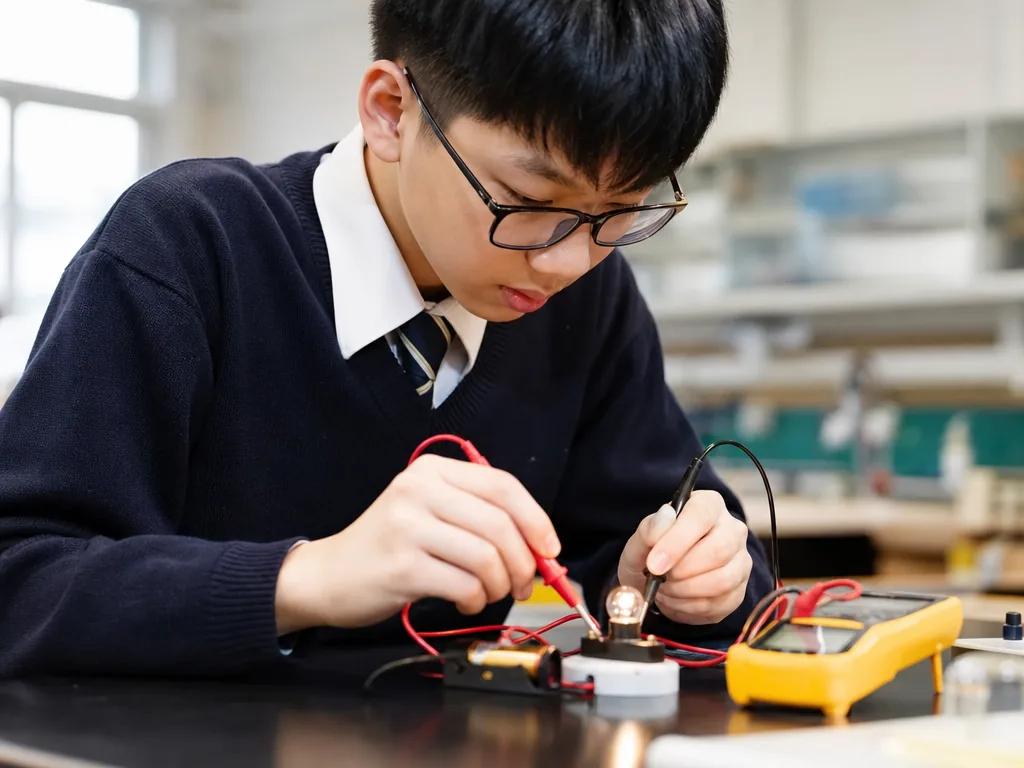
- Experiment Report and Research Project——Approx. 2000 words. Example topic: “Investigating Energy Conversion in Simple Harmonic Motion.”
SBA Components:
- Experiment Design and Data Analysis——Conduct experiments, collect data, and analyse results.
- Application of Physics Theory——Link experimental results to physical theory and analyse underlying principles.
- Discussion and Conclusion——Discuss experimental outcomes, identify potential sources of error, and draw reasonable conclusions.
Effective Learning Strategies
1. Solidifying Basic Knowledge
- Memorise and understand key formulas and laws, ensuring you grasp their underlying physical meanings.
- Create concept maps after each unit to link related concepts and formulas.
2. Enhancing Experiment Skills
- Repeatedly practise fundamental experiments (e.g., measuring gravitational acceleration, verifying Newton’s laws) to master experimental design and data handling.
- Focus on writing clear, logically structured experiment reports and accurately interpreting results.
3. Problem-Solving and Application
- Practise real-world case studies (e.g., applying physics in daily life) to improve the ability to solve complex problems.
- Develop a systematic approach to solving problems across various topics (mechanics, electricity, thermodynamics, etc.) through extensive practice.
Common Challenges and Solutions
1. Physics Calculation Errors
- Practise regularly to become familiar with formulas and improve accuracy.
- Double-check each step in your calculations to avoid errors, especially in unit conversions.
2. Difficulty Relating Theory to Practice
- Use real-life examples and case studies to bridge the gap between abstract theory and practical applications.
3. Challenges in Experimental Design and Data Analysis
- Learn effective experimental design techniques and apply appropriate statistical methods to analyse data, understanding error margins to draw reasonable conclusions.
Academic Pathways and Career Connections
- University Subjects——Physics, Engineering, Computer Science, Material Science, Astronomy, and more.
- Career Paths——Physicist, Engineer (Mechanical, Electronics, Civil), Data Scientist, Researcher, Educator.
Exam Time Management & Actionable Tips
Time Management for Exams
- Paper 1——Allocate approximately 45 minutes per question (including 5 minutes for planning).
- Paper 2——Allocate approximately 60 minutes per question.
Actionable Tips for Success
- Weekly Practice——Engage in weekly practice with comprehensive questions, focusing especially on application-based questions to ensure flexibility in applying learned concepts.
- Join Physics Societies or Science Experiment Activities——Boost interest and practical skills by participating in extracurricular activities related to physics.
Conclusion
DSE Physics is more than just a subject — it’s a platform for developing logical thinking, critical analysis, and real-world problem-solving skills. It prepares students for future academic and career paths in science and technology, equipping them with the skills to tackle complex challenges and contribute to innovation and progress in various fields.
For more information, visit the Hong Kong Education Bureau.
Frequently Asked Questions (FAQ)
Q: What is the weighting of the public examination and SBA in DSE Physics?
The public examination accounts for 70% of the final grade, while the School-based Assessment (SBA) contributes the remaining 30%.
Q: What topics does the DSE Physics curriculum cover?
The syllabus spans five main areas: Mechanics, Thermodynamics, Electricity, Optics, and Modern Physics (relativity and quantum mechanics, plus atomic and nuclear physics).
Q: How can I reduce calculation errors in physics?
Practise regularly to become fluent with formulas, double-check every step of your working, and pay close attention to unit conversions.
Q: What university and career paths does DSE Physics open up?
It leads to subjects such as Physics, Engineering, Computer Science, Material Science and Astronomy, and to careers including physicist, engineer, data scientist, researcher and educator.
Further Resources & Next Steps
- Official Resources——The Hong Kong Education Bureau website is the authoritative source for DSE subject information and updates.
- Further Reading——Consult the Hong Kong Examinations and Assessment Authority (HKEAA) for past papers, marking schemes and the latest assessment arrangements.
- Parent Tips——Encourage a steady weekly practice routine and support participation in physics societies or science experiment activities to build hands-on skills.
Note: The information above is for reference only. Please consult professional education institutions for details.
This article was initially drafted and organised with AI. Editor / Professor Chan Kwok-wai; Managing Editor / Kong Yee-leung
Act Now: Find a Tutor / Register as a Tutor
For parents & students: looking for a home or online tutor for this subject? Click the button below to post a free tuition case (subject, level and preferred time) — TutorZone will match you with suitable tutors:
For tutors: do you teach this subject? Click the button below to register for free and receive more suitable cases — you pay only when a match is made: