
 Chinese (Traditional)
 Chinese (Simplified)
 English



GCE A-Level Engineering: Curriculum Overview, Exam Structure & Career Pathways
TUTORZONE SUBJECT GUIDE · GCE
GCE A-Level Engineering is the STEM course that turns scientific theory into working solutions. This guide covers the full curriculum, exam structure, study strategies, and the university and career pathways it unlocks.
Direct Answer:What is GCE A-Level Engineering?
GCE A-Level Engineering is a STEM course that turns scientific theory into working solutions, with robotics and control systems as core threads.

What is GCE A-Level Engineering?
GCE A-Level Engineering is a practical, application-driven subject within the STEM education system of international schools. Unlike traditional A-Level Physics, this course focuses on engineering principles, design thinking, and problem-solving. Designed for aspiring engineers, it bridges the gap between scientific theory and real-world applications.
GCE Engineering, offered at AS-Level and A-Level, equips students with the technical and analytical skills required in fields such as mechanical, electrical, and structural engineering. The curriculum emphasizes innovation, sustainable design, and hands-on experience, making it a foundational course for future engineers.
5 Core Modules of the GCE Engineering Curriculum
1. Mechanical Engineering Principles
- Statics and Mechanics: Equilibrium, moment calculations, stress-strain analysis
- Motion Systems: Gear ratios, linkage mechanisms
- Materials Science: Comparison of metals, polymers, and composites
2. Electrical and Electronic Engineering
- Circuit Design: Ohm’s Law, Kirchhoff’s Laws
- Digital Systems: Truth tables, AND/OR/NOT gates
- Control Systems: Open-loop vs closed-loop systems
3. Structural Engineering
| Concept | Key Techniques | Case Studies |
|---|---|---|
| Load Analysis | Static/live/environmental loads | Taipei 101 wind damper |
| Truss Design | Joint and section methods | Optimized bridge trusses |
| Earthquake Engineering | Base isolation, energy dissipation | Japanese seismic innovations |
4. Thermodynamics & Energy Systems
- Laws of Thermodynamics: Carnot efficiency
- Renewable Energy: Solar panel tilt optimization
- Fluid Dynamics: Bernoulli’s principle in pipelines
5. Engineering Design Process
- Design Cycle: Needs analysis → Ideation → Prototyping → Testing
- Project Management: Gantt charts, critical path analysis
- Engineering Ethics: Balancing safety, cost, and sustainability
Distinctive Features of GCE Engineering in International Schools
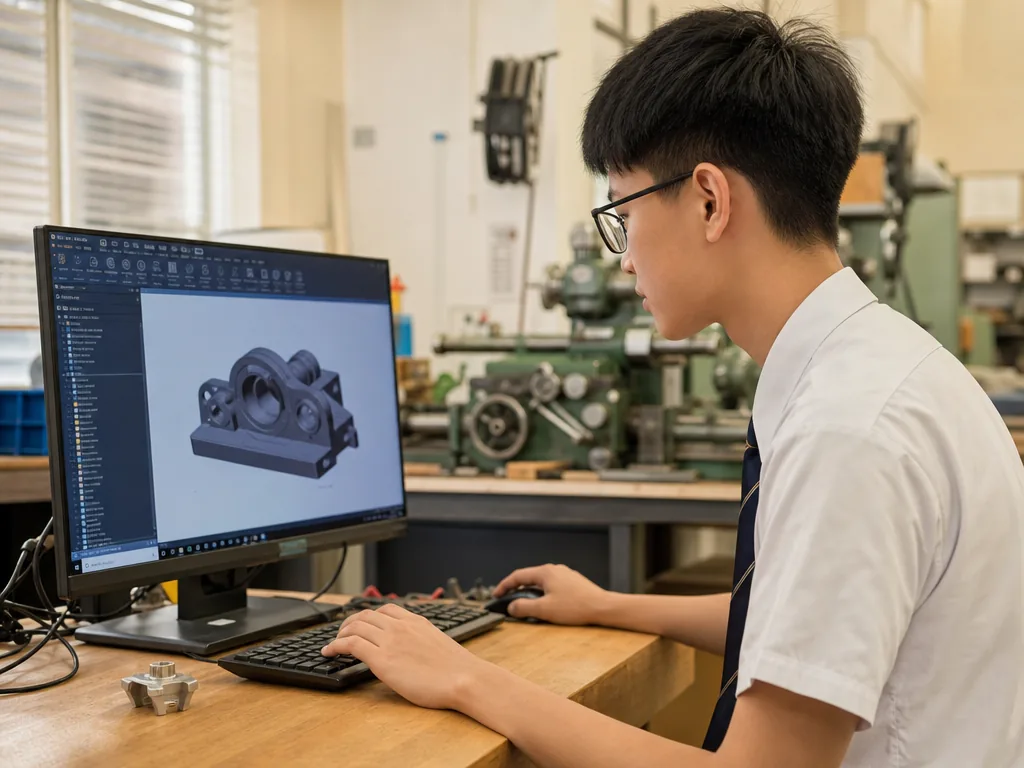
- Hands-on Learning: 3–4 hours/week of lab or workshop sessions (e.g. CNC machining, 3D printing)
- Interdisciplinary Approach: Integrates math modeling, physics, and computing
- Industry Tools Training: Use of AutoCAD, SolidWorks, MATLAB
- STEM Competitions: Participation in FIRST Robotics, civil engineering bridge design contests
- Sustainability Focus: Emphasis on eco-friendly design and circular economy principles
GCE Engineering vs. Related Subjects
| Aspect | Engineering | Physics | Design & Technology (DT) |
|---|---|---|---|
| Focus | Real-world problem-solving | Exploration of natural laws | Product aesthetics & usability |
| Methodology | Analyze → Design → Test | Experiment → Model | Ideation → Prototyping |
| Tasks | Optimize solar tracker | Prove Newton’s Laws | Design ergonomic chair |
| Skill Output | Patent writing, CAD drawing | Scientific writing | Product modeling |
Assessment Structure (Edexcel Example)
AS-Level (Year 1)
- Unit 1: Engineering Principles (Written exam: materials, mechanics, electronics)
- Unit 2: Engineering Processes (6-hour practical design & build task)
A-Level (Year 2)
- Unit 3: System Engineering (Thermal, fluid, and control systems)
- Unit 4: Major Project (Research report + working prototype in chosen field)
External Assessment: A 12-week engineering project accounting for 30% of the final grade.
Study Tips for GCE A-Level Engineering
1. Master Engineering Thinking
Use the IDEAL problem-solving model:
- Identify the problem
- Define the need
- Explore solutions
- Act on the best one
- Look back and refine
2. Technical Drawing Skills
- Learn third-angle projection (international standard)
- Practice dimensioning rules (ISO 129-1)
3. Applied Math Tools
Visualize key formulas like stress calculation:
σ = F ÷ A (Stress = Force ÷ Area)
4. Learn from Engineering Failures
Build a failure case archive:
- Tacoma Narrows Bridge collapse (1940)
- Challenger disaster due to O-ring failure (1986)
University & Career Pathways
University Entry
- Imperial College London: Requires A-Level Engineering + Math + Physics
- HKUST (Hong Kong): Gives priority to students with engineering background
Career Prospects
- Traditional Engineering: Civil, mechanical, electrical engineering
- Emerging Fields: Renewable energy systems, robotics
- Cross-disciplinary: Patent law, engineering project management
- Entrepreneurship: CTO in tech start-ups
Common Challenges & Practical Solutions
- Struggling with Math?——Use Wolfram Alpha for truss analysis breakdowns
- Lacking Design Innovation?——Apply TRIZ (40 inventive principles)
- Time Management Issues?——Implement Agile Sprint Planning for projects
Why Choose GCE A-Level Engineering?
This subject nurtures the rare ability to turn ideas into functional solutions. Students will develop:
Systematic Thinking
Break down and model complex engineering problems
Technical Execution
Turn sketches into real, working prototypes
Sustainable Mindset
Make decisions balancing efficiency, cost, and environmental impact
In a tech-driven world, the power to engineer meaningful change is one of the most valuable skills students can gain.
Frequently Asked Questions (FAQ)
Q: Is GCE A-Level Engineering harder than A-Level Physics?
It is application-driven rather than purely theoretical, combining mathematics, physics, and hands-on design. Students who learn best by building and testing will often find it more intuitive than traditional Physics.
Q: Do I need to be strong in mathematics to take GCE Engineering?
A solid foundation in math and physics helps, but the course develops applied skills progressively, and tools such as Wolfram Alpha can support analysis of complex systems.
Q: Which universities accept GCE A-Level Engineering?
Many leading institutions value the qualification — Imperial College London requires it alongside Math and Physics, while HKUST gives priority to students with an engineering background.
Q: What careers can GCE Engineering lead to?
Graduates move into civil, mechanical, and electrical engineering, renewable energy, robotics, patent law, project management, and tech entrepreneurship.
Further Resources & Next Steps
- Official Resources——Review the Edexcel GCE Engineering specification, past papers, and mark schemes to understand exactly what examiners expect.
- Further Reading——Explore TRIZ (40 inventive principles) and ISO 129-1 technical drawing standards to sharpen your design and drafting skills.
- Parent Tips——Encourage hands-on projects at home, from robotics kits to model structures, so students can practice the design-and-test mindset outside the classroom.
Note: The information above is for reference only. Please consult professional education institutions for details.
This article was initially drafted and organised with AI. Editor / Professor Chan Kwok-wai; Managing Editor / Kong Yee-leung
Act Now: Find a Tutor / Register as a Tutor
For parents & students: looking for a home or online tutor for this subject? Click the button below to post a free tuition case (subject, level and preferred time) — TutorZone will match you with suitable tutors:
For tutors: do you teach this subject? Click the button below to register for free and receive more suitable cases — you pay only when a match is made: