
 Chinese (Traditional)
 Chinese (Simplified)
 English



What is Adobe Illustrator?
TUTORZONE SUBJECT GUIDE · COMPUTER
Adobe Illustrator is Adobe’s professional vector graphics application for creating logos, icons, typography, illustrations, brand identities and UI/UX design. Because it builds artwork from mathematical paths rather than pixels, everything you draw stays crisp at any size — here is a complete guide to what it does and why designers learn it.
Direct Answer:What is Adobe Illustrator?
Adobe Illustrator is Adobe’s professional vector graphics application for logos, icons, typography, illustrations, brand identities, and UI/UX design.
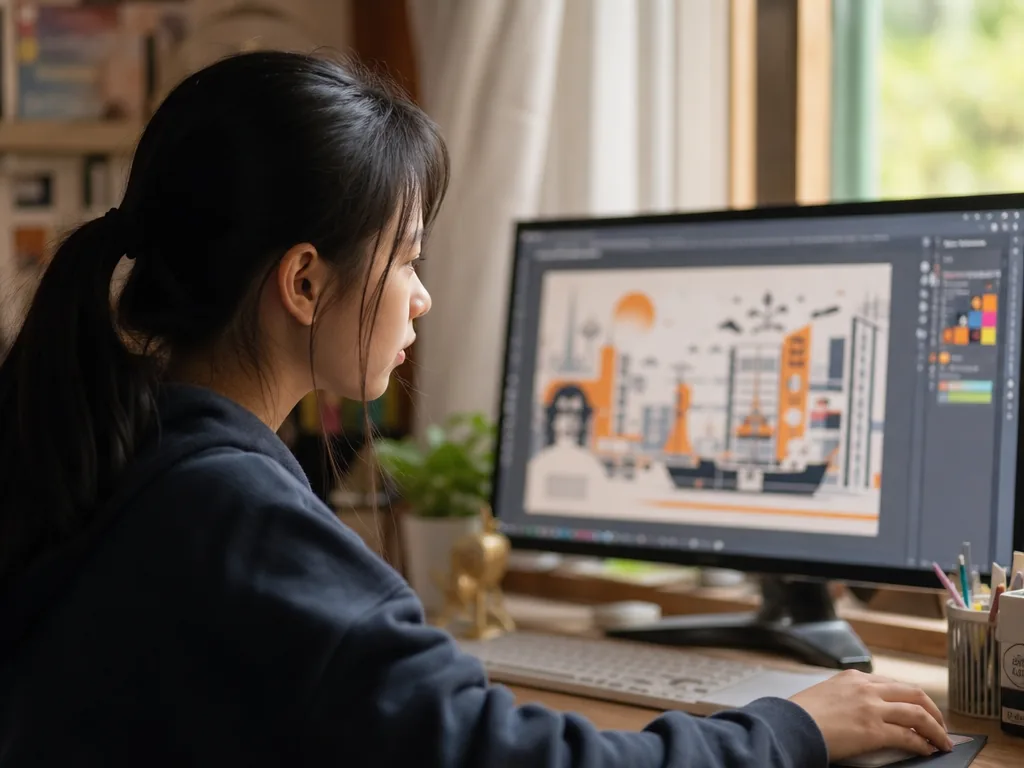
What Is Adobe Illustrator?
Adobe Illustrator (abbreviated as Illustrator or AI) is a professional vector graphics software developed by Adobe. It is primarily used for creating illustrations, icons, typography, brand logos, graphic design, and UI/UX design.
- Unlike Photoshop, Illustrator uses “vector graphics” technology, allowing works to retain their authenticity even when magnified hundreds of times, making it particularly suitable for designs requiring high precision and scalability.
Key Features of Illustrator
1. Vector Graphics Technology
- Uses mathematical formulas to define lines, shapes, and colors.
- Images can be infinitely scaled without losing resolution, making them ideal for prints and large posters.
2. Multifunctional Drawing Tools
- Equipped with various brushes, pen tools, shape tools, path management, etc., so you can precisely control every design detail.
- Supports custom brushes and styles to create unique illustrations.
3. Fine Typography and Text Processing
- Powerful built-in text layout features include support for kerning, leading, font deformation, and font creation.
- Suitable for design projects that require artistic fonts, such as book covers, DM design, and commercial posters.
4. Color Management and Matching
- Supports Pantone color swatches, gradients, transparency settings, and color blending modes.
- Create brand color swatches to ensure consistent color reproduction across all media.
5. Interoperability and Format Support
- Seamlessly integrates with Adobe software such as Photoshop, InDesign, and After Effects.
- Supports multiple file formats, such as AI, EPS, PDF, SVG, PNG, etc., to meet different output needs.
6. Powerful Symbol and Component Management
- Reusable components (Symbols) can be created, greatly improving the production efficiency of large projects.
- Suitable for UI designers to create unified interface elements.
7. Latest Cloud and AI Features (Adobe Sensei)
- Intelligent tool assistance, such as automatic graphic reorganization, color recommendation, and Image Trace for fast vectorization of bitmaps.
Common Application Areas of Illustrator
| Application Areas | Actual Examples |
|---|---|
| Brand Design | Logo design and corporate identity system (CIS) production. |
| Illustration Art | Hand-drawn style illustrations, children’s picture book illustrations, digital art creations. |
| Graphic Design | Poster, flyer, business card, product packaging design. |
| Web and Application Design | UI icon, web page layout, interface template design. |
| Animation Production Support | Provide detailed character or scene drawing materials for animation. |
| Product Design | Sketches of various product appearances and structural diagrams. |
| Layout and Typesetting Design | Book cover design and magazine layout element production. |
Illustrator vs. Other Design Software
| Software Name | Main Applications | Advantages and Features |
|---|---|---|
| Illustrator | Vector graphics, typography, branding design | Lossless scaling, high precision, professional typesetting |
| Photoshop | Bitmap image editing, photo retouching | Powerful image processing and special effects editing |
| InDesign | Layout design, long-form typesetting | Professional multi-page document layout and management |
| CorelDRAW | Vector graphics, commercial print design | Powerful typesetting integration and friendly learning curve |
| Affinity Designer | Vector and pixel hybrid design | One-time payment, high cost performance |
Advantages and Future Trends
Advantages
- Industry standard — Whether it’s advertising design, brand marketing, or product packaging, over 90% of professional designers worldwide choose Illustrator.
- Cross-platform synchronization — Supports Windows and Mac, and works across devices anytime with Creative Cloud.
- Rich learning resources — Massive online tutorials, official guides, and design examples help you get started quickly.
Future Trends
- AI-assisted creation — Adobe Sensei technology accelerates the drawing process and provides color suggestions.
- Real-time cloud collaboration — Multiple people can collaborate on design projects to improve team efficiency.
- Enhanced cross-media output — Supports more interactive designs (such as SVG animations) and AR/VR graphics applications.
Why Illustrator Is a Must-Have Skill for Designers
- Essential for brand design — Professional logos and corporate identity systems require vector files, and Illustrator is the industry’s top choice.
- Flexible output — Whether for print, digital advertising or web, it can provide high-quality, adaptable design files.
- Wide range of career opportunities — Mastering Illustrator is very advantageous for becoming a freelance designer, an advertising agency artist, or a brand visual designer.
Summary
Adobe Illustrator is an essential vector graphics tool for professional designers and creators. It’s not only suitable for creating detailed illustrations and logos, but also for large-scale typography and brand identity design. As digital transformation accelerates, Illustrator’s application will become even more widespread. Whether in commercial design, online marketing, or emerging media, mastering AI skills will be crucial for career advancement and a creative future.
Frequently Asked Questions (FAQ)
Q: Is Adobe Illustrator the same as Photoshop?
No. Photoshop edits pixel-based (bitmap) images and photos, while Illustrator works with vector graphics built from mathematical paths. Vectors can be scaled infinitely without losing quality, making Illustrator the better choice for logos, icons and typography.
Q: Do I need to be able to draw by hand to use Illustrator?
Not at all. While a drawing background helps, Illustrator’s pen, shape and path tools let you build precise artwork from scratch, and its Image Trace feature can convert bitmap images into editable vector paths automatically.
Q: What file formats does Illustrator support?
Illustrator opens and exports many formats, including its native AI, plus EPS, PDF, SVG and PNG. This makes it easy to move work between print, web and other Adobe apps such as Photoshop, InDesign and After Effects.
Q: Is Illustrator difficult for beginners to learn?
It has a steeper learning curve than basic photo editors, but there are massive online tutorials, official guides and design examples that help new users get started quickly. Starting with the pen tool, shape tools and basic color panels is a good way to build confidence.
Further Resources & Next Steps
- Official Resources — Adobe Illustrator’s official product page and the Adobe Help Center.
- Further Reading — Adobe’s Creative Cloud tutorials and design communities offer step-by-step lessons on the pen tool, typography and logo design.
- Parent Tips — Encourage learners to recreate simple logos or icons first, then gradually try the pen tool and brand color swatches to build real, portfolio-ready projects.
Note: The information above is for reference only. Please consult professional education institutions for details.
This article was initially drafted and organised with AI. Editor / Professor Chan Kwok-wai; Managing Editor / Kong Yee-leung
Adobe Illustrator FAQ
Direct Answer:What is the difference between Illustrator and AI (artificial intelligence)?
In design, “AI” usually means Adobe Illustrator, the professional vector graphics software used for logos, illustrations, typography and layout. Artificial intelligence is the technology that lets computers mimic human intelligence — a completely different concept. Adobe has recently added AI-assisted features inside Illustrator itself, so the two are gradually converging at the product level.
Direct Answer:Is Adobe Illustrator good for beginners?
Yes. The core tools (Pen, Shape tools, Layers) follow a clear learning path with plenty of free tutorials; beginners should start with simple logos and typography projects to get comfortable with vector concepts.
Act Now: Find a Tutor / Register as a Tutor
For parents & students: looking for a home or online tutor for this subject? Click the button below to post a free tuition case (subject, level and preferred time) — TutorZone will match you with suitable tutors:
For tutors: do you teach this subject? Click the button below to register for free and receive more suitable cases — you pay only when a match is made: