
 中文(繁體)
 中文(簡體)
 English



Harp: A Complete Guide to Its Origins, History and Greatest Players
TUTORZONE SUBJECT GUIDE · STRING INSTRUMENTS
From the harps of ancient Egypt to the concert stages of today, the harp has evolved over more than three thousand years into one of music’s most expressive instruments. This guide traces its origins and development, profiles five of its greatest players, and recommends the essential works every harp student should hear.
Direct Answer:What is the harp?
The harp evolved from the harps of ancient Egypt over more than three thousand years into one of music’s most expressive concert instruments.
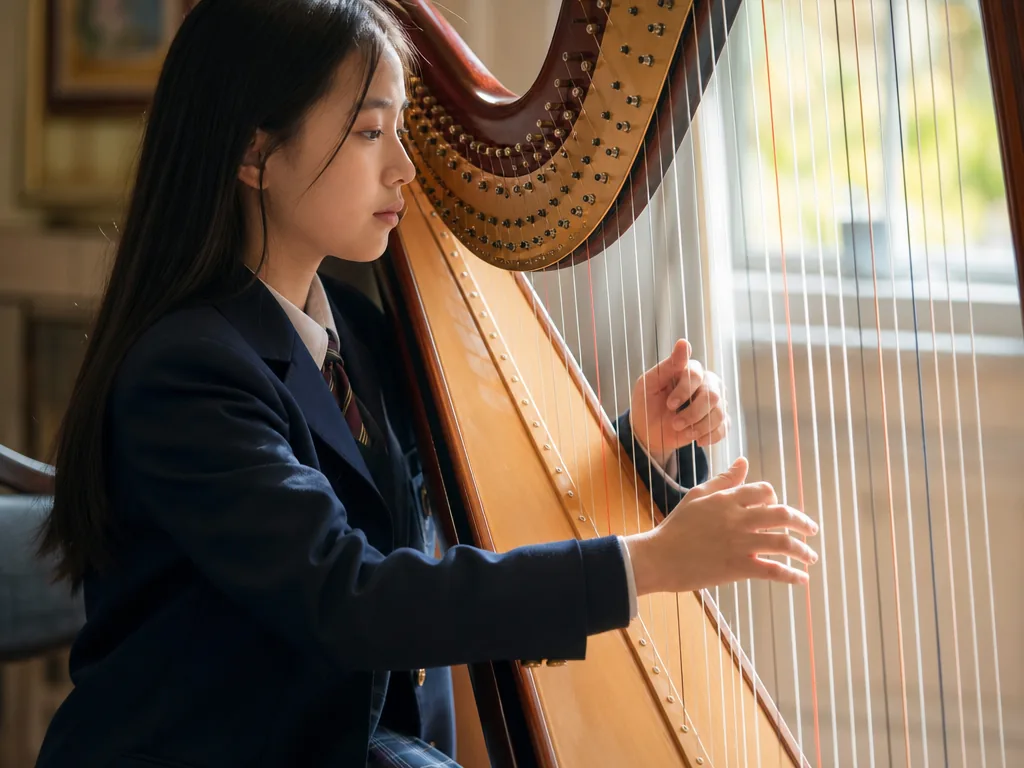
The Birth of the Harp: An Ancient Stringed Instrument
The harp is a stringed instrument characterised by vertically arranged strings that are sounded by plucking with the fingers or by bowing. Its history is long; it appeared in ancient civilisations and evolved over time into its modern form, becoming an indispensable instrument in music around the world.
The Ancient Origins
- Around 3000 BC: The earliest harps appeared in ancient Egypt; these early harps were mostly small with relatively few strings, often used in religious ceremonies and court music.
- Ancient Greek and Roman periods: The harp gradually evolved into a more structured instrument and took a place in musical performance. Ancient Greek lyre players already used the harp to perform lyrical songs.
The Middle Ages and the Renaissance: The Development of the Harp
- Middle Ages (5th–15th centuries): With the development of Christian church music, the harp gradually took an important place in church music. Medieval harps had more strings and more varied playing techniques.
- Renaissance (14th–17th centuries): The harp’s design began to approach its modern form and was gradually incorporated into more musical works, particularly accompanying the court music and dance music of the time.
Modern Development: The Birth of the Modern Harp
- Late 18th century: The modern harp’s design was gradually established, gaining metal strings and foot pedals and a more stable structure. These changes enriched and diversified the harp’s tone and enabled it to perform a wider range of music.
- 19th century: With advances in musical technique, the harp gradually became an important member of symphony and chamber orchestras, collaborating with other instruments in a variety of works.
With advances in musical technique, the harp gradually became an important member of symphony and chamber orchestras.
Outstanding Harp Masters and Their Representative Works
The harp has attracted the attention of many musicians since ancient times, and several masters have made outstanding contributions, expanding harp technique and creating many classic works. Here are several of the most influential harp masters and their representative works.
1. Marcel Grandjany (1891–1975)
Nationality: French
Contributions: Marcel Grandjany was one of the most important harp masters of the 20th century. A founder of modern harp technique, he made major contributions to both harp performance and composition. He also taught at the Juilliard School, training many harpists.
Representative works:
- Impromptu——showcases Grandjany’s technique and the richness of the harp’s tone, one of his most representative compositions.
- Concertino for Harp and Orchestra——a work combining solo harp and orchestra, demonstrating his ability to blend the harp with other instruments.
2. Nicanor Zabaleta (1907–1993)
Nationality: Spanish
Contributions: One of Spain’s most influential harpists, Zabaleta’s style is regarded as a perfect blend of technique and emotion. His contribution lies not only in superb technique but also in his interpretations of modern harp works.
Representative works:
- Harp Concerto in C Minor (Francisco José Álvarez)——his performance showcases deep technique and emotional interpretation.
- Sonata for Harp (Carlos Salzedo)——one of the modern harp works he performed, challenging and demonstrating his superb technique.
3. Alice Chalifoux (1920–2019)
Nationality: American
Contributions: One of America’s most influential harpists, Alice Chalifoux’s style was praised for its technical brilliance and emotion. She taught at the Juilliard School and made important contributions to the development of modern harp technique.
Representative works:
- Harp Concerto in B-flat Major (George Frideric Handel)——Chalifoux’s interpretation is considered one of the most emotionally expressive.
- Suite for Harp and Strings (Gerald Finzi)——a work combining harp and strings, showcasing her superb technique and emotional interpretation.
4. Xavier de Maistre (b. 1970)
Nationality: French
Contributions: Xavier de Maistre is one of the most important harpists of our time, with a style that is both modern and poetic. He has achieved great success in classical music while also exploring contemporary works.
Representative works:
- Harp Concerto in E-flat Major (Reinhold Glière)——a classic interpretation demonstrating his perfect fusion of harp and orchestra.
- Fantaisie for Harp (Jean-Michel Damase)——showcases his outstanding technique and emotional expression.
5. Cécile Ousset (b. 1944)
Nationality: French
Contributions: Ousset is one of the most celebrated harp masters of the present day, combining technique and expressiveness and known for her meticulous interpretations. She has made outstanding contributions to the promotion of modern harp music.
Representative works:
- Concerto for Harp and Orchestra (Alfredo Casella)——Ousset’s performance is considered the classic version, full of passion and technique.
- Harp Sonata (Jean-Michel Damase)——showcases her excellent musical creativity and technique.
Classic Harp Works Recommended
| Composer/Musician | Work | Style | Characteristics |
|---|---|---|---|
| Marcel Grandjany | Impromptu | Classical | Technique and the richness of the harp’s tone |
| Nicanor Zabaleta | Harp Concerto in C Minor | Modern | A challenging harp concerto |
| Alice Chalifoux | Harp Concerto in G Major | Classical | Refined emotional expression |
| Xavier de Maistre | Concerto for Harp and Orchestra | Modern | A perfect fusion of modern harp and orchestra |
| Cécile Ousset | Concerto for Harp and Orchestra | Modern | Harp playing combining technique and emotion |
Frequently Asked Questions (FAQ)
Q: At what age can a child start learning the harp?
Many children begin around the ages of 5 to 7 using a small lever (also called Irish or Celtic) harp, which is lighter and easier for small hands; students typically move to a full-size pedal harp once they have grown and built their basic technique.
Q: What is the difference between a lever harp and a pedal harp?
A lever harp changes pitch using hand-operated levers on each string, making it lighter, simpler and more affordable for beginners. A pedal harp uses foot pedals to change the pitch of every string of the same note at once, giving the full chromatic range and power needed for advanced and orchestral repertoire.
Q: Is the harp difficult to learn compared with other instruments?
The basics — plucking the strings and learning correct hand position — can be picked up fairly quickly, which makes early progress rewarding. The greater challenges are its size, the need to coordinate hand and pedal (or lever) changes, and the ongoing cost of strings and instrument maintenance.
Q: Do harpists read music the same way as pianists?
Yes — harp music is written on the grand staff, exactly like piano music, with the left hand on the bass clef and the right on the treble. Scores also add pedal or lever markings and special notation for effects such as glissando.
Further Resources & Next Steps
- Official Resources——The World Harp Congress (worldharpcongress.com) and the American Harp Society publish repertoire guides, masterclass listings and directories of teachers and competitions.
- Further Reading——Roslyn Rensch’s Harps and Harpists is the standard history of the instrument, while exam boards such as ABRSM and Trinity College London publish graded harp syllabuses for structured progression.
- Parent Tips——For young beginners, start with a lightweight lever harp and consider renting before buying; a full concert pedal harp is a major investment, so renting lets your child’s interest and commitment grow first.
Note: The information above is for reference only. Please consult professional education institutions for details.
This article was initially drafted and organised with AI. Editor / Professor Chan Kwok-wai; Managing Editor / Kong Yee-leung
Act Now: Find a Tutor / Register as a Tutor
For parents & students: looking for a home or online tutor for this subject? Click the button below to post a free tuition case (subject, level and preferred time) — TutorZone will match you with suitable tutors:
For tutors: do you teach this subject? Click the button below to register for free and receive more suitable cases — you pay only when a match is made: