 中文(繁體)
 中文(簡體)
 English



IB Chemistry SL Guide (2025): Curriculum, Assessment, Study Tips, and University Pathways
TUTORZONE SUBJECT GUIDE · IB
IB Chemistry SL (Standard Level) is part of the IB Diploma Programme’s Group 4 sciences. Designed for students not specializing in chemistry or STEM, it provides a solid foundation in key chemical principles while emphasizing real-world applications and experimental skills.
Direct Answer:What is IB Chemistry SL?
IB Chemistry SL is an IB Group 4 science course for non-specialists, providing foundational chemistry principles, real-world applications, experime。
What is IB Chemistry SL?
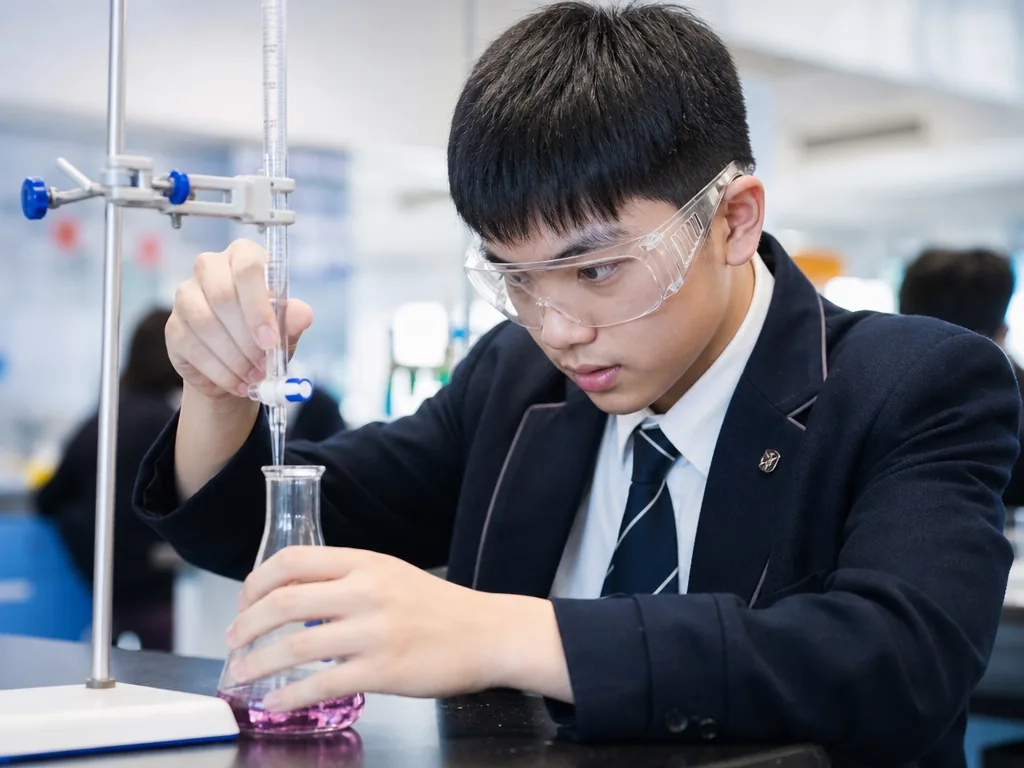
IB Chemistry SL is an introductory chemistry course ideal for students aiming for non-STEM university majors or simply seeking scientific literacy. It balances theory with practical investigation and fosters critical thinking through scientific inquiry.
Key Features
- Emphasis on practical work——Strong focus on lab skills and experimentation.
- Real-life relevance——Chemistry concepts are tied to environmental, industrial, and everyday contexts.
- Core concept coverage——Includes 11 core topics, ensuring broad foundational knowledge.
- Scientific thinking development——Trains students in data analysis, hypothesis testing, and evaluation.
Advantages Over HL
- About 40% less content——than Higher Level (HL).
- Lower mathematics demand——basic algebra and simple logarithms only.
- More manageable——for students not pursuing science degrees.
Curriculum Overview (2025 Syllabus)
The 2025 IB Chemistry SL syllabus includes 11 core topics, with each unit focusing on key scientific ideas and lab applications:
| Topic | Key Content | Core Concepts |
|---|---|---|
| Structure of Matter | Atomic structure, chemical bonding | Electron configuration, hybrid orbitals |
| Chemical Reactions | Stoichiometry, reaction types | Mole calculations, redox chemistry |
| Energetics | Thermochemistry, enthalpy changes | Hess’s Law, calorimetry |
| Kinetics | Collision theory, rate factors | Rate laws, Arrhenius equation |
| Chemical Equilibrium | Dynamic equilibrium principles | Equilibrium constant, Le Châtelier’s principle |
| Acids and Bases | Acid-base theories, pH calculations | Buffers, titration curves |
| Redox Processes | Electrochemistry basics | Standard electrode potential, cells |
| Organic Chemistry | Functional groups and reactions | Nomenclature, isomerism |
| Measurement & Data | Lab techniques, data analysis | Uncertainty, significant figures |
Assessment Structure
External Assessment — 80% of Final Grade
| Paper | Duration | Format | Weighting |
|---|---|---|---|
| Paper 1 | 45 minutes | Multiple-choice (30 questions) | 20% |
| Paper 2 | 1 hour 15 mins | Structured and short-answer | 40% |
| Paper 3 | 1 hour | Data-based & practical questions | 20% |
Internal Assessment (IA) — 20%
Students must complete a scientific investigation and write a 6–12 page report based on a minimum of 10 hours of experimentation.
Key IA elements:
- Independent research question
- Data collection, processing, and analysis
- Uncertainty and error discussion
- Evaluation of methods and results
SL vs HL: Key Differences
| Aspect | SL | HL |
|---|---|---|
| Depth of Content | Core concepts only | Includes advanced topics like quantum chem |
| Maths Requirement | Algebra & basic logarithms | Includes calculus-based equations |
| Lab Work Complexity | Standard techniques | Involves advanced instruments |
| Total Teaching Hours | 150 hours | 240 hours |
Top Study Strategies
1. Concept Memorization Tips
Use mnemonics for the periodic table:
- Group 1 Elements——“Hi Li Na K Rb Cs Fr”
- Memory Aid——“Harry Likes Naughty Kids Running Crazy Fast”
2. Calculation Problem-Solving Framework
Use the 4-step method:
- Identify known and unknown variables
- Select the appropriate formula
- Check unit conversions
- Apply significant figures correctly
3. Lab Report Writing Tips
| Assessment Criteria | What Examiners Want | Common Mistakes |
|---|---|---|
| Research Question | Clear, focused, and measurable | Too broad or vague |
| Data Processing | Correct use of sig figs and error bars | Ignoring uncertainty or inconsistent units |
Recommended Learning Resources
| Resource Type | Example | Best Use Case |
|---|---|---|
| Textbook | IB Chemistry SL by Oxford | Structured concept learning |
| Past Papers | 2016–2024 past exams | Realistic test preparation |
| Online Simulators | Chemix.org | Virtual lab pre-practice |
| Flashcards | Anki chemistry decks | Rapid review of terms and reactions |
Common Challenges and How to Overcome Them
1. Balancing Chemical Equations
Use the algebraic balancing method:
- Assign variables to coefficients
- Set up conservation equations
- Solve for the smallest whole-number ratio
2. Confusion in Organic Chemistry
Use functional group mind maps to visualize compound families and reactions.
3. Error-Prone Data Handling
Always apply the three-step data check:
- Ensure consistent units
- Follow significant figure rules
- Calculate uncertainty propagation
University Applications and Career Relevance
University Advantages
IB Chemistry SL satisfies many universities’ basic science requirements. Particularly helpful for:
- Environmental Science
- Food Science
- Pre-Pharmacy programs
Career Opportunities
- Laboratory Technician
- Chemical Sales Engineer
- Environmental Testing Analyst
Study Timeline (Suggested)
| Semester | Key Focus Areas | Benchmark |
|---|---|---|
| Semester 1 | Stoichiometry and atomic structure | Complete mole calculations independently |
| Semester 2 | Organic chemistry and equilibrium | Master functional group reactions |
| Semester 3 | IA + final topic revision | Finish all IA lab work |
| Pre-exam period | Full exam paper practice | ≥80% accuracy on Paper 1 mock exams |
What It Takes to Score a Level 7
Top scorers don’t just memorize chemistry — they learn to apply it flexibly and show every step of their reasoning.
Top Scorer Traits
- Applies chemistry concepts flexibly
- Produces well-analyzed and accurate lab reports
- Shows complete steps in calculations with precision
Mistakes to Avoid
- Incorrect unit conversions
- Ignoring significant figure rules
- Lack of control variables in experiments
Action Plan
- Keep a “Common Mistakes” notebook
- Practice 3 full calculation problems weekly
- Join a school chemistry club or competition
Frequently Asked Questions (FAQ)
Q: What is the difference between IB Chemistry SL and HL?
SL covers the core concepts only and requires about 150 teaching hours, while HL adds advanced topics such as quantum chemistry, involves more complex lab work and higher mathematics, and requires 240 teaching hours.
Q: How is IB Chemistry SL assessed?
External assessment accounts for 80% of the final grade across three papers — Paper 1 (multiple-choice), Paper 2 (structured and short-answer), and Paper 3 (data-based and practical questions). The Internal Assessment, a 6–12 page scientific investigation report, makes up the remaining 20%.
Q: Is IB Chemistry SL enough for university applications?
Yes — IB Chemistry SL satisfies many universities’ basic science requirements and is particularly helpful for degrees in environmental science, food science, and pre-pharmacy programs.
Q: How can I score a Level 7 in IB Chemistry SL?
Apply concepts flexibly, write well-analyzed lab reports with proper uncertainty and significant-figure handling, and show complete calculation steps. Avoid unit-conversion errors and missing control variables, and practise past papers regularly.
Further Resources & Next Steps
- Official Resources——The official IBO website for the latest syllabus and updates, together with the IB Chemistry Data Booklet, the official reference from the IBO.
- Further Reading——Chemistry in Everyday Life, a beginner-friendly chemistry book, and the Royal Society of Chemistry YouTube channel for real experiment videos.
- Parent Tips——Encourage a steady weekly routine of short, focused review sessions; chemistry is content-heavy, and frequent practice beats last-minute cramming.
Note: The information above is for reference only. Please consult professional education institutions for details.
This article was initially drafted and organised with AI. Editor / Professor Chan Kwok-wai; Managing Editor / Kong Yee-leung
Act Now: Find a Tutor / Register as a Tutor
For parents & students: looking for a home or online tutor for this subject? Click the button below to post a free tuition case (subject, level and preferred time) — TutorZone will match you with suitable tutors:
For tutors: do you teach this subject? Click the button below to register for free and receive more suitable cases — you pay only when a match is made: