 中文(繁體)
 中文(簡體)
 English


Primary Mathematics tutor
TUTORZONE SUBJECT GUIDE · LOCAL PRIMARY SCHOOL
Mathematics is one of the three core subjects in Hong Kong primary schools, building from everyday counting and shapes up to early algebra and data handling. This guide walks through the curriculum goals, grade-by-grade content, teaching methods, and assessment — plus practical ways parents can support their child at home.
Direct Answer:What is Primary Mathematics in Hong Kong?
Primary Mathematics is one of the three core subjects in Hong Kong primary schools, building from counting and shapes to early algebra and data han。
Introduction to Primary Mathematics
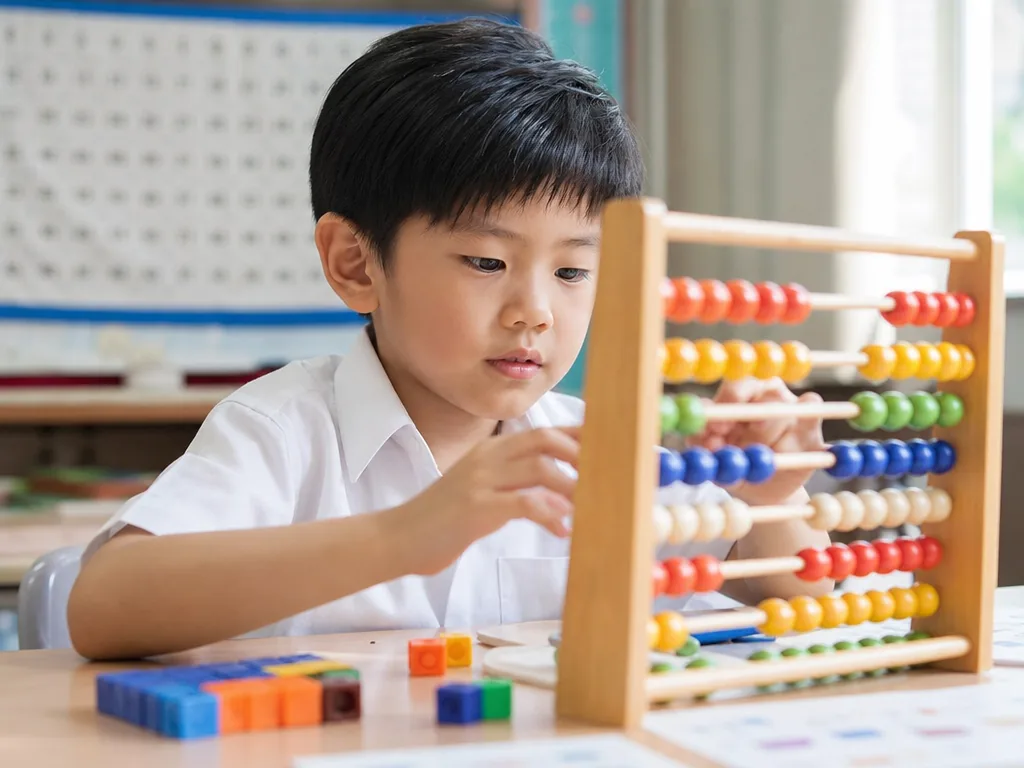
Mathematics in Hong Kong primary schools focuses on basic skills and practical application, with a curriculum designed to progress from concrete to abstract concepts. The course emphasizes logical reasoning, and in the future, it will place greater importance on interdisciplinary integration and the use of digital tools to equip students for a technology-driven society. As one of the core subjects in primary education, the Mathematics curriculum aims to cultivate logical thinking, computational skills, and the ability to solve real-world problems.
Curriculum Goals of Primary Mathematics
The primary objectives of the Mathematics curriculum include:
Basic Arithmetic
Mastering the four basic operations (addition, subtraction, multiplication, and division) and applying them in daily life.
Space and Geometry
Understanding the properties of geometric shapes (such as symmetry and angles) and simple measurements.
Data Handling
Learning basic statistics (e.g., chart analysis and mean calculations).
Logical Reasoning
Developing critical thinking and problem-solving skills through mathematical problems.
Secondary School Connection
Laying the foundation for secondary school mathematics and STEM subjects.
Curriculum Content by Grade
The Mathematics curriculum is divided into six learning stages, with content gradually becoming more advanced:
Lower Primary (Grades 1–3)
Numbers and Algebra
- Basic operations: Addition and subtraction (up to 20) in Grade 1, multiplication and division tables (Grade 2–3).
- Fraction concepts: Simple fractions such as ½, ¼.
- Money and Time: Currency calculations (Hong Kong dollars) and reading clocks.
Space and Geometry
- Recognizing 2D shapes (squares, circles) and 3D shapes (cubes, spheres).
- Simple symmetry and pattern arrangements.
Measurement
- Comparison of length, weight, and volume (units: cm, kg, L).
Upper Primary (Grades 4–6)
Numbers and Algebra
- Large number calculations (millions, billions) and conversions between decimals and percentages.
- Mixed operations (e.g., 12 + 3 × 4).
- Basic algebra: Simple equations (e.g., x + 5 = 10).
Space and Geometry
- Angle calculation (acute, obtuse angles) and classification of triangles and quadrilaterals.
- Perimeter, area, and volume formulas (e.g., area of a rectangle = length × width).
Data Handling
- Statistical charts (bar charts, line graphs).
- Introduction to probability (e.g., likelihood terms like “certain,” “likely”).
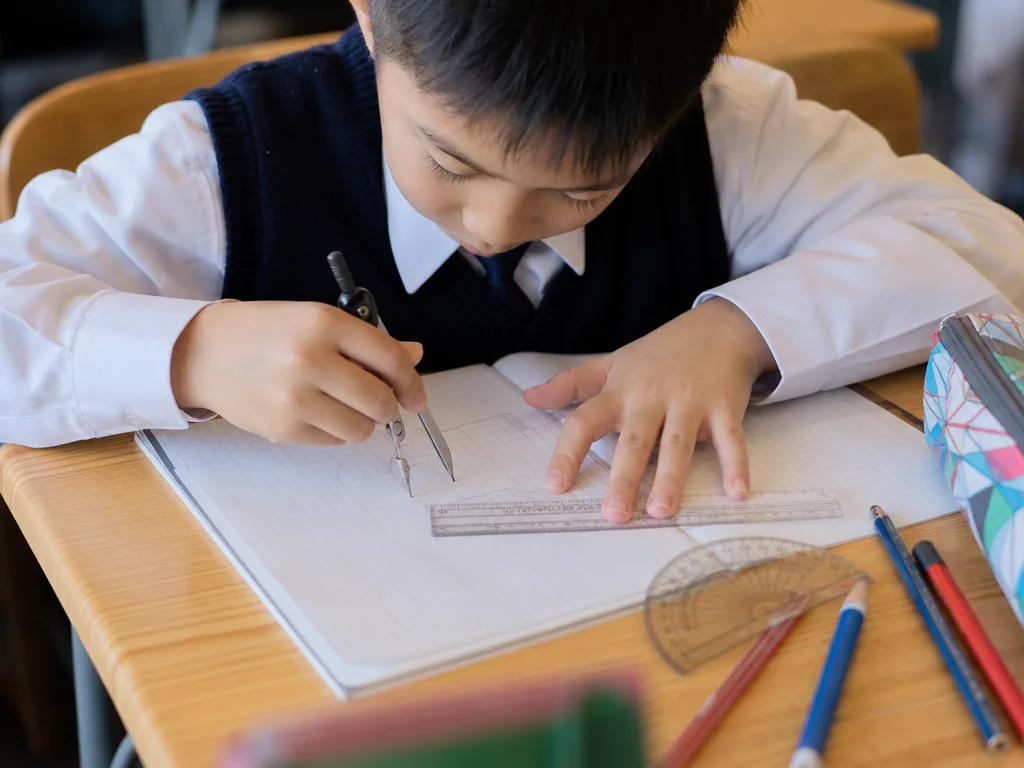
Teaching Methods for Mathematics
Hands-on Learning
Using tools (e.g., blocks, balance scales) to understand abstract concepts.
Contextual Teaching
Incorporating real-life examples, such as shopping for change or planning travel routes, to explain mathematical ideas.
Inquiry-Based Learning
Discovering mathematical principles through activities like paper folding to understand symmetry.
Digital Tools
Using calculators, mathematics software (e.g., GeoGebra), and online platforms to enhance learning.
Assessment Methods in Mathematics
Internal Assessments
Written Exams — the main focus includes:
- Multiple choice questions (testing concept comprehension).
- Short answer questions (solving step-by-step calculations).
- Applied problems (solving real-life scenarios).
Practical Assessments — such as measuring classroom dimensions or creating statistical graphs.
Project-Based Learning — group activities like “designing the cheapest party budget” allow students to apply problem-solving skills.
Territorial Assessments
TSA (Territorial System Assessment) — students in Grades 3 and 6 are required to participate in TSA, which evaluates core mathematical skills.
Textbooks and Resources
Commonly Used Textbooks
- Modern Mathematics by Modern Education Research Association.
- New Century Mathematics by Oxford.
- Happy Learning Mathematics by Education Publishing House.
Supplementary Practice
Books like Daily Ten Questions and Mathematical Olympiad Training.
Online Resources
- Mathland by the Hong Kong Education Bureau.
- Khan Academy (Chinese version) for supplementary lessons.
Transition to Secondary School Mathematics
The primary school mathematics curriculum sets a solid foundation for more advanced mathematical topics in secondary school, including:
- Arithmetic Extension: From basic operations to more advanced topics like exponents and radicals.
- Geometry Expansion: Transitioning from basic shapes to Pythagoras’ theorem and trigonometric ratios.
- Algebra Advancement: From simple equations to topics like quadratic equations and functions.
Recent Reforms and Challenges in Mathematics Education
STEM Education Integration
Strengthening the connection between Mathematics, Science, and Technology, such as:
- Using Scratch programming to understand coordinate geometry.
- Learning 3D printing to explore 3D shapes and volume.
Emphasis on Applied Mathematics
Increasing focus on practical, real-world problems like:
- Environmental data analysis.
- Personal finance planning (e.g., budgeting).
Addressing Learning Differences
Schools implement group teaching or school-based remedial programs to accommodate students at different learning levels.
Parental Support and Suggestions
Everyday Learning
Encourage math practice in everyday life, such as comparing prices at the supermarket or measuring ingredients in cooking.
Game-Based Learning
Play math-related games like Monopoly to practice calculations or use Sudoku to train logical reasoning.
Avoid Over-Practice
Focus on understanding concepts rather than engaging in repetitive, mechanical drills.
Conclusion
The Mathematics curriculum in Hong Kong’s primary schools aims to cultivate students’ abilities in both foundational arithmetic and practical application, preparing them for the challenges of the digital and technology-driven future. With an emphasis on logical reasoning, data handling, and interdisciplinary integration, the curriculum equips students with essential skills for secondary education and beyond.
For more detailed information, please refer to the Hong Kong Education Bureau website: www.edb.gov.hk.
Frequently Asked Questions (FAQ)
Q: What are the core objectives of the primary Mathematics curriculum?
The curriculum aims to build basic arithmetic, space and geometry, data handling, and logical reasoning skills, while laying a foundation for secondary school mathematics and STEM subjects.
Q: How is the curriculum organised across grade levels?
Content is divided into six learning stages. Lower Primary (Grades 1–3) covers basic operations, fractions, money, time, and simple shapes; Upper Primary (Grades 4–6) extends into large numbers, early algebra, angle and area, and data handling.
Q: How is students’ Mathematics ability assessed in Hong Kong?
Schools use internal assessments (written exams, practical tasks, and project-based learning), while students in Grades 3 and 6 also sit the territory-wide TSA, which evaluates core mathematical skills.
Q: How can parents support Mathematics learning at home?
Parents can weave maths into everyday life (shopping, cooking), use games like Monopoly or Sudoku, and focus on conceptual understanding rather than repetitive drills.
Further Resources & Next Steps
- Official Resources——Hong Kong Education Bureau: www.edb.gov.hk and the EDB’s Mathland platform.
- Further Reading——Supplementary practice books such as Daily Ten Questions and Mathematical Olympiad Training.
- Parent Tips——Keep practice playful and practical: compare prices at the supermarket, measure ingredients while cooking, and praise the process of problem-solving rather than only the final answer.
Note: The information above is for reference only. Please consult professional education institutions for details.
This article was initially drafted and organised with AI. Editor / Professor Chan Kwok-wai; Managing Editor / Kong Yee-leung
Act Now: Find a Tutor / Register as a Tutor
For parents & students: looking for a home or online tutor for this subject? Click the button below to post a free tuition case (subject, level and preferred time) — TutorZone will match you with suitable tutors:
For tutors: do you teach this subject? Click the button below to register for free and receive more suitable cases — you pay only when a match is made: