
 中文(繁體)
 中文(簡體)
 English



A-Level Maths Syllabus (Cambridge 9709) – Complete Guide
TUTORZONE SUBJECT GUIDE · A-LEVEL
Cambridge International AS & A Level Mathematics (9709) is the world’s most popular A-Level mathematics qualification — six components span pure mathematics, mechanics and probability & statistics. This complete guide covers the 2026–2027 syllabus, every paper with its marks and weighting, the AS and A Level routes, and the study habits that earn an A*.
Direct Answer:What does Cambridge A-Level Maths (9709) cover?
A-Level Mathematics (9709) covers six components: Pure Mathematics 1, 2 and 3; Mechanics; Probability & Statistics 1; and Probability & Statistics 2. A Level candidates take four papers — Pure Mathematics 1 and Pure Mathematics 3, plus either Mechanics with Probability & Statistics 1, or Probability & Statistics 1 and 2 — preparing students for mathematics, engineering, economics, computer science and the sciences at university.
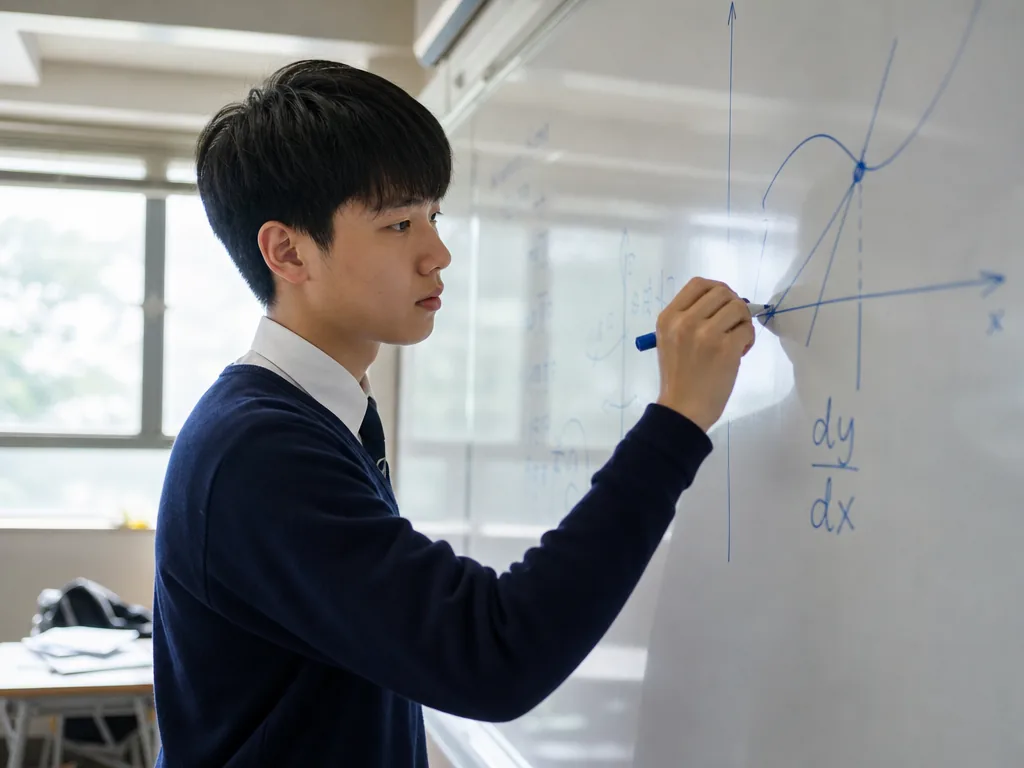
What Is A-Level Mathematics (Cambridge 9709)?
Cambridge International AS & A Level Mathematics (code 9709) is Cambridge Assessment International Education’s (CAIE) flagship mathematics qualification, typically taken by students aged 16 to 19, with examinations in the June and November series. It is one of more than 50 Cambridge International AS & A Level subjects and is recognised by universities worldwide — UK ENIC, the UK’s national recognition agency, has benchmarked it as comparable, grade for grade, to AS & A Level Mathematics in the UK.
The A Level builds a deep command of pure mathematics — algebra, trigonometry and calculus — and lets students specialise in mechanics or statistics through the applied papers.
The AS Level makes up the first half of the A Level and can also be taken as a standalone qualification; the full A Level provides a foundation for the study of mathematics or related courses in higher education. The 2026–2027 syllabus is version 4, published in December 2025, with no significant changes affecting teaching — textbooks endorsed for the syllabus from 2020 remain suitable.
Syllabus Topics & the Six Components
The 9709 syllabus is organised into six components, each assessed by its own written paper:
1. Pure Mathematics 1 (Paper 1)
- Quadratics — completing the square, the discriminant, quadratic equations and inequalities
- Functions — domain, range, inverse functions and composition of functions
- Coordinate geometry, circular measure and trigonometry
- Series, differentiation and integration
2. Pure Mathematics 2 (Paper 2)
- Algebra, logarithmic and exponential functions
- Trigonometry, differentiation and integration
- Numerical solution of equations
- AS Level only — its content is largely a subset of the Pure Mathematics 3 content
3. Pure Mathematics 3 (Paper 3)
- Algebra, logarithmic and exponential functions, trigonometry
- Differentiation, integration and numerical solution of equations
- Vectors, differential equations and complex numbers — the topics unique to A Level
4. Mechanics (Paper 4)
- Forces and equilibrium
- Kinematics of motion in a straight line, momentum and Newton’s laws of motion
- Energy, work and power
5. Probability & Statistics 1 (Paper 5)
- Representation of data, permutations and combinations
- Probability, discrete random variables and the normal distribution
6. Probability & Statistics 2 (Paper 6)
- The Poisson distribution, linear combinations of random variables and continuous random variables
- Sampling and estimation, and hypothesis tests
Knowledge of the content of Cambridge IGCSE Mathematics (0580, Extended curriculum) or Cambridge O Level Mathematics (4024/4029) is assumed before starting the course.
Exam Format & Paper Structure
AS Level candidates take two components in the same series: Pure Mathematics 1 plus one of Pure Mathematics 2, Mechanics or Probability & Statistics 1. Note that the Pure Mathematics-only route is available at AS Level only — candidates who take it cannot carry their AS result forward to complete the A Level. A Level candidates take four components: Pure Mathematics 1 and Pure Mathematics 3 are compulsory, plus either Mechanics with Probability & Statistics 1, or Probability & Statistics 1 with Probability & Statistics 2. Paper 6 builds on Paper 5’s content, so Mechanics and Probability & Statistics 2 cannot be combined.
| Paper | Component | Duration | Marks | Questions | AS Weighting | A Level Weighting |
|---|---|---|---|---|---|---|
| Paper 1 | Pure Mathematics 1 | 1 hr 50 min | 75 | 10–12 | 60% | 30% |
| Paper 2 | Pure Mathematics 2 | 1 hr 15 min | 50 | 6–8 | 40% | — |
| Paper 3 | Pure Mathematics 3 | 1 hr 50 min | 75 | 9–11 | — | 30% |
| Paper 4 | Mechanics | 1 hr 15 min | 50 | 6–8 | 40% | 20% |
| Paper 5 | Probability & Statistics 1 | 1 hr 15 min | 50 | 6–8 | 40% | 20% |
| Paper 6 | Probability & Statistics 2 | 1 hr 15 min | 50 | 6–8 | — | 20% |
All papers are written examinations, externally assessed, with every question compulsory. A scientific calculator and a ruler are required for each paper (a protractor and compasses are not), and the List of Formulae and Statistical Tables (MF19) is provided in the exam room. Non-exact numerical answers should be given correct to three significant figures, or one decimal place for angles in degrees. Assessment objectives:
AO1 — Knowledge and understanding
Show understanding of relevant mathematical concepts, terminology and notation, and recall and use appropriate manipulative techniques accurately. Weighting: 55% of the AS Level, 52% of the A Level.
AO2 — Application and communication
Recognise the appropriate procedure for a given situation, apply combinations of skills in solving problems, and present work clearly and logically. Weighting: 45% of the AS Level, 48% of the A Level.
Why Study A-Level Mathematics?
Gateway to STEM Degrees
A foundation for university courses in mathematics, engineering, economics, computer science, physics, actuarial science and finance — Cambridge A Level Mathematics is a standard entry requirement for these programmes worldwide.
Globally Recognised
UK ENIC has benchmarked Cambridge International AS & A Level as comparable, grade for grade, to UK AS & A Levels; the qualification is valued by leading universities in the UK, US, Europe, Australia, Canada and New Zealand.
Flexible & Focused
Choose the mechanics or statistics route to match your university plans, take the AS Level as a standalone qualification, or progress to Cambridge International AS & A Level Further Mathematics (9231).
Study Tips & Preparation Strategies
- Past papers by component——Practise Paper 1, 3, 4, 5 and 6 papers with the official mark schemes to learn question patterns, command words and where method marks are awarded.
- Learn your formula list——The MF19 booklet is provided in every exam, but not every formula appears on it; know which identities and integration results you must memorise, such as trigonometric identities and standard integrals.
- Master Pure Mathematics 1 first——P1 is the foundation for every other component, and both applied papers assume its content; a weak P1 foundation shows up in every later paper.
- Write full, logical solutions——AO2 rewards clear communication of method; examiners award method marks at every step, so show your working even when the final answer is wrong.
- Calculator fluency——A scientific calculator is required for all six papers; use it to check graph sketches, numerical solutions and statistics calculations under timed conditions.
- Round only at the end——Give non-exact answers to three significant figures (one decimal place for angles in degrees); premature rounding costs accuracy marks.
Who Should Take A-Level Mathematics?
- Students aged 16 to 19 aiming at university courses in mathematics, engineering, physics, economics, computer science, actuarial science or finance
- Learners who have completed IGCSE Mathematics (0580, Extended) or O Level Mathematics and want to continue to advanced mathematics
- Students targeting university entry in the UK, US, Australia, Canada or New Zealand, where Cambridge A Levels are widely recognised
- Those planning to progress to Cambridge International AS & A Level Further Mathematics (9231)
Recommended Resources
- Cambridge 9709 syllabus & past papers——the official 2026–2027 syllabus (version 4, December 2025), specimen papers, mark schemes and the MF19 formula booklet on the Cambridge International website.
- Cambridge endorsed textbooks——the Cambridge International AS & A Level Mathematics series covering Pure Mathematics 1–3, Mechanics, and Probability & Statistics 1–2, updated for the current syllabus.
- Physics & Maths Tutor——free 9709 past papers organised by topic, with mark schemes.
- Video walkthroughs——TLMaths and ExamSolutions offer clear worked solutions to every topic in the syllabus.
- Sibling guides——build the foundations with our IGCSE Mathematics Syllabus 2026 guide and What is IGCSE International Mathematics?, or see how maths powers physics in our IGCSE Physics Complete Guide.
Expert Advice: How to Score an A*
Top-scoring candidates treat every past paper as an exam: timed, marked against the official scheme, with every lost mark traced back to a skill to practise.
- Mark your own past papers——Use official mark schemes to see exactly how method marks and accuracy marks are awarded; most 9709 candidates lose marks on unfinished working, not mathematics.
- Practise under timed conditions——Papers run from 1 hour 15 minutes to 1 hour 50 minutes; examiner reports repeatedly highlight candidates who run out of time on later questions.
- Specialise early——Choose the mechanics or statistics route in the first year so the applied papers get two full years of attention, and keep practising to three significant figures throughout.
Frequently Asked Questions (FAQ)
Q: What is the difference between AS Level and A Level Mathematics (9709)?
The AS Level is the first half of the A Level: two papers taken in one series, graded a–e, and it can be taken as a standalone qualification. A Level Mathematics is four papers — Pure Mathematics 1 and 3 plus two applied components — graded A*–E, and it is the qualification universities typically require for mathematics-based degrees.
Q: How many papers are there in Cambridge A-Level Maths?
Four papers for the full A Level: Paper 1 (Pure Mathematics 1), Paper 3 (Pure Mathematics 3), plus either Paper 4 (Mechanics) with Paper 5 (Probability & Statistics 1), or Paper 5 with Paper 6 (Probability & Statistics 2). AS Level students take two papers: Paper 1 plus one of Papers 2, 4 or 5.
Q: Should I take Mechanics or Probability & Statistics?
Mechanics suits students heading for physics, engineering or mathematics, while Probability & Statistics suits economics, finance, business and the social sciences. You can also take Probability & Statistics 1 and 2 together. Mechanics and Probability & Statistics 2 cannot be combined, because Paper 6 assumes the content of Paper 5.
Q: What maths do I need before starting 9709?
Cambridge assumes knowledge of IGCSE Mathematics (0580, Extended curriculum) or O Level Mathematics (4024/4029). You should already be comfortable with surds, index laws and the shapes of basic graphs such as y = kxⁿ before starting Pure Mathematics 1.
Further Resources & Next Steps
- Official Resources——Cambridge Assessment International Education (CAIE) publishes the official 2026–2027 syllabus for 9709 (version 4, December 2025), specimen and past papers, mark schemes and the MF19 list of formulae and statistical tables.
- Further Reading——the Cambridge-endorsed 9709 textbook series (Pure Mathematics 1–3, Mechanics, Probability & Statistics 1–2) and free topic-by-topic past papers on Physics & Maths Tutor.
- Parent Tips——Encourage short, regular practice sessions and ask your child to explain each method aloud; teaching a concept is the fastest way to master it.
Note: The information above is for reference only. Please consult professional education institutions for details.
This article was initially drafted and organised with AI. Editor / Professor Chan Kwok-wai; Managing Editor / Kong Yee-leung
Direct Answer:What topics are in the A-Level Maths 9709 syllabus?
Pure Mathematics 1 covers quadratics, functions, coordinate geometry, circular measure, trigonometry, series, differentiation and integration; Pure Mathematics 3 adds vectors, differential equations and complex numbers. The applied papers cover mechanics (forces, kinematics, momentum, Newton’s laws, energy) and probability & statistics (data representation, probability, random variables, the normal and Poisson distributions, sampling and hypothesis tests).
Direct Answer:Is A-Level Maths hard?
A-Level Mathematics is demanding — a clear step up from IGCSE — but very achievable with structured practice. The genuinely new material is calculus, vectors, complex numbers and statistics; students who master Pure Mathematics 1 first, practise past papers by component and mark their own work against the official mark scheme consistently score A* to A.
Act Now: Find a Tutor / Register as a Tutor
For parents & students: looking for a home or online tutor for this subject? Click the button below to post a free tuition case (subject, level and preferred time) — TutorZone will match you with suitable tutors:
For tutors: do you teach this subject? Click the button below to register for free and receive more suitable cases — you pay only when a match is made:
Practice paper for this subject (original, with full worked solutions):A Level Mathematics 9709 Paper 1 mock paper。