
 中文(繁體)
 中文(簡體)
 English




DSE Chemistry Syllabus: Compulsory Topics, Electives and Exam Structure
TUTORZONE SUBJECT GUIDE · DSE CHEMISTRY SYLLABUS
The DSE Chemistry Syllabus is made up of three parts — the Compulsory Part, the Elective Part and the Investigative Study — planned at about 250 hours, roughly 10% of the total senior secondary lesson time. The Compulsory Part is planned at about 182 hours and covers twelve topics — Earth, Microscopic World I, Metals, Acids and Bases, Fossil Fuels and Carbon Compounds, Microscopic World II, Redox Reactions, Chemical Cells and Electrolysis, Chemical Reactions and Energy, Rate of Reaction, Chemical Equilibrium, Chemistry of Carbon Compounds, and Patterns in the Chemical World — and every candidate must take it. The Elective Part is planned at about 48 hours, and candidates must choose two of the three topics Industrial Chemistry, Materials Chemistry and Analytical Chemistry (about 24 hours each); a further 20 hours or so go to the Investigative Study. This guide, compiled from the Education Bureau’s Chemistry Curriculum and Assessment Guide (Secondary 4–6) and the Hong Kong Examinations and Assessment Authority’s Chemistry assessment framework, sets out the twelve compulsory topics and their learning focus, the content of the three elective topics, the assessment design and mark weighting of Paper 1 and Paper 2, the school-based assessment arrangements, and a practical plan for revision and exam strategy.
Direct Answer:What parts does the DSE Chemistry Syllabus include?
The DSE Chemistry Syllabus consists of a Compulsory Part, an Elective Part and the Investigative Study, planned at about 250 hours in total. The Compulsory Part (about 182 hours) covers twelve topics — Earth, Microscopic World I, Metals, Acids and Bases, Fossil Fuels and Carbon Compounds, Microscopic World II, Redox Reactions, Chemical Cells and Electrolysis, Chemical Reactions and Energy, Rate of Reaction, Chemical Equilibrium, Chemistry of Carbon Compounds, and Patterns in the Chemical World — and every candidate must take it. The Elective Part (about 48 hours) offers three topics — Industrial Chemistry, Materials Chemistry and Analytical Chemistry — from which candidates must choose two (about 24 hours each), and about 20 hours are given to the Investigative Study. Public assessment is made up of a public examination (80%) and school-based assessment (20%): Paper 1 examines the Compulsory Part over 2 hours 30 minutes and carries 60%; Paper 2 examines the Elective Part over 1 hour and carries 20%; school-based assessment carries 20%.
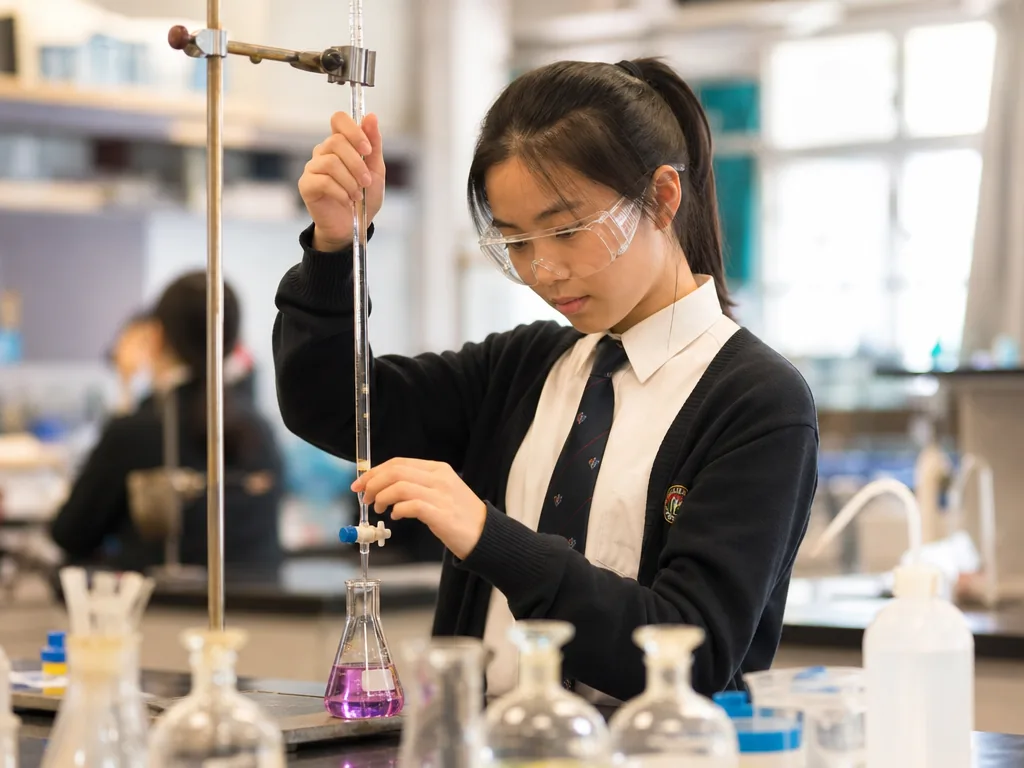
What Is the DSE Chemistry Syllabus?
Chemistry is one of the elective subjects of the Science Education Key Learning Area in the senior secondary curriculum, and public assessment is built on the Chemistry Curriculum and Assessment Guide (Secondary 4–6), prepared jointly by the Curriculum Development Council and the Hong Kong Examinations and Assessment Authority. Candidates are expected to bring the knowledge gained in junior secondary science, and to use the calculation techniques of the Compulsory Part of the DSE Mathematics curriculum — mole calculations, concentration conversions, molar volume of gases and chemical stoichiometry are the everyday language of the subject. The DSE Chemistry Syllabus is designed precisely to link up three levels: the macroscopic phenomenon, the microscopic explanation and the symbolic representation.
In structure, chemistry is planned at about 250 hours (roughly 10% of the total senior secondary lesson time) and divides into three parts: the Compulsory Part (about 182 hours) covers twelve topics that every candidate must study; the Elective Part (about 48 hours) offers three elective topics from which a candidate chooses two (about 24 hours each); and about 20 hours go to the Investigative Study, which asks students to investigate a chemistry-related question in small groups and report their findings.
Topics I to V, VII and VIII of the Compulsory Part also make up the chemistry component of the Combined Science curriculum (some sub-topics are adjusted to suit the needs of Combined Science), and this is where the two subjects are most easily confused. In addition, in June 2026 the Education Bureau issued a consultation draft on the Updated Chemistry Curriculum and Assessment Framework (Secondary 4–6), proposing a reorganisation of the number of topics and the allocation of lesson hours; that document is still at the consultation stage and has not been implemented, so this article follows the current (June 2018 update) version of the curriculum and assessment guide throughout.
On assessment objectives, the HKEAA expects candidates to: recall and understand the facts, concepts, principles and vocabulary of chemistry; apply chemical knowledge to explain phenomena and solve problems; master experimental techniques and handle errors and data; express chemical concepts accurately with graphs, chemical equations and written text; use mole calculations and stoichiometry to analyse quantitative problems; and evaluate chemistry-related issues from scientific, technological, social and environmental (STSE) perspectives.
The distinctive difficulty of chemistry is that it demands three abilities at once: an experiment you can see, a particle world you can only imagine, and symbolic calculation you have to write out clearly. Rely on memorising the textbook with one of the three missing, and your marks will stall at a particular kind of question.
The Compulsory Part: Twelve Topics and Their Learning Focus
The Compulsory Part runs to about 182 hours and twelve topics, moving from the macroscopic world of Earth’s resources into the microscopic world of particles, and then back to the patterns of energy, rate and equilibrium. The planned hours and core learning focus of each topic are set out below, so that parents and students can check whether their notes are complete.
Earth6 hours · starting from macroscopic resources
- The atmosphere — the composition of air, the fractional distillation of liquid air, and the tests for oxygen
- The ocean — the composition of sea water, the extraction of common salt and the separation of pure water, and the choice and comparison of physical separation methods such as evaporation, distillation, crystallisation and filtration
- Rocks and minerals — methods of extracting metals from ores, the different forms of calcium carbonate in nature (limestone, chalk and marble), thermal decomposition, and the tests for carbon dioxide and calcium ions
Microscopic World I21 hours · the first construction of the particle world
- Atomic structure and the basic arrangement of the periodic table
- Metallic bonding, the structure of metals and their general properties
- Ionic and covalent bonding, giant ionic structures and simple molecular structures
- Giant covalent structures (such as diamond and graphite), and comparisons of structure and properties
Metals22 hours · reactivity and stoichiometry
- Sources of metals and methods of extraction (physical methods, heating alone, heating with carbon)
- Reactivity of metals and the metal reactivity series
- Reaction masses and mole calculations
- Corrosion of metals and methods of rust prevention (painting, oiling, electroplating, sacrificial protection)
Acids and Bases25 hours · one of the heaviest compulsory topics
- An introduction to acids and bases, indicators and pH
- Strong and weak acids and bases, and the extent of ionisation
- Salts and neutralisation, and the preparation of salts
- Concentration of solutions and conversion between concentration and molarity
- The principles of volumetric analysis (titration) involving acids and bases, and the related calculations
Fossil Fuels and Carbon Compounds18 hours · where organic chemistry begins
- Hydrocarbons in fossil fuels and their fractional distillation products
- Homologous series, structural formulae and the basics of naming
- Typical reactions of alkanes and alkenes (combustion, the reaction with bromine, and so on)
- Addition polymerisation and common plastics
Microscopic World II8 hours · pushing the particle world towards molecules
- Polarity of bonds and molecules, and the concept of electronegativity
- Intermolecular forces (van der Waals’ forces and hydrogen bonding)
- The structure and properties of ice
- Properties of substances with simple molecular structures, and the shapes of simple molecules
Redox Reactions, Chemical Cells and Electrolysis23 hours · the most concepts, appearing across question types
- Chemical cells in daily life (such as nickel-metal hydride batteries)
- Reactions in simple chemical cells and metal electrodes
- Recognising redox reactions and electron transfer
- Redox reactions in chemical cells
- The principles and applications of electrolysis (such as the electrolysis of dilute sulphuric acid and its products)
Chemical Reactions and Energy7 hours · the fewest hours, the most concentrated calculation
- Energy changes in chemical reactions and energy diagrams
- Standard enthalpy changes (enthalpy of formation, enthalpy of combustion, enthalpy of neutralisation)
- Hess’s law and enthalpy cycles
Rate of Reaction9 hours · an experiment-led topic
- The definition of rate of reaction and methods of measuring it
- Factors affecting the rate of reaction (concentration, temperature, surface area, catalyst)
- Molar volume of gases (at room temperature and pressure) and the related calculations
Chemical Equilibrium10 hours · abstract but clearly patterned
- The concept and characteristics of dynamic equilibrium
- Expressing and using the equilibrium constant
- Effects of changes in concentration, temperature and pressure on equilibrium
Chemistry of Carbon Compounds25 hours · the heaviest topic alongside Acids and Bases
- An introduction to selected homologous series and their functional groups
- Isomerism and the writing of structural formulae
- Typical reactions of each functional group (alcohols, aldehydes, ketones, carboxylic acids, esters and so on)
- Interconversion between carbon compounds and reaction routes
- The identification and applications of important organic substances
Patterns in the Chemical World8 hours · drawing the whole subject together into patterns
- Periodic variation in physical properties
- Bonding and stoichiometric composition
- General properties of transition metals
The Elective Part: Two Topics Out of Three
The Elective Part runs to about 48 hours in total, and candidates must choose two of the three topics below (about 24 hours each). Before choosing, check which topics your own school actually offers — some schools run only two or three of them — and note that Paper 2 examines only the two topics a candidate has chosen.
Industrial Chemistrybringing rate and catalysis into the factory
- The importance of industrial processes and the factors considered (yield, cost, safety, environmental protection)
- Rate equations and activation energy
- Catalysis and catalysts in industrial processes
- Analysis of specific industrial processes, and the relationship between green chemistry and sustainable development
Materials Chemistryfrom polymers to alloys
- Natural polymers (such as starch and proteins)
- Synthetic polymers and plastics (addition polymerisation and condensation polymerisation)
- Structures of metals and alloys (close-packed and open structures)
- Synthetic materials in modern life and green chemistry
Analytical Chemistrythe “eyes” of chemistry
- Detecting the presence of chemical species (tests for various gases and ions)
- Separation and purification methods
- Methods of quantitative analysis
- A first acquaintance with instrumental methods of analysis (such as chromatography and spectroscopy)
- The contribution of analytical chemistry to society
Exam Format and Mark Weightings
Public assessment in chemistry is made up of a public examination (80%) and school-based assessment (20%). Paper 1 examines all the topics of the Compulsory Part and carries 60% of the subject over 2 hours 30 minutes; Paper 2 examines the Elective Part and carries 20% over 1 hour. Under the HKEAA’s current chemistry assessment framework these weightings remain unchanged.
| Assessment component | Content | Duration | Weighting |
|---|---|---|---|
| Paper 1 | Compulsory Part: multiple-choice questions, short questions, structured questions and essay questions (candidates must answer all questions) | 2 hours 30 minutes | 60% |
| Paper 2 | Elective Part: candidates answer on the two elective topics they have chosen | 1 hour | 20% |
| School-based assessment | Practical work and investigative activities in school (the mark is calculated after statistical moderation) | Across Secondary 5 and Secondary 6 | 20% |
The question types in Paper 1 span multiple-choice questions, short questions, structured questions and essay questions: multiple-choice and short questions test the breadth of the curriculum content; structured questions require candidates to analyse the information given and apply their knowledge to familiar and unfamiliar contexts; essay questions require candidates to discuss chemical issues in depth and to organise and present their arguments coherently. There is no choice on Paper 1 — candidates must answer every question on the paper — so skipping a topic is the same as giving up its marks outright.
Paper 2 covers the Elective Part only. Since the three elective topics together carry only 20% of the subject while the preparation each one demands is far from light, the trade-off you make when choosing an elective has a direct effect on your overall result. Candidates should first confirm which topics their school actually offers and how they are taught, and then decide according to their own plans for after Secondary 6.
For school-based assessment, chemistry assesses students’ experimental skills and generic skills through practical work and investigative activities in school; marks are statistically moderated to balance differences in marking between schools and to preserve the rank order of students within a school, and are finally combined with the public examination result, carrying 20% of the subject. The specific assessment requirements, the number of experiments and the mark submission arrangements are announced to schools by the Hong Kong Examinations and Assessment Authority, and candidates should follow the guidance of their own teachers.
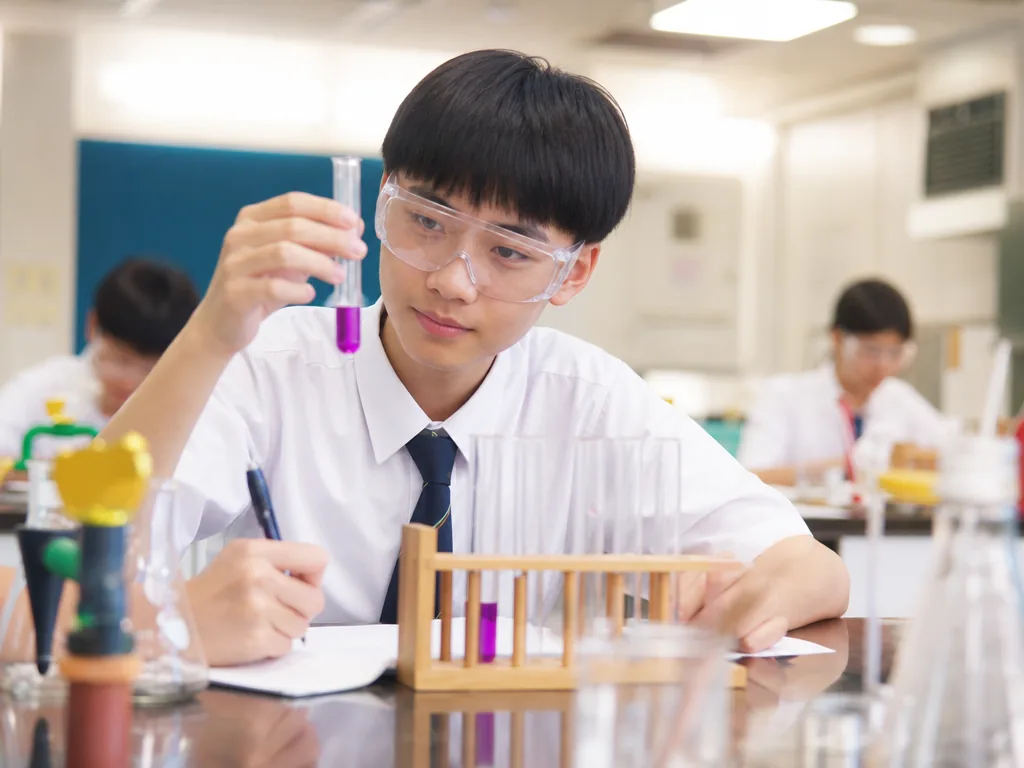
Assessment Objectives and Question-Type Strategy
Chemistry questions test roughly three kinds of ability: knowledge and understanding, application and problem solving, and experimental work and data handling. Each is revised in a different way, and dividing time evenly across the three is usually the least efficient plan there is.
Knowledge and understanding — multiple-choice and short questions test definitions, vocabulary and the recognition of phenomena. This is the part most easily trained back, and the key is to distil the definitions, chemical equations and common colour changes from the textbook into a single page of your own notes. Pay particular attention to the contrast between ideas that look alike: atoms and ions, atoms and molecules, ionic bonding and covalent bonding, strong acids and concentrated acids, and rate and equilibrium are all common traps.
Application and problem solving — structured questions usually ask for four steps: read the situation carefully, write the relevant chemical equation, substitute into the mole calculation, and check the units and significant figures. The commonest error is reaching for a formula before working out whether the question is asking for concentration or for number of moles. Wherever a graph appears, ask two questions first: what do the start and end points of the curve represent? And does the change in gradient reflect a change in rate or in equilibrium?
Experimental work and data handling — questions on titration, gas collection and the measurement of rate feed both the experimental questions in Paper 1 and the school-based assessment that carries 20%. Reading instrument scales accurately, choosing the appropriate indicator, and handling significant figures and errors all require candidates to answer in the language of chemistry rather than in vague phrases.
Finally, essay and explanation questions. Marking schemes have always rewarded a complete chain of cause and effect: state the cause, then the mechanism, then the observation. Explaining how a catalyst speeds up a reaction, for example, means working through the catalyst providing an alternative route with a lower activation energy, then the increase in the proportion of particles that collide successfully, and only then the increase in rate; at the same time you have to point out that the position of equilibrium is not changed. Omit any one step and key marks go with it.
Why Study Chemistry? Further Study and Careers
Chemistry is knowledge, but it is also a gateway to further study and a proof of ability. The three points below are the practical considerations that come up most often when families weigh up the subject.
A common requirement for medical and science programmes
Medicine, dentistry, pharmacy, nursing, biomedical science, chemistry, biotechnology, engineering and environmental science programmes at local and overseas universities commonly require, or give preference to, a good grade in chemistry. Chemistry is among the most widely accepted subjects in a science combination.
Training in quantitative thinking and experimental skill
Chemistry asks students to turn a real situation into a chemical equation, choose the appropriate mole relationship, carry out the quantitative calculation, and then check from the errors and the units whether the answer is sensible. That way of thinking — model, calculate, verify — is a transferable skill in science and engineering degrees and in the workplace alike.
A complete science combination with biology and physics
Chemistry plus biology plus physics is the most common combination among science students, balancing coherence of content against flexibility in university applications; taking chemistry with biology alone also covers the requirements of most healthcare and life science programmes. The microscopic imagination that chemistry trains in turn helps students understand the molecular mechanisms of biology.
Revision Strategy and the Marks Most Often Lost
Results in chemistry are rarely separated by cleverness; they are separated by method. Six patterns come up again and again in tutoring.
- Moles and stoichiometry—the most calculation-heavy part of the subject. Practise the conversions between mass, number of moles, concentration and gas volume until they need no thought, and only then start on combined questions; write down the units and the significant figures in every calculation.
- Chemical equations and state symbols—equations must be balanced and must carry state symbols, and reactions involving ions have to be written as ionic equations. This is the easiest place to drop careless marks.
- A functional group and reaction chart—make your own chart of functional group, reagent, phenomenon and product covering the typical reactions of alcohols, aldehydes, ketones, carboxylic acids and esters; it is far more effective than re-reading the textbook page by page.
- Experimental and titration technique—the steps and precautions for titration, gas collection and the measurement of rate have to be memorised accurately, and you should get used to answering questions from the angle of improving the experimental design.
- The divide between rate and equilibrium—a catalyst only speeds up the rate of reaction and does not change the position of equilibrium; a change in concentration affects the two differently as well. Most lost marks on conceptual questions trace back to confusion here.
- Past papers and the examination report—the HKEAA examination report includes the marking scheme and commentary on candidates’ performance, and reflects the demands of the examination far better than any compiled notes circulating in the market.
Who Should Take Chemistry? And How It Differs from Combined Science
Chemistry suits students who are curious about how substances change, are willing to work with their hands in the laboratory, and do not resist quantitative calculation. For a student intending to apply for healthcare, science or engineering programmes, chemistry is usually an elective worth the investment; taken only to make up the number of electives, it is a subject in which confidence tends to collapse on the two big blocks of mole calculation and organic chemistry.
The question that comes up more often is how chemistry differs from Combined Science (the chemistry component). Combined Science is also planned at about 250 hours, but it has to cover the foundation topics of two science subjects at the same time, and its chemistry component mainly covers the foundation content within the Compulsory Part of chemistry. Chemistry taken on its own goes deeper and wider in both content and coverage, and adds a separate Elective Part of about 48 hours and an Investigative Study of about 20 hours. So if the aim is a healthcare or science and engineering programme, or to demonstrate a complete training in chemistry in the DSE, the stand-alone subject is the better fit; if you would rather cover two science areas in fewer hours, Combined Science is more flexible.
As for whether an extended mathematics module has to be taken at the same time, the answer is no. Chemistry assessment rests on the techniques of the Compulsory Part of the mathematics curriculum, mainly ratio, indices and logarithms. That said, if you also take an extended module, calculations on gases and equilibrium come more smoothly, which is why so many science students choose that combination.
Frequently Asked Questions (FAQ)
Q:Is there school-based assessment in DSE Chemistry?
Yes, and it carries 20% of the subject. School-based assessment assesses students’ experimental skills and generic skills through practical work and investigative activities in school, and the marks are statistically moderated before being combined with the public examination result. The specific assessment requirements and the mark submission arrangements are announced to schools by the Hong Kong Examinations and Assessment Authority, and candidates should follow the guidance of their own teachers.
Q:How many topics are there in the Compulsory Part of DSE Chemistry?
Twelve in all, planned at about 182 hours, running from Earth all the way to Patterns in the Chemical World. Every candidate must take them, and Paper 1 examines the full content of all twelve.
Q:How many elective topics do I have to study?
Two of the three elective topics (Industrial Chemistry, Materials Chemistry and Analytical Chemistry), each planned at about 24 hours, making about 48 hours in total. Paper 2 examines only the two topics a candidate has chosen, so check which topics your school actually offers before choosing.
Q:What is the difference between chemistry and the chemistry component of Combined Science?
The chemistry component of Combined Science mainly covers the foundation content within the Compulsory Part of chemistry and has to be planned together with another science subject. The stand-alone subject goes deeper and wider, and adds a separate Elective Part of about 48 hours and an Investigative Study of about 20 hours. For a student intending to apply for healthcare, science or engineering programmes, taking chemistry on its own is generally recommended.
Further Resources and Next Steps
- Official sources—the Education Bureau’s Chemistry Curriculum and Assessment Guide (Secondary 4–6), prepared jointly by the Curriculum Development Council and the Hong Kong Examinations and Assessment Authority; the HKEAA Chemistry assessment framework and the examination report, with its marking scheme and commentary on candidates’ performance. Curriculum documents and the assessment framework are always more reliable than the notes circulating in the market.
- Further reading—the science guides on this platform: DSE Mathematics Syllabus, DSE Physics Syllabus, and IGCSE Chemistry Syllabus.
- Parent tip—chemistry marks are lost more often through incomplete calculation steps and hazy recall of functional group reactions. Checking that your child writes the units and significant figures clearly in every calculation, and helping them build a functional group reaction chart, is more effective than working blindly through supplementary exercises.
Note: The information above is for reference only. Please consult professional education institutions for details.
This article was initially drafted and organised with AI. Editor / Professor Chan Kwok-wai
Act Now: Find a Tutor / Register as a Tutor
For parents & students: looking for a home or online tutor for DSE Chemistry? Click the button below to post a free tuition case (subject, level and preferred time) — TutorZone will match you with suitable tutors:
For tutors: do you teach this subject? Click the button below to register for free and receive more suitable cases — you pay only when a match is made:
Managing Editor / Kong Yee-leung
Direct Answer:How many papers does DSE Chemistry have, and how are the marks weighted?
The subject has two public papers. Paper 1 examines all the topics of the Compulsory Part over 2 hours 30 minutes and carries 60% of the subject, with question types covering multiple-choice questions, short questions, structured questions and essay questions, and every question must be answered. Paper 2 examines the Elective Part over 1 hour and carries 20% of the subject, and candidates answer on the two elective topics they have chosen. Together with school-based assessment at 20% (assessed through practical work and investigative activities in school and calculated after statistical moderation), the three components make up 100%.
Direct Answer:How should the three elective topics be chosen?
The three elective topics are Industrial Chemistry, Materials Chemistry and Analytical Chemistry, each planned at about 24 hours, and a candidate studies and is examined on only two of them, making about 48 hours in total. Three things are worth weighing when choosing: which topics your school actually offers; where you intend to go after Secondary 6 (for example, Materials Chemistry suits students heading for chemistry or materials-related programmes, Industrial Chemistry suits those interested in industrial production and processes, and Analytical Chemistry suits those who enjoy experimental work and instrumental analysis); and how the school teaches and assesses that topic. Paper 2 examines only the two topics a candidate has chosen, and together they carry 20% of the subject — not an insignificant weighting.
