
 中文(繁體)
 中文(简体)
 English

Primary STEM Education in Hong Kong: Complete Curriculum Guide for Parents and Educators
TUTORZONE SUBJECT GUIDE · LOCAL PRIMARY SCHOOL
STEM education is reshaping Hong Kong primary classrooms through interdisciplinary, hands-on learning backed by the Education Bureau. This guide maps the curriculum structure, sample projects, assessment methods, and practical steps for parents and teachers to support young innovators from P1 to P6.
Direct Answer:What is primary STEM education in Hong Kong?
Primary STEM education in Hong Kong uses interdisciplinary, hands-on learning backed by the Education Bureau to reshape primary classrooms.
Share this paper / article:
WhatsApp
Facebook
Telegram
Email
WeChat / Xiaohongshu: tap “Copy link” and paste.
Curriculum Positioning and Core Features
Hong Kong’s STEM curriculum promotes problem-solving, technological literacy, and creative thinking from early primary levels. It encourages students to apply knowledge from General Studies, Mathematics, and Computer Studies to real-world contexts.
Key Features of Hong Kong’s Primary STEM Curriculum
- Interdisciplinary Learning——Breaks down subject silos by integrating science, math, and IT.
- Maker Culture & Hands-On Practice——“Learning by doing” to foster engineering thinking.
- Innovation and Problem Solving——Real-life project-based learning from everyday scenarios.
- 21st-Century Skills Development——Logical reasoning, teamwork, coding, and design thinking.
Curriculum Structure and Sample Projects
| Grade Level | STEM Topics/Projects | Key Skills | Teaching Mode |
|---|---|---|---|
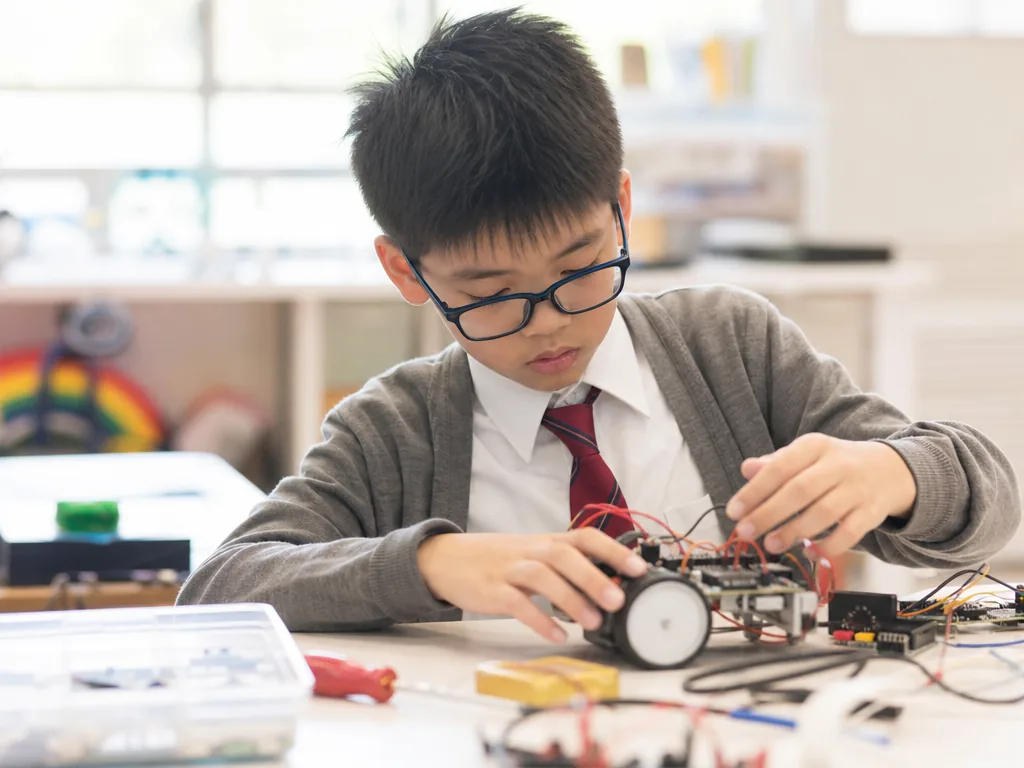
| P1–P2 (Lower Primary) | Paper pinwheel, magnet exploration | Observation, basic logic | General Studies + Simple STEM |
| P3–P4 (Middle Primary) | Temperature sensors, automatic watering system | Basic circuits, intro to coding | Thematic & inquiry learning |
| P5–P6 (Upper Primary) | Smart bins, solar-powered cars | Arduino, micro:bit, design thinking | Group projects + tech builds |
Many schools enrich their school-based curriculum with coding classes, 3D printing, AI exploration, and drone programming.
Assessment and Learning Modes
| Assessment Type | Format & Content | Emphasis |
|---|---|---|
| Inquiry-Based Projects | Design reports, prototypes, video journals | Creativity, logic, teamwork |
| Technical Skills | Programming (Scratch, micro:bit), circuits | Practical execution |
| Oral Presentation | Group presentation, innovation review | Communication, reflection |
Non-traditional test formats prioritize application of knowledge and student-led learning.
Common Learning Challenges and Solutions
| Challenge | Strategy / Solution |
|---|---|
| Difficulty understanding concepts | Use daily-life examples (e.g. auto-door → sensors) + animations |
| Weak hands-on skills | Use modular tools (e.g. LEGO SPIKE) for scaffolded learning |
| Lack of creativity | Apply Design Thinking Steps: Empathize → Define → Ideate → Prototype → Test |
| Fear of failure | Emphasize “Trial → Error → Learning” as core STEM value |
Effective Learning at Home: A Weekly STEM Plan for Families
Recommended weekly STEM schedule for primary students:
- Monday——Watch one STEM video (NASA Kids, BrainPop).
- Wednesday——Family DIY project (Bottle volcano, Solar oven).
- Friday——Scratch programming challenge or micro:bit game.
- Weekend——Visit a science museum or maker space (InnoCarnival, HK Science Park Open Day).
Suggested STEM Platforms
| Platform Name | Content Type | Suitable For |
|---|---|---|
| Hong Kong STEM Resource Bank | Lesson plans, competition info, videos | Teachers & Students |
| Scratch | Coding tutorials and game dev community | P3–P6 Students |
| BBC Bitesize | Interactive science & tech content | English-medium school students |
| MakerBay HK | Workshops, maker programs, family STEM | Local makers & parents |

Secondary School Pathways and Future Connections
Academic Bridging
- Secondary subjects like Technology and Living, Computer Literacy, and Integrated STEM.
- Foundation for DSE subjects: Physics, ICT, and Design & Technology.
- Entry-level courses in Python and Drone Programming, among others.
Career Awareness
- Develop engineering and coding fundamentals.
- Stimulate interest in AI, innovation, architecture, and tech entrepreneurship.
Action Plan for Parents and Teachers
- Learn by doing——Encourage “learning by doing” over rote answers.
- Everyday challenges——Use daily problems for creative challenges (e.g. design a contactless hand washer).
- Competitions——Support participation in STEM competitions (e.g. Young Inventor Challenge, AI Innovation Contest).
- Stay in touch——Communicate regularly with teachers/STEM mentors about your child’s progress and strengths.
Frequently Asked Questions (FAQ)
Q: What exactly is STEM education in Hong Kong primary schools?
STEM stands for Science, Technology, Engineering, and Mathematics. In Hong Kong primary schools it is an interdisciplinary approach backed by the Education Bureau that combines General Studies, Mathematics, and Computer Studies through hands-on, project-based learning, with the aim of building problem-solving, technological literacy, and creative thinking.
Q: What kinds of projects do primary students build at each level?
P1–P2 students start with paper pinwheels and magnet exploration; P3–P4 progress to temperature sensors and automatic watering systems; P5–P6 tackle smart bins and solar-powered cars using Arduino and micro:bit.
Q: How is STEM assessed if there are few written tests?
Assessment is largely non-traditional and centres on inquiry-based projects (design reports, prototypes, video journals), technical skills (Scratch, micro:bit, circuits), and oral presentations — emphasising application of knowledge and student-led learning.
Q: How can parents support STEM at home?
Follow a light weekly routine: a STEM video on Monday, a family DIY project on Wednesday, a Scratch or micro:bit coding challenge on Friday, and a weekend visit to a science museum or maker space such as InnoCarnival or the Hong Kong Science Park Open Day.
Further Resources & Next Steps
- Official Resources——Hong Kong Education Bureau, “STEM Education in Primary Schools: Practices and Innovations” (www.edb.gov.hk).
- Further Reading——“Is STEM the Language of Our Children’s Future?” — Expert Forum Feature.
- Parent Tips——Try a weekly family STEM routine (video Mondays, DIY Wednesdays, coding Fridays) and visit InnoCarnival or the Hong Kong Science Park Open Day. Trending searches by HK parents: “Which primary schools teach STEM well in Hong Kong?” and “What STEM competitions are there for primary students?”
Note: The information above is for reference only. Please consult professional education institutions for details.
This article was initially drafted and organised with AI. Editor / Professor Chan Kwok-wai; Managing Editor / Kong Yee-leung
Act Now: Find a Tutor / Register as a Tutor
For parents & students: looking for a home or online tutor for this subject? Click the button below to post a free tuition case (subject, level and preferred time) — TutorZone will match you with suitable tutors:
For tutors: do you teach this subject? Click the button below to register for free and receive more suitable cases — you pay only when a match is made:
