
 中文(繁體)
 中文(簡體)
 English



Hong Kong Secondary 3 (S3) Mathematics Syllabus – Complete Guide
TUTORZONE SUBJECT GUIDE · LOCAL JUNIOR SECONDARY
Secondary 3 is the capstone year of Hong Kong’s junior secondary mathematics curriculum: the later learning units — surds, errors in measurement and trigonometry — arrive in quick succession, and the emphasis shifts from studying isolated topics to applying them together. That makes S3 the bridge into senior secondary (DSE) mathematics. Drawing on the Education Bureau’s Mathematics Education Key Learning Area Curriculum Guide (Primary 1 – Secondary 6) (2017) and the Supplement to the Mathematics Education Key Learning Area Curriculum Guide: Learning Content of Junior Secondary Mathematics (2017), this guide sets out the learning units and targets students commonly meet in S3 mathematics, how schools assess them, and effective revision and bridging strategies.
Direct Answer:What topics does Secondary 3 mathematics cover?
According to the Education Bureau’s Learning Content of Junior Secondary Mathematics (2017), the junior secondary mathematics curriculum is organised into three learning dimensions — Number and Algebra, Measures, Shape and Space, and Data Handling — with a total teaching time of roughly 331 to 413 hours across the three junior years, about 12% to 15% of the whole junior secondary curriculum. The curriculum documents do not divide content by year level; schools arrange the units flexibly. In the arrangement used by most mainstream Hong Kong schools, Secondary 3 concentrates on the later units of the curriculum: in Number and Algebra, rational and irrational numbers (including the four operations on simple surds), errors in measurement, and further factorisation depending on the school’s scheme; in Measures, Shape and Space, trigonometry (sine, cosine, tangent and their applications), the centres of a triangle and more advanced applications of the rectangular coordinate system; and in Data Handling, integrated application and critical thinking. Individual schools may teach in a different order — always follow your school’s own scheme of work.
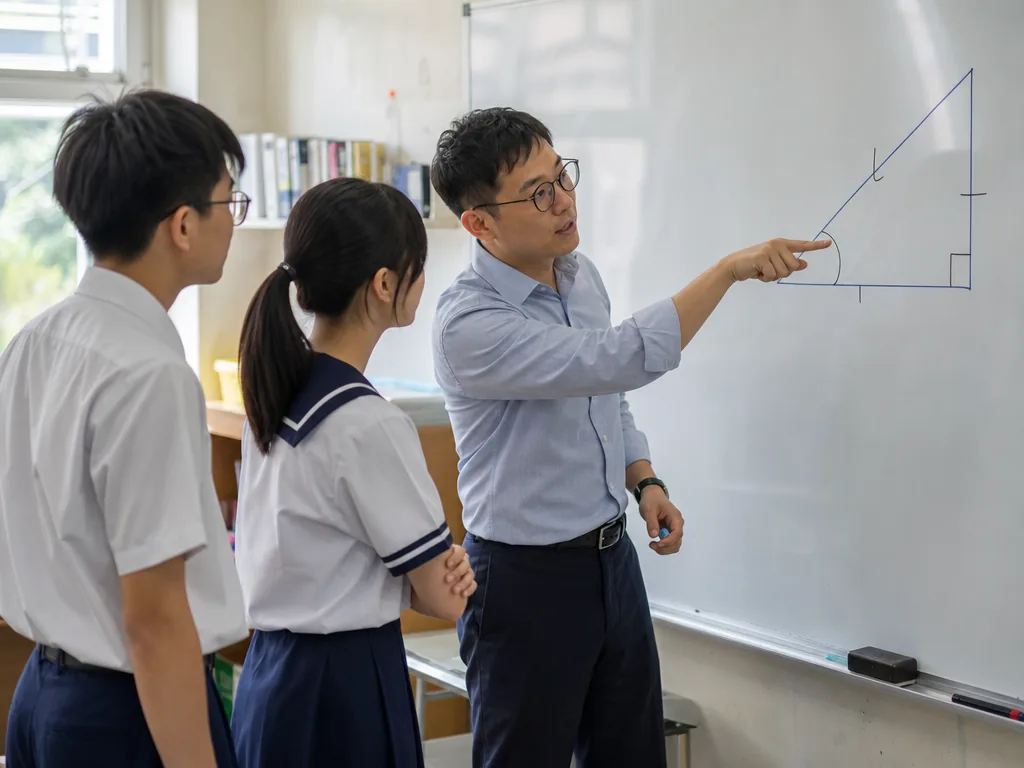
What Is the S3 Mathematics Syllabus?
Hong Kong’s junior secondary mathematics curriculum is governed by curriculum documents issued by the Education Bureau. The current framework is built on the Mathematics Education Key Learning Area Curriculum Guide (Primary 1 – Secondary 6) (2017), with the Supplement to the Mathematics Education Key Learning Area Curriculum Guide: Learning Content of Junior Secondary Mathematics (2017) detailing each learning unit and its learning targets, and later supplemented by the Interpretation of the Junior Secondary Mathematics Curriculum (2020), which clarifies how the content may be arranged for teaching. The curriculum is organised into three learning dimensions — “Number and Algebra”, “Measures, Shape and Space” and “Data Handling” — together with one enrichment learning unit, “Exploration and Research” (about 20 hours), which lets students discover and construct knowledge through activities.
Secondary 3 is not an “official boundary” in the curriculum documents — the Education Bureau allows schools to arrange the order of learning units according to their students’ ability. Two common patterns can be seen among mainstream schools. Faster-paced schools complete units such as factorisation, the laws of integral exponents and linear inequalities in one unknown by Secondary 2, leaving S3 to concentrate on the later units: surds, errors, trigonometry and advanced coordinate geometry. Schools that teach the “3A textbook in S3” arrangement instead start the S3 year with deepening content such as further factorisation in the first term before moving on to new units like trigonometry. Whichever arrangement a school uses, the shared mission of the S3 year is the same: finish the remaining learning units, integrate what has been learnt through cross-topic questions, and prepare for the transition to Secondary 4.
The “integrated application” required in S3 mathematics is the final rehearsal before senior secondary mathematics branches into deeper, separate topics — Pythagoras’ theorem, mensuration and trigonometry meet inside a single question, training students to choose and organise their solution strategies.
Syllabus Topics: Number and Algebra
In the “Number and Algebra” dimension, S3 introduces two entirely new conceptual units — irrational numbers and errors — and deepens the factorisation of polynomials depending on the school’s arrangement. The common S3 learning units are listed below (the numbers in brackets refer to the learning targets in the Learning Content of Junior Secondary Mathematics, 2017):
Rational and Irrational Numbers (Surds)Learning targets 4.1–4.3
- Understand the concept of the nth root, and the concepts of rational and irrational numbers (for example, √2 is irrational yet can still be represented on the number line)
- Perform the four mixed operations on simple surds, including simplification and collecting like surds
- Many schools schedule this unit near the end of the junior secondary curriculum (from late S2 into S3), because surds are often used together with Pythagoras’ theorem and the exact values of trigonometric ratios at special angles
Errors in MeasurementLearning targets 15.1–15.3
- Understand the concept of error in measurement, and the concepts of maximum absolute error, relative error and percentage error
- Solve application problems involving errors (for example, judging the reliability of a result from the accumulated error of measurements)
- This unit takes about 6 hours of lesson time. It is common content near the end of the junior curriculum and echoes the measurement experiments students do in science lessons
Polynomials and Factorisation (Deepening)Learning targets 11.1–11.3
- Add, subtract and multiply polynomials and carry out mixed operations, understanding factorisation as the inverse of expansion
- In schools that follow the “3A textbook in S3” arrangement, the first term of S3 covers “further factorisation” — using the extraction of common factors, grouping and identities (difference of two squares, perfect squares) to factorise more complex polynomials; faster-paced schools finish the basics by S2
- The same learning unit (for example, factorisation, the laws of integral exponents, or linear inequalities in one unknown) may be taught in S2 or S3 depending on the pace of the school — both arrangements satisfy the curriculum requirements
Syllabus Topics: Measures, Shape and Space
Geometry and measurement form the other pillar of S3 mathematics: trigonometry makes its first systematic appearance, coordinate geometry moves from “recognition” to “application”, and the centres of a triangle bring together the properties of angle bisectors, perpendicular bisectors and medians learnt in S2. The common S3 learning units are:
TrigonometryLearning targets 27.1–27.5
- Understand the definitions of sine, cosine and tangent for angles from 0° to 90° (expressed as ratios of the sides of a right-angled triangle); this unit takes about 18 hours, making it one of the longest single geometry units in the junior secondary curriculum
- Understand the properties of trigonometric ratios, including sin²θ+cos²θ=1, tanθ=sinθ/cosθ, and the complementary-angle relations such as sin(90°−θ)=cosθ
- Know the exact values of the trigonometric ratios at 30°, 45° and 60° (which can be derived from an equilateral triangle and an isosceles right-angled triangle)
- Solve application problems involving plane figures, as well as problems involving slope, angles of elevation and depression, and bearings
Centres of a TriangleLearning targets 24.1–24.3
- Understand the properties of angle bisectors and perpendicular bisectors (for example, every point on an angle bisector is equidistant from the two sides of the angle)
- Recognise that the angle bisectors of a triangle are concurrent and that its perpendicular bisectors are concurrent; understand the in-centre and circumcentre and their properties
- Recognise that the medians and the altitudes of a triangle are concurrent; understand the centroid and the orthocentre
- This unit takes about 8 hours; some schools schedule it in S3, while others treat it as an extension topic
Rectangular Coordinate System (Advanced Applications)Learning targets 26.8–26.10
- Understand the slope relations between parallel lines and between perpendicular lines, and solve related application problems
- Use coordinate geometry for simple geometric proofs (for example, using slopes to prove that two lines are perpendicular)
- Finding the point of division with external ratios is an enrichment topic (enrichment topics are marked with a double asterisk in the curriculum documents) that faster classes may explore
Integrated Use of Pythagoras’ Theorem and MensurationCross-unit consolidation
- The curriculum documents do not create a separate new unit for this, but S3 tests and examinations frequently assess cross-topic integration: for example, finding the length of a space diagonal in a solid figure, using Pythagoras’ theorem together with trigonometric ratios to find the sides of a right-angled triangle, or calculating the surface area of a cone
- Solving problems fluently by combining Pythagoras’ theorem, mensuration formulas and trigonometric ratios — the “three in one” — is an important S3 mathematical skill
Syllabus Topics: Data Handling
Most of the learning units in the “Data Handling” dimension — organisation and representation of data, measures of central tendency, and probability (learning targets 28–31) — are completed in the first two years of junior secondary school. In S3 the focus shifts to integrated application and critical thinking:
Integrated Application of Probability and StatisticsRevision and deepening
- Use tools such as tree diagrams to handle the probability of multi-step compound events, consolidating sample spaces and systematic counting methods
- Apply the mean, median and mode to real data contexts, judging which measure of central tendency is most appropriate in each case
- Critically analyse the use — and misuse — of statistical graphs in everyday life (for example, truncated axes or misleading scales)
- In the senior secondary compulsory part of the curriculum, students go on to measures of dispersion and more systematic statistical inference; the data literacy built in S3 is exactly the foundation for that
Assessment and Exam Format
There is no public examination at the junior secondary level, so mathematics is assessed mainly through school-based assessment. Schools generally combine “formative assessment” and “summative assessment” to reflect students’ learning progress comprehensively:
| Assessment type | Common formats | Main purpose |
|---|---|---|
| Formative assessment | Quizzes, class exercises, homework, project work | Provide continuous feedback so that teachers and students can correct course early |
| Summative assessment | Tests, uniform tests, examinations (some schools run two major examinations per year, one each term) | Summarise the learning outcomes of a stage and review overall mastery |
| Bridging assessment | Whole-year comprehensive assessment at the end of S3; mathematics readiness checks before S4 | Consolidate what has been learnt across junior secondary; some schools use the results to help allocate senior secondary classes |
In terms of question types, S3 papers generally include multiple-choice questions, short questions, multi-step application problems and geometric proofs, and some schools add “challenge questions” to differentiate between levels of ability. Compared with S2, S3 questions are longer and involve more steps: trigonometry application problems and cross-topic integrated questions require students to choose their own solution strategies, so the format is already close to that of senior secondary mathematics. In addition, the S3 territory-wide system assessment (TSA) has been suspended in recent years — please refer to the latest announcements from the Education Bureau.
Why S3 Mathematics Matters
The capstone and consolidation of the junior curriculum
S3 strings together everything learnt across the three junior years: surds serve Pythagoras’ theorem and trigonometry, errors link measurement with scientific inquiry, and coordinate geometry unifies algebra and geometry. Students who finish S3 hold the complete junior secondary mathematics framework and can handle cross-topic integrated questions.
A direct springboard into senior secondary mathematics
Topics in the compulsory part of DSE mathematics — quadratic equations, functions and their graphs, and the properties of circles — are built directly on junior secondary algebra and geometry foundations. Students aiming for the extended modules M1 (Calculus and Statistics) or M2 (Algebra and Calculus) especially need fluent computation and a solid trigonometry base from S3. Some schools also refer to S3 mathematics performance when helping students plan their senior subject choices.
Real-world applications of trigonometry and errors
Measuring the height of a building, navigating by bearings on a map, the angle of a slope, and error analysis in engineering and scientific experiments — the new concepts in S3 mathematics are drawn heavily from the real world. They are also foundational tools for fields such as architecture, engineering, healthcare and data science, and link directly to STEM learning.
Study Tips and Revision Strategies
- Trigonometry: definitions first, applications second — memorise the definitions of sine, cosine and tangent in a right-angled triangle (opposite, adjacent, hypotenuse) first, then practise the exact values at 30°, 45° and 60°; derive them once yourself from an equilateral triangle and an isosceles right-angled triangle rather than memorising the table by rote.
- Turn the exact values into a table you can drill — write out the values of sin, cos and tan at 30°, 45° and 60° on a card pinned by your desk and recite it once a day; a week of this is enough to lock them in. For application problems, form the habit of drawing a diagram first and labelling what is given and what is unknown.
- Drill surds by rule — simplifying (√12=2√3), collecting like terms, and multiplication and division (√2×√8=√16=4) each follow fixed rules; ten minutes of pure computation practice a day builds fluency within two to three weeks.
- Tie error questions back to the definitions — the maximum absolute error is half of the measuring unit, while relative error and percentage error compare the size of the error with the measurement itself; circle the keywords when reading a question (such as “correct to the nearest centimetre”) to avoid confusing the concepts.
- Keep an error notebook organised by topic — record each mistake from tests with its cause (careless error, unclear concept, misreading the question) and the correct method, then redo the entries regularly; an error notebook is the single most efficient revision material.
- Prepare for the whole-year scope — S3 tests and examinations often cover the content of both terms, so take a short stage quiz after finishing each unit and reserve two to three weeks at the end of the school year for cross-topic revision, redoing past school papers to become familiar with the question styles.
Expert Advice: What It Takes to Master S3 Maths
The real value of S3 mathematics is that students must, for the first time, solve the same problem using two languages — geometry and algebra. That ability to switch between representations is exactly the core competency needed for senior secondary mathematics and beyond.
- Build a “side–angle exchange” intuition through trigonometry — trigonometry is the first topic in the junior curriculum to connect angles with lengths. Understand the definitions from the right-angled triangle and do plenty of basic problems (“two sides given, find the angle” and “one side and one angle given, find the side”); application problems will then fall into place naturally.
- Keep the algebraic fundamentals alive — errors in surd operations often trace back to unsteady foundations in fractions and exponents from the early years. If the basics feel shaky, go back to the relevant earlier units and revise rather than drilling only new topics.
- Replace “reading through” with testing — when revising, test yourself under exam conditions (timed, closed book), because “I understand it when I read it” and “I can write it out” are two different abilities — and only the latter is what examinations measure.
- Turn mistakes into learning material — after an examination, analyse the cause of each error question by question instead of looking only at the score; one complete error analysis is worth more than three new worksheets.
Frequently Asked Questions (FAQ)
Q:How is S3 mathematics different from S2 mathematics?
Secondary 2 mathematics is centred on “reasoning”: simultaneous linear equations, factorisation and geometric proofs build the foundations of algebra and logic. S3 concentrates on the later units of the junior curriculum and moves towards “integration”: surds and errors in measurement are entirely new concepts, trigonometry (sine, cosine and tangent) is introduced systematically for the first time, coordinate geometry moves from recognition to application (the slope relations of parallel and perpendicular lines, and simple coordinate proofs), and cross-topic integrated questions bring Pythagoras’ theorem, mensuration and trigonometry together. On the whole, S3 questions are longer with more steps and sit much closer to senior secondary question styles.
Q:Why do some commercial workbooks still contain “quadratic equations for S3”? Is it in the current syllabus?
Under the current curriculum (revised in 2017), quadratic equations have been moved to the compulsory part of senior secondary mathematics; the junior secondary curriculum documents no longer list them as a standalone learning unit, and some commercial workbooks or older textbooks still follow the old curriculum arrangement. Faster-paced schools may pre-teach the factorisation method for solving quadratic equations in the second term of S3 as a bridging measure so that students are ready for S4. For the actual content, always follow your school’s scheme of work and the textbook in use.
Q:Does S3 mathematics affect senior subject selection and DSE mathematics?
Yes. S3 is both the summary of junior secondary mathematics and the starting point of senior secondary mathematics: topics in the DSE compulsory part — quadratic equations, functions and their graphs, and the properties of circles — are all built on the algebra and geometry foundations of the junior years. Students hoping to take M1 (Calculus and Statistics) or M2 (Algebra and Calculus) need fluent algebraic computation and a solid trigonometry base established by S3. Some schools also use S3 mathematics results as one of the criteria when streaming students for senior subject selection. If clear weaknesses appear in S3, use the summer systematically to revise — there is still plenty of room to catch up.
Q:How should students prepare for mathematics in the summer before S4?
Three things in parallel. First, consolidate junior weaknesses — redo the mistakes from tests and examinations, especially surds, trigonometry and integrated application questions. Second, preview the first two senior secondary topics — quadratic equations and functions and their graphs — getting an early feel for the factorisation method and the quadratic formula, and for the vertex and axis of symmetry of a graph (if the school has issued the senior textbook, follow its table of contents). Third, keep up about 20 to 30 minutes of regular practice a day to maintain computational fluency. There is no need to race far ahead — solidity comes first.
Further Resources and Next Steps
- Official resources — the Education Bureau’s Mathematics Education website hosts the full set of curriculum documents, including the Mathematics Education Key Learning Area Curriculum Guide (Primary 1 – Secondary 6) (2017), the Supplement on the Learning Content of Junior Secondary Mathematics (2017) and the Interpretation of the Junior Secondary Mathematics Curriculum (2020). Parents and students can read them at the EDB Mathematics curriculum documents page.
- Further reading — besides the textbook chosen by the school (for example, Oxford University Press’s New Century Mathematics or the Modern Educational Research Society’s Modern Secondary Mathematics), complete a moderate amount of exercises from the matching series workbook each chapter. For the overall shape of the junior secondary curriculum, see our Hong Kong Junior Secondary Mathematics subject guide, and for year-by-year comparison, the Secondary 2 Mathematics range guide (available in Traditional Chinese). This guide is also available in Traditional Chinese and Simplified Chinese; families planning an international route can compare with our IGCSE Mathematics Syllabus guide.
- Parent tip — S3 is the crucial year before senior subject selection. At the start of the term, go through the school’s scheme of work with your child and note the test dates for every unit. In daily life, ask your child to “teach you back” one problem they solved that day — having them explain each step lets you judge whether they truly understand it, which works especially well for trigonometry and integrated application questions that require students to articulate their reasoning.
Note: The information above is for reference only. Please consult professional education institutions for details.
This article was initially drafted and organised with AI. Editor / Professor Chan Kwok-wai; Managing Editor / Kong Yee-leung
Direct Answer:How does S3 mathematics relate to senior secondary (DSE) mathematics?
S3 mathematics is the key bridge into DSE mathematics: surds and trigonometric ratios are the prerequisite tools for senior topics such as “quadratic equations”, “functions and their graphs” and “properties of circles”, while the slope and proof training of coordinate geometry underpins the later topics of equations of straight lines and loci. Students who plan to take M1 (Calculus and Statistics) or M2 (Algebra and Calculus) should build fluent algebraic computation and a solid trigonometry base by S3 — the pace of the senior curriculum is markedly faster, and the cost of fixing shaky junior foundations later is very high.
Direct Answer:How can students revise S3 mathematics effectively?
The most effective way to revise S3 mathematics is “definitions first, integrated drilling, redo the mistakes”: for new topics such as trigonometry, first understand the definitions in the right-angled triangle and derive the exact values of the special angles yourself, then practise for about 20 minutes a day to keep your computation fluent; for integrated application questions, form the habits of drawing a diagram, labelling what is given, and breaking the problem into steps; and redo the mistakes from tests and examinations, classified by topic. In the last two to three weeks of the school year, redo past school papers across the whole-year scope — this steadily raises results and smooths the transition to senior secondary mathematics.
Act Now: Find a Tutor / Register as a Tutor
For parents & students: looking for a home or online tutor for this subject? Click the button below to post a free tuition case (subject, level and preferred time) — TutorZone will match you with suitable tutors:
For tutors: do you teach this subject? Click the button below to register for free and receive more suitable cases — you pay only when a match is made: