 中文(繁體)
 中文(简体)
 English



IB Physics SL – Course Guide: Syllabus, Assessment and Study Tips
TUTORZONE SUBJECT GUIDE · IB
IB Physics SL is the foundational physics course among the IB sciences, built on scientific thinking and real-world application rather than heavy calculation. This guide maps the syllabus, assessment and study strategies you need to move from a solid pass to a 7.
Direct Answer:What is IB Physics SL?
IB Physics SL is the foundational physics course among IB sciences, built on scientific thinking and real-world application rather than heavy calcu。
Course Positioning and Features
IB Physics SL (Standard Level) is the foundational physics course among the IB sciences, focused on developing scientific thinking and real-world application. Its core features include:
- Concept-oriented——emphasises understanding physical principles rather than complex calculation
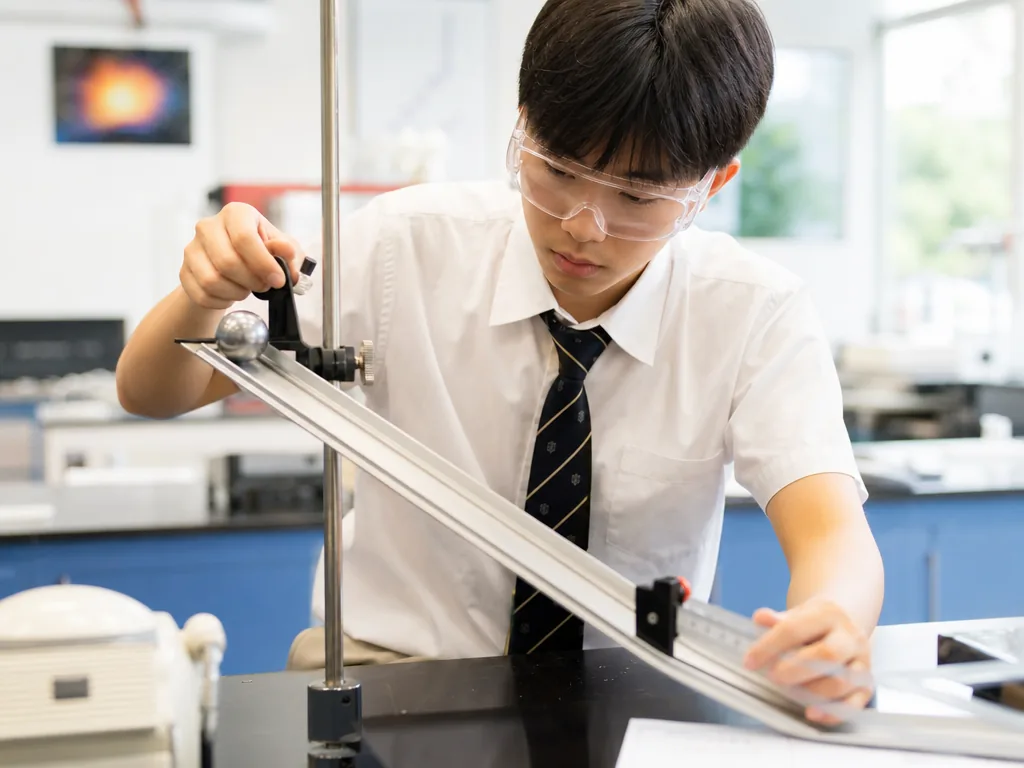
- Experimental skills——verify theory through practice
- Interdisciplinary links——connects with engineering, environmental science and other fields
- Global perspective——explores the social impact of technological development
Differences between SL and HL
- Content depth——SL studies 8 core topics, while HL must complete 4 additional higher-level topics
- Mathematical requirements——SL only needs algebra, while HL involves calculus applications
- Teaching hours——150 hours for SL (240 for HL)
Course Structure (2025 Syllabus)
The 2025 syllabus is organised into seven compulsory core modules:
| Core module | Compulsory SL content | Key concepts |
|---|---|---|
| Mechanics | Newton’s laws and conservation of energy | Momentum, work and power |
| Thermal physics | The first law of thermodynamics | Specific heat capacity, ideal gas behaviour |
| Waves | Basics of sound and optics | Interference, the Doppler effect |
| Electricity | DC circuit analysis | Ohm’s law, electrical power |
| Magnetism | Magnetic fields and electromagnetic induction | Faraday’s law, Lenz’s law |
| Atomic physics | Atomic structure and radioactivity | Half-life calculations, nuclear reactions |
| Energy | Renewable energy technologies | Energy conversion efficiency |
Optional topic (choose one)
- A. Relativity
- B. Engineering physics
- C. Imaging
Assessment and Marking
External assessment (80%)
| Paper | Duration | Question type | Marking focus |
|---|---|---|---|
| Paper 1 | 45 minutes | 30 multiple-choice questions (core content) | Conceptual understanding and quick judgement |
| Paper 2 | 1.25 hours | Structured and short-answer questions | Problem-solving and formula application |
Internal assessment (20%)
Scientific investigation (10 hours of experiment + report):
- Self-designed experiment (such as “determining a spring constant”)
It must include:
- Analysis of data uncertainty
- Graph drawing and trend interpretation
- Discussion of methodological limitations
SL Study Focus
| Skill dimension | Specific requirement | Typical question |
|---|---|---|
| Conceptual understanding | Explain the essence of physical phenomena (such as why the sky is blue) | Use Rayleigh scattering to explain the colour of the sky |
| Mathematical application | Algebraic calculation and unit conversion | Calculate total resistance in a circuit |
| Experimental design | Controlling variables and handling errors | Design a method to measure gravitational acceleration |
Formula memory tips
- Conservation of energy——kinetic energy + potential energy = constant
- Electrical power——P = IV = I²R
- Wave speed——v = f × wavelength

Effective Study Strategies
5.1 Concept Visualisation
- Mechanics model——force leads to acceleration, which leads to a change in state of motion
- Circuit analysis——use circuit simulation software (such as PhET)
5.2 Processing Experimental Data
Three-step method:
- Draw a scatter plot
- Calculate the line of best fit
- Analyse the margin of error
5.3 Tackling Question Types
Calculation question template:
- List the known quantities (with units)
- Choose a suitable formula
- Substitute values and calculate
- Check unit consistency
Essential Tools and Resources
| Type | Recommended resource | Use case |
|---|---|---|
| Textbook | IB Physics Course Book | Systematic study of core concepts |
| Calculator | TI-84 calculator | Data statistics and equation solving |
| Simulation software | Algodoo | Interactive mechanics simulation |
| Question bank | Past Papers 2016–2024 | Familiarising with exam style |
Common Challenges and Solutions
7.1 Difficult Abstract Concepts
Everyday analogies:
- Voltage is like water pressure
- Current is like water flow
7.2 Controlling Experimental Error
Error checklist:
- Systematic error (instrument precision)
- Random error (operational fluctuation)
7.3 Confusing Formulae
Derivation practice:
- Derive from basic definitions (such as P = Fv from W = Fs)
University and Career Links
8.1 University Advantages
- Credit exemption for foundational science and engineering courses (such as engineering foundation)
- Especially helpful for applying to:
- Mechanical engineering
- Environmental science
- Architectural technology
8.2 Career Paths
- Technology——electronics engineer
- Education——physics teacher at an international school
- Emerging industries——renewable energy technician
Study Plan Example
| Stage | Core task | Milestone |
|---|---|---|
| Term 1 | Master mechanics and energy concepts | Able to solve inclined-plane problems independently |
| Term 2 | Complete electricity and wave experiments | Lab reports reach a 6 standard |
| Term 3 | Optional topic + full revision | Mock Paper 2 score of 5 or above |
Examiner Expectations and High-Scoring Traits
Key indicators for a 7:
- Explain the physical meaning of formulae——such as the mass-energy conversion in E = mc²
- Lab reports——contain creative design elements
- Calculation questions——show the full derivation
To avoid:
- Inconsistent unit conversion
- Incorrect significant figures
- Conclusions not supported by data
A 7 in IB Physics SL comes not from memorising formulae, but from explaining what they mean.
Action Plan
Turn this guide into momentum with three concrete next steps:
Enter the junior Physics Olympiad selection
Competition preparation stretches problem-solving well beyond the SL syllabus.
Subscribe to the physics column of Scientific American
Regular reading builds the conceptual fluency examiners reward.
Keep an “error notebook” of common mistakes
Reviewing recurring slips is the fastest way to lift a grade.
Frequently Asked Questions (FAQ)
Q: Is IB Physics SL hard for students who are not strong in maths?
No — SL requires only algebra, not calculus. A solid grasp of algebra, unit conversion and formula application is enough to do well, provided you focus on conceptual understanding.
Q: How is the final IB Physics SL grade calculated?
External assessment (Papers 1 and 2) contributes 80% and the internal scientific investigation contributes 20%. Paper 1 is 30 multiple-choice questions, while Paper 2 is structured and short-answer questions.
Q: How many teaching hours does IB Physics SL require?
150 hours, compared with 240 for HL. The course covers eight core topics plus one optional topic chosen from Relativity, Engineering physics or Imaging.
Q: Do universities give credit for IB Physics SL?
Many universities grant credit exemption for foundational science and engineering courses — particularly useful for mechanical engineering, environmental science and architectural technology.
Further Resources & Next Steps
- Official Resources——International Baccalaureate official website (www.ibo.org) and the IBO official SL assessment criteria.
- Further Reading——MIT OpenCourseWare Classical Mechanics (https://ocw.mit.edu/) and IB Physics.net question-type analysis.
- Parent Tips——Help your child build a consistent revision timetable and a quiet study space, and encourage an “error notebook” to review recurring mistakes before mock exams.
Note: The information above is for reference only. Please consult professional education institutions for details.
This article was initially drafted and organised with AI. Editor / Professor Chan Kwok-wai; Managing Editor / Kong Yee-leung
Act Now: Find a Tutor / Register as a Tutor
For parents & students: looking for a home or online tutor for this subject? Click the button below to post a free tuition case (subject, level and preferred time) — TutorZone will match you with suitable tutors:
For tutors: do you teach this subject? Click the button below to register for free and receive more suitable cases — you pay only when a match is made: