
 中文(繁體)
 中文(簡體)
 English




DSE Biology Syllabus: Compulsory Topics, Electives and Exam Structure
TUTORZONE SUBJECT GUIDE · DSE BIOLOGY SYLLABUS
The DSE Biology Syllabus is made up of three parts — the Compulsory Part, the Elective Part and the Scientific Investigation — planned at about 250 hours, roughly 10% of the total senior secondary lesson time. The Compulsory Part is planned at 200 hours and covers four topics — Cells and Molecules of Life (44 hours), Genetics and Evolution (38 hours), Organisms and Environment (84 hours) and Health and Diseases (14 hours) — and every candidate must take it. The Elective Part is planned at 50 hours, and candidates must choose two of the four topics Human Physiology: Regulation and Control, Applied Ecology, Microorganisms and Humans and Biotechnology (25 hours each); a further 20 hours go to the Scientific Investigation, which is used for relatively large-scale or cross-topic investigative work. This guide, compiled from the Education Bureau’s Biology Curriculum and Assessment Guide (Secondary 4–6) and the Hong Kong Examinations and Assessment Authority’s Biology assessment framework, sets out the four compulsory topics and their learning focus, the content of the four elective topics, the assessment design and mark weighting of Paper 1 and Paper 2, the school-based assessment arrangements, and a practical plan for revision and exam strategy.
Direct Answer:What parts does the DSE Biology Syllabus include?
The DSE Biology Syllabus consists of a Compulsory Part, an Elective Part and the Scientific Investigation, planned at about 250 hours in total (roughly 10% of the total senior secondary lesson time). The Compulsory Part (200 hours) covers four topics — Cells and Molecules of Life (44 hours), Genetics and Evolution (38 hours), Organisms and Environment (84 hours) and Health and Diseases (14 hours) — and every candidate must take it. The Elective Part (50 hours) offers four topics — Human Physiology: Regulation and Control, Applied Ecology, Microorganisms and Humans and Biotechnology — from which candidates must choose two (25 hours each); another 20 hours are given to the Scientific Investigation. Public assessment is made up of a public examination (80%) and school-based assessment (20%): Paper 1 examines the Compulsory Part over 2 hours 30 minutes and carries 60%, of which Section A multiple-choice questions carry 18% of the subject and Section B short questions, structured questions and essay questions carry 42%; Paper 2 examines the Elective Part over 1 hour and carries 20%; school-based assessment carries 20%.
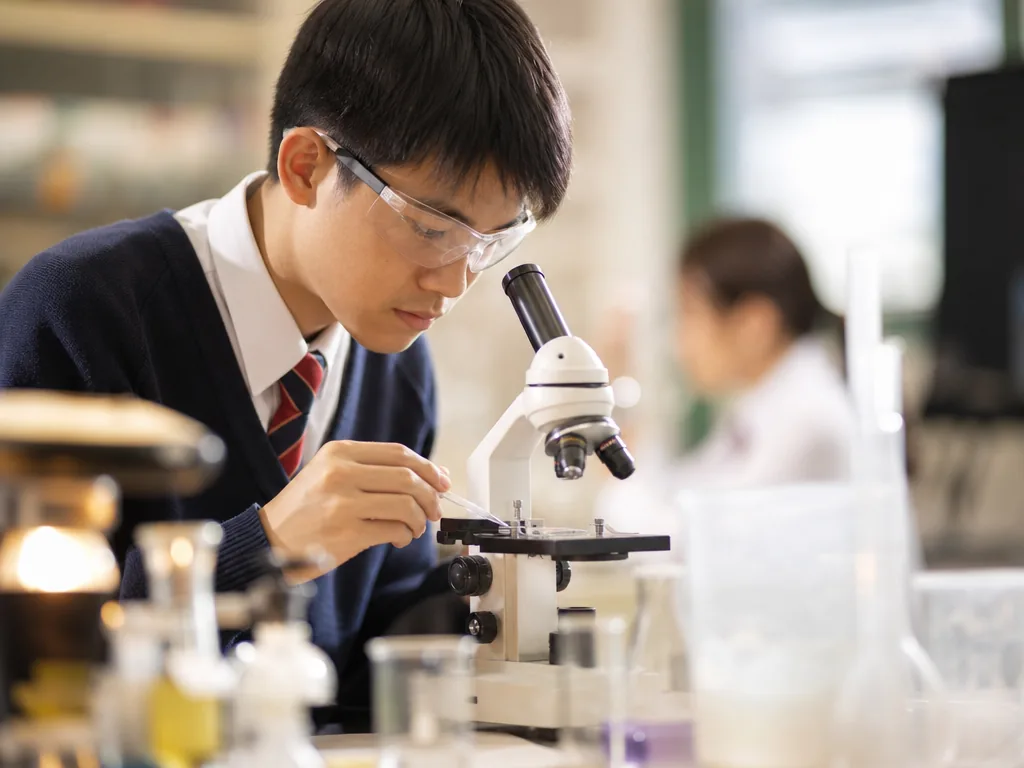
What Is the DSE Biology Syllabus?
Biology is one of the elective subjects of the Science Education Key Learning Area in the senior secondary curriculum, and public assessment is built on the Biology Curriculum and Assessment Guide (Secondary 4–6), prepared jointly by the Curriculum Development Council and the Hong Kong Examinations and Assessment Authority (prepared in 2007 and updated in November 2015). Candidates are expected to bring the general knowledge gained in junior secondary science, and the mathematical techniques the subject needs rest mainly on the Compulsory Part of the DSE Mathematics curriculum. The DSE Biology Syllabus is designed precisely to link up four levels of living phenomena: the molecule, the cell, the organism and the ecosystem.
In structure, biology is planned at about 250 hours (roughly 10% of the total senior secondary lesson time) and divides into three parts: the Compulsory Part (200 hours) covers four topics that every candidate must study; the Elective Part (50 hours) offers four elective topics from which a candidate chooses two (25 hours each); and 20 hours go to the Scientific Investigation, used for relatively large-scale or cross-topic investigative work — the simpler investigations and experiments are already counted within the suggested hours of each topic.
Parts of the four compulsory topics (the parts flagged with an asterisk in the guide) also form part of the biology component of Combined Science (Biology, Physics) and Combined Science (Chemistry, Biology), and this is where the two subjects are most easily confused. Candidates should also note that the curriculum takes the junior secondary science curriculum as its starting point, and that senior secondary concepts are layered on top of that foundation.
On assessment objectives, the HKEAA expects candidates to: recall and understand biological facts, concepts and principles, and the relationships between topics; apply biological knowledge to explain phenomena and solve problems; formulate workable hypotheses for a problem and design and carry out tests for them; demonstrate experimental techniques related to the study of biology; present data in tables, graphs, charts, drawings and diagrams, and convert between these different forms; generate ideas and select, integrate and communicate information clearly, accurately and logically; understand the applications of biology in daily life and its contribution to the modern world; recognise and critically evaluate the ethical, moral, social, economic and technological implications of biological issues; and make recommendations, choices and judgements on issues affecting individuals, society and the environment.
The distinctive difficulty of biology is that it demands four languages at once: what you observe under the microscope, the data of the laboratory, the symbols of genetics and molecules, and the arguments of ecology and ethics. Rely on memorising the textbook with one of the four missing, and your marks will stall at a particular kind of question.
The Compulsory Part: Four Topics and Their Learning Focus
The Compulsory Part runs to 200 hours and four topics, moving from molecules and cells all the way to genetics, ecosystems and health. The planned hours and core learning focus of each topic are set out below, so that parents and students can check whether their notes are complete.
Cells and Molecules of Life44 hours · everything starts from molecules and cells
- Molecules of life — the important molecules that make up life and their roles in living activities
- Cellular organisation — the structure of cells, and how cells are organised into tissues and organs
- Movement of substances across the cell membrane — the routes by which substances enter and leave a cell and the related mechanisms
- Cell cycle and division — the processes of cell growth, replication and division
- Cellular energetics — the concepts of energy conversion within the cell
Genetics and Evolution38 hours · from parent to population
- Basic genetics — the fundamental laws of inheritance and the concepts commonly used
- Molecular genetics — understanding at the molecular level how genetic information is stored and transmitted
- Biodiversity and evolution — how biodiversity arises, and the mechanisms of evolution
Organisms and Environment84 hours · the heaviest compulsory topic in lesson hours
- Essential life processes in plants — how plants obtain and use matter and energy
- Essential life processes in animals — basic processes in animals such as nutrition, gas exchange and transport
- Reproduction, growth and development — the whole journey from reproduction to the growth of an organism
- Coordination and response — how organisms receive stimuli and make coordinated responses
- Homeostasis — how organisms keep their internal environment stable
- Ecosystems — the relationships between organisms and their environment, and the flow of energy and matter
Health and Diseases14 hours · the lightest in hours but the closest to daily life
- Personal health — the factors and living habits that affect personal health
- Diseases — the causes of common diseases and how they are transmitted
- The body’s defence mechanisms — how the human body resists invasion by pathogens
The Elective Part: Two Topics Out of Four
The Elective Part runs to 50 hours in total, and candidates must choose two of the four topics below (25 hours each). Before choosing, check which topics your own school actually offers — some schools run only two or three of them — and note that Paper 2 examines only the two topics a candidate has chosen.
Human Physiology: Regulation and Control25 hours · the human body as the object of study
- Osmoregulation — how the human body maintains its water balance
- Regulation of body temperature — how the body keeps its temperature constant
- Regulation of blood gas content — how the gas content of the blood is monitored and adjusted
- Hormonal control of the reproductive cycle — how hormones regulate the reproductive cycle
Applied Ecology25 hours · bringing ecological knowledge to environmental issues
- Human impact on the environment — how human activity changes ecological environments
- Pollution control — the methods and considerations for reducing and treating pollution
- Conservation — the ideas and practice behind protecting species and habitats
- Global issues — environmental problems that cross national boundaries, and the debate around them
Microorganisms and Humans25 hours · neighbours invisible to the naked eye
- Microbiology — a basic understanding of microorganisms and how they are studied
- The use of microorganisms — their uses in daily life and in industry
- Microbial genetics — genetic phenomena at the level of microorganisms
- The harmful effects of microorganisms — the problems they cause and how these are controlled
Biotechnology25 hours · from the laboratory into life and ethics
- The techniques of modern biotechnology — the main techniques used in contemporary biotechnology
- Applications of biotechnology — its applications in daily life and in industry
- Bioethics — the ethical debate raised by biotechnology
Exam Format and Mark Weightings
Public assessment in biology is made up of a public examination (80%) and school-based assessment (20%). Paper 1 examines all the topics of the Compulsory Part and carries 60% of the subject over 2 hours 30 minutes; Paper 2 examines the Elective Part and carries 20% over 1 hour. Under the HKEAA’s current biology assessment framework these weightings remain unchanged.
| Paper | Content examined | Time | Weighting |
|---|---|---|---|
| Paper 1 | Compulsory Part: Section A multiple-choice questions (18% of the subject); Section B short questions, structured questions and essay questions (42% of the subject); every question must be answered | 2 hours 30 minutes | 60% |
| Paper 2 | Elective Part: structured questions covering the four elective topics, with candidates answering only on the two topics they have chosen | 1 hour | 20% |
| School-based assessment | Starting in Secondary 5, assessed through experiment-related and non-experiment-related tasks | Across Secondary 5 and Secondary 6 | 20% |
The question types in Paper 1 span multiple-choice questions, short questions, structured questions and essay questions: Section A multiple-choice questions carry 18% of the subject in total, and Section B short questions, structured questions and essay questions carry 42% of the subject in total. Short questions test the breadth of the curriculum content; structured questions require candidates to analyse the information given and apply their knowledge to familiar and unfamiliar contexts; essay questions require candidates to discuss biological issues in depth and to organise and present their arguments coherently. There is no choice on Paper 1 — candidates must answer every question on the paper — so skipping a topic is the same as giving up its marks outright.
Paper 2 covers the Elective Part only. Its questions are structured questions covering the four elective topics, and candidates answer only on the two topics they have chosen. Since the four elective topics together carry only 20% of the subject while each one is planned at 25 hours of study, the trade-off you make when choosing an elective has a direct effect on your overall result. Candidates should first confirm which topics their school actually offers and how they are taught, and then decide according to their own plans for after Secondary 6.
For school-based assessment, biology assesses students’ experimental skills and generic skills through experiment-related and non-experiment-related tasks, starting in Secondary 5, and the result is finally combined with the public examination result, carrying 20% of the subject. The public examination and school-based assessment together make up 100%. The specific assessment requirements, the arrangement of the tasks and the mark submission arrangements are announced to schools by the Hong Kong Examinations and Assessment Authority, and candidates should follow the guidance of their own teachers.
Assessment Objectives and Question-Type Strategy
Biology questions test roughly three kinds of ability: knowledge and understanding, application and problem solving, and experimental work and data handling. Each is revised in a different way, and dividing time evenly across the three is usually the least efficient plan there is.
Knowledge and understanding — multiple-choice and short questions test definitions, vocabulary and the recognition of facts, concepts and principles. This is the part most easily trained back, and the key is to distil the definitions and key terms of every topic into a single page of your own notes. Pay particular attention to the relationships between topics: genetics and evolution, and physiological processes and homeostasis, are the connections most often missed.
Application and problem solving — structured questions and essay questions apply biological knowledge to familiar and unfamiliar contexts, explain phenomena and solve problems, ask you to formulate workable hypotheses and design and carry out tests for them, and require you to generate ideas and select, integrate and communicate information clearly, accurately and logically. Wherever a question supplies data or a situation, read the question carefully first and only then decide which topic’s concepts to bring in.
Experimental work and data handling — the common demand of the experimental questions and of school-based assessment. Candidates should demonstrate experimental techniques related to the study of biology, be able to describe the steps taken and the reasons for the instruments chosen, and present data in tables, graphs, charts, drawings and diagrams, converting between these forms. Issues should also be evaluated from ethical, moral, social, economic and technological angles, with recommendations and judgements offered on matters affecting individuals, society and the environment.
Finally, essay and explanation questions. Marking schemes have always rewarded a complete chain of cause and effect: state the cause, then the mechanism, then the observation. Explaining the regulation of homeostasis, for example, means working through how a receptor detects a change, how the coordinating mechanism issues its instruction and how the effector responds, and only then the return of the internal environment to a stable state; omit any one of those steps and key marks go with it. Questions touching on biotechnology or ecological issues should keep the ethical, social and environmental angles in view at the same time.
Why Study Biology? Further Study and Careers
Biology is knowledge, but it is also proof of ability. The three points below are the practical considerations that come up most often when families weigh up the subject.
A complete view from cells to health
The four compulsory topics run from Cells and Molecules of Life and Genetics and Evolution to Organisms and Environment and Health and Diseases, and the Elective Part allows Human Physiology: Regulation and Control and Microorganisms and Humans. The HKEAA also explicitly expects candidates to understand the applications of biology in daily life and its contribution to the modern world, and the content bears directly on personal health and public health issues.
Training in scientific investigation and data expression
The curriculum sets aside 20 hours for the Scientific Investigation, and every topic includes experimental work; the assessment objectives require candidates to formulate workable hypotheses for a problem and design tests for them, and then to present the data in tables, graphs, charts, drawings and diagrams and convert between these forms. That habit of hypothesise, verify and express is the common language of science and of healthcare work.
A perspective on biotechnology and bioethics
The two elective topics Biotechnology and Microorganisms and Humans reach straight into the techniques of modern biotechnology, the uses and the harmful effects of microorganisms, and issues such as bioethics. The assessment objectives require candidates to recognise and critically evaluate the ethical, moral, social, economic and technological implications of biological issues — training that is not easily obtained in other elective subjects.
Revision Strategy and the Marks Most Often Lost
Results in biology are rarely separated by cleverness; they are separated by method. Six patterns come up again and again in tutoring.
- Allocate revision time by planned hours—the four compulsory topics are planned at 44, 38, 84 and 14 hours, so Organisms and Environment is the heaviest compulsory topic and revision time should lean that way, while Health and Diseases, with only 14 hours, is relatively concentrated and can be consolidated quickly. Spreading the four topics evenly is the surest way to lose marks on the heaviest one.
- Settle the two electives early—the Elective Part runs to 50 hours and a candidate studies and is examined on only two of the four topics, 25 hours each. Confirm which topics your school actually offers first, then decide in line with your plans after Secondary 6; changing elective late is expensive and leaves both topics studied too shallowly.
- Never write off a topic—there is no choice on Paper 1, so every question must be answered and skipping a topic is the same as giving up its marks outright.
- Build up experimental work and school-based assessment as you go—school-based assessment carries 20% of the subject and starts in Secondary 5, assessed through experiment-related and non-experiment-related tasks. Recording the aim, procedure, observations, data and conclusion of every experiment as you go is far more effective than writing the reports up after the event, and the specific assessment requirements and submission arrangements are always governed by your own teacher’s guidance.
- Answer in complete causal chains—the assessment objectives expressly reward information selected, integrated and communicated clearly, accurately and logically, so the organisation of an answer is itself a place to earn marks: cause first, then mechanism, then observation, with the ethical, social, economic and environmental angles covered where the question invites them.
- Put data in the right form—get used to presenting the same data as a table, a graph, a chart, a biological drawing and a diagram, and to converting between these forms. Inaccurate vocabulary and drawings left half finished are among the commonest places to drop marks.

Who Should Take Biology? And How It Differs from Combined Science
Biology suits students who are curious about living phenomena, willing to work with their hands in the laboratory, and not resistant to memorising and to writing. For a student intending to move towards the life sciences, healthcare or environmental work, biology is usually an elective worth the investment; taken only to make up the number of electives, it is a subject in which confidence tends to collapse on the concept-dense blocks such as genetics and physiology.
The question that comes up more often is how biology differs from Combined Science (the biology component). Under the curriculum and assessment guide, the parts of the four compulsory topics flagged with an asterisk also form part of the biology component of Combined Science (Biology, Physics) and Combined Science (Chemistry, Biology), and this is where the two subjects are most easily confused. Biology taken on its own is planned at about 250 hours, including 200 hours of Compulsory Part, 50 hours of Elective Part (two topics out of four) and 20 hours of Scientific Investigation; Combined Science, by contrast, has to cover the foundation topics of two science subjects at the same time, and its biology component covers a comparatively narrower range of content. So if the aim is to go deep into biology, or to demonstrate a complete training in biology in the DSE, the stand-alone subject is the better fit; if you would rather cover two science areas in fewer hours, Combined Science is more flexible.
As for whether an extended mathematics module has to be taken at the same time, the answer is no. The mathematical techniques biology assessment needs rest mainly on the Compulsory Part of the DSE Mathematics curriculum, and the emphasis is on organising data, reading graphs and simple calculation, not on the knowledge of an extended module. Candidates are also expected to bring the general knowledge of the junior secondary science curriculum, and to build the senior secondary biological concepts on that foundation.
Frequently Asked Questions (FAQ)
Q:How many papers does DSE Biology have?
The public examination has two papers. Paper 1 examines the Compulsory Part, carries 60% of the subject and runs for 2 hours 30 minutes, and every question must be answered: Section A multiple-choice questions carry 18% of the subject, and Section B short questions, structured questions and essay questions carry 42%. Paper 2 examines the Elective Part, carries 20% of the subject and runs for 1 hour. Together with school-based assessment at 20%, the three components make up 100%, that is a public examination worth 80% and school-based assessment worth 20%.
Q:How should the four elective topics be chosen?
The Elective Part offers Human Physiology: Regulation and Control, Applied Ecology, Microorganisms and Humans and Biotechnology, each planned at 25 hours, and candidates study and are examined on two of them, 50 hours in total. Paper 2’s structured questions cover all four elective topics, and candidates answer only on the two they have chosen. Three things are worth weighing when choosing: which topics your school actually offers, where you intend to go after Secondary 6, and how the school teaches and assesses that topic.
Q:What is the difference between biology and the biology component of Combined Science?
The parts of the four compulsory topics flagged with an asterisk in the guide also form part of the biology component of Combined Science (Biology, Physics) and Combined Science (Chemistry, Biology), which is where the two are most easily confused. Biology taken on its own is planned at about 250 hours, with a further 50 hours of Elective Part (two topics out of four) and 20 hours of Scientific Investigation; Combined Science, by contrast, has to cover the foundation topics of two science subjects at the same time, and its biology component covers a comparatively narrower range of content. For a student intending to move towards the life sciences or healthcare, taking biology on its own is generally recommended.
Q:Does biology need strong mathematics?
No. The mathematical techniques biology needs rest mainly on the Compulsory Part of the DSE Mathematics curriculum, and the emphasis is on organising data, reading graphs and simple calculation; the knowledge of an extended mathematics module is not required. What deserves your time instead is the ability to write experimental data into tables and graphs and to convert between different forms of presentation — precisely the skill the assessment objectives set out in writing.
Further Resources and Next Steps
- Official sources—the Education Bureau’s Biology Curriculum and Assessment Guide (Secondary 4–6), prepared jointly by the Curriculum Development Council and the Hong Kong Examinations and Assessment Authority (prepared in 2007, updated in November 2015); and the HKEAA Biology assessment framework. Curriculum documents and the assessment framework are always more reliable than the notes circulating in the market.
- Further reading—the science guides on this platform: DSE Chemistry Syllabus, DSE Physics Syllabus, and IGCSE Biology Syllabus.
- Parent tip—biology marks are lost more often through concepts run together and explanations left incomplete. Encouraging your child to build a one-page concept comparison chart for each topic (for example, splitting the heaviest topic, Organisms and Environment, into plants, animals, reproduction, coordination and response, homeostasis and ecosystems) and to get used to explaining phenomena in full sentences is more effective than working blindly through supplementary exercises.
Note: The information above is for reference only. Please consult professional education institutions for details.
This article was initially drafted and organised with AI. Editor / Professor Chan Kwok-wai
Act Now: Find a Tutor / Register as a Tutor
For parents & students: looking for a home or online tutor for DSE Biology? Click the button below to post a free tuition case (subject, level and preferred time) — TutorZone will match you with suitable tutors:
For tutors: do you teach this subject? Click the button below to register for free and receive more suitable cases — you pay only when a match is made:
Managing Editor / Kong Yee-leung
Direct Answer:How many papers does DSE Biology have, and how are the marks weighted?
The subject has two public papers. Paper 1 examines all the topics of the Compulsory Part over 2 hours 30 minutes and carries 60% of the subject: Section A multiple-choice questions carry 18% of the subject and Section B short questions, structured questions and essay questions carry 42%, and every question must be answered. Paper 2 examines the Elective Part over 1 hour and carries 20% of the subject, and candidates answer on the two elective topics they have chosen. Together with school-based assessment at 20% (starting in Secondary 5 and assessed through experiment-related and non-experiment-related tasks), the three components make up 100%, that is a public examination worth 80% and school-based assessment worth 20%.
Direct Answer:How should the four elective topics be chosen?
The four elective topics are Human Physiology: Regulation and Control, Applied Ecology, Microorganisms and Humans and Biotechnology, each planned at 25 hours, and a candidate studies and is examined on only two of them, making 50 hours in total. Three things are worth weighing when choosing: which topics your school actually offers; where you intend to go after Secondary 6 (for example, Human Physiology suits a student interested in how the human body works, Applied Ecology suits one concerned about environmental issues, Microorganisms and Humans suits one who enjoys microorganisms and laboratory work, and Biotechnology suits one who wants to understand frontier technology and bioethics); and how the school teaches and assesses that topic. Paper 2 examines only the two topics a candidate has chosen, and together they carry 20% of the subject — not an insignificant weighting.
