
 中文(繁體)
 中文(简体)
 English



ABRSM Grade 5 Music Theory Mock Paper: a Full 7-Section, 75-Mark Paper with Answers and a 12-Week Plan
TUTORZONE EXAM PRACTICE · ABRSM Grade 5 Music Theory
Grade 5 Music Theory is the gate that Hong Kong music students must pass: without it you cannot even enter for a Grade 6, 7 or 8 Practical or Performance exam. And since 2020 the Grades 1–5 theory exams are online and on demand, with a fixed paper shape of 7 sections, 75 marks and 2 hours. This paper follows that official shape exactly, with full answers and marking points.
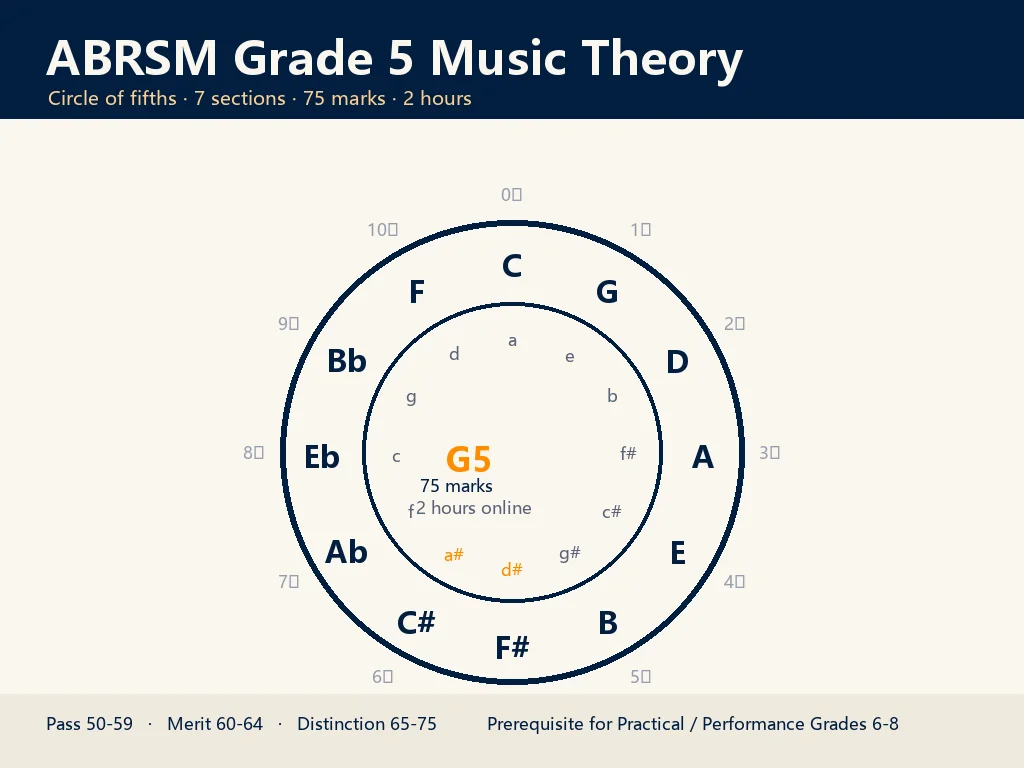
Quick answer: ABRSM Grade 5 Music Theory is an online exam (Grades 1–5 are all online and available on demand) with a 2-hour limit and a paper of 7 sections totalling 75 marks. Results are banded 65–75 Distinction, 60–64 Merit, 50–59 Pass, 0–49 Below Pass. Its real importance: you must pass Grade 5 or above Music Theory before you can enter for Grade 6, 7 or 8 Practical or Performance (Grade 5 Practical Musicianship or a Jazz Practical Grade subject is also accepted). This is an original TutorZone mock paper, not an ABRSM past paper.
Download and print (free, no registration)
The whole paper — questions, model answers and marking scheme — is laid out for A4 printing: Download the PDF | Open the print view (opens the print dialogue)
The print dialogue opens automatically; choose “Save as PDF” to keep a copy.
The exam at a glance
| Item | Official specification |
|---|---|
| Grades | Grades 1–8; Grades 1–5 are online and on demand, Grades 6–8 are paper-based on set dates |
| Grade 5 timing | 2 hours (Grades 1–3: 1.5 hours; Grades 6–8: 3 hours) |
| Paper structure | 7 sections; for Grades 4–5 the maximum marks are 10, 10, 15, 10, 10, 10, 10 |
| Total marks | 75 |
| Result categories | Distinction 65–75 / Merit 60–64 / Pass 50–59 / Below Pass 0–49 |
| Why it matters | Grade 5 or above Music Theory is a prerequisite for Grades 6, 7 and 8 Practical or Performance |
| Marking | Marked automatically, but results are released only after the exam recordings have been reviewed |
| Assessed on | Rhythm; pitch and transposition; keys and scales; intervals; triads and chords; terms, signs and instruments; music in context |
Plan early: because Grades 1–5 are now on demand, many students leave Grade 5 theory until they need it for a Grade 6 practical — then they are practising repertoire and catching up on theory in the same term. Take it during your Grade 4 or 5 instrumental year instead.
About this paper and copyright
- This is an original mock paper: every question was written by TutorZone against the official syllabus. It contains no ABRSM past-paper or exam questions. The framework facts were checked against ABRSM’s Music Theory Qualification Specification and the syllabus in force from May 2020.
- Musical examples are given as note names and note values (e.g. F–A–C, crotchets) so they read well on screen and in print; the live exam also contains staff-notation questions.
- The paper follows the official 7-section, 75-mark layout, with the same marks per section as the real paper.
- Answers and marking points are in section 10 — finish the paper first.
Section 1 — Rhythm (10 marks)
2 marks each.
1. In a bar of a melody the crotchets clearly fall into groups of 3 + 2 + 2. What time signature is the bar most likely to be in?
2. A 5/4 bar contains a dotted minim followed by a minim. Is the bar complete? Explain.
3. A 7/4 bar contains two minims and a crotchet. Which rest completes the bar?
4. In 5/8, how are five quavers normally grouped?
5. In simple time, five notes played in the time of four quavers form which irregular division?
Section 2 — Pitch and transposition (10 marks)
2 marks each.
1. The tenor clef is a C clef. Which line of the staff (counting from the bottom) does it mark as middle C?
2. In the tenor clef, which note is written on the third line (relative to middle C)?
3. A part for clarinet in A is written with the note C. What note actually sounds, and by how much has it moved?
4. A part for horn in F is written with the note C. What note actually sounds, and by how much has it moved?
5. A melody must sound in G major. In which key must it be written for a B♭ instrument?
Section 3 — Keys and scales (15 marks)
1. (2) A key signature has 6 sharps (F♯ C♯ G♯ D♯ A♯ E♯). Which major key is it, and what is its relative minor?
2. (2) A key signature has 6 flats (B♭ E♭ A♭ D♭ G♭ C♭). Which major key is it, and what is its relative minor?
3. (2) What is the relative minor of E major?
4. (3) Write out the scale of A major, ascending, one octave (eight notes).
5. (3) Write out the melodic minor scale of B♭, ascending and descending (seven notes each).
6. (3) How many sharps are in the key signature of E major, and which notes are they?
Section 4 — Intervals (10 marks)
2 marks each. Give the full name of each interval (e.g. “major third”).
1. C up to A
2. E♭ up to C
3. F♯ up to D
4. C up to the E in the next octave
5. B down to D
Section 5 — Chords and cadences (10 marks)
2 marks each.
1. In C major, write the three notes of the supertonic triad in root position.
2. In G major, write the three notes of the dominant triad in first inversion (lowest note first).
3. In C major a phrase ends with the chords F then C. Which cadence is this?
4. In F major a phrase ends with the chords C then F. Which cadence is this?
5. In D major, which chord should end a phrase to make an imperfect cadence?
Section 6 — Terms, signs and instruments (10 marks)
2 marks each.
1. What does the sign “tr” above a note mean?
2. Which Italian term means “gradually getting slower”? Give one term and its abbreviation.
3. What does the German word “langsam” mean?
4. Which instrument family does the oboe belong to, and how is its sound produced?
5. List the four voice types from the lowest to the highest.
Section 7 — Music in context (10 marks)
Read the original extract described below, then answer the questions (2 marks each).
Extract. An 8-bar melody in 3/4 time. Its key signature has F♯ and C♯. The melody begins on D; in bars 1–2 the important notes are D–F♯–A. In bar 4 the harmony moves A → D. Bar 5 begins with the marking “dolce“.
1. Which key is the melody in, and which notes make up its key signature?
2. Which cadence does the A → D progression in bar 4 form?
3. What is the interval from the D in bar 1 to the F♯ in bar 2?
4. What does “dolce” mean?
5. How many beats are there in the whole melody?
Answers and marking points
Finish the paper first. Marks follow the official 7-section structure, total 75. Use section 11 to convert your score into a result band.
Section 1 (10 marks)
1. 7/8 (3 + 2 + 2 crotchet-equivalents = seven quavers; an irregular time signature with accents on the 1st, 4th and 6th quavers).
2. Yes, it is complete: a dotted minim = 3 beats, a minim = 2 beats, and 3 + 2 = 5 beats, exactly one bar of 5/4.
3. It needs 2 more beats: 2 + 2 + 1 = 5 beats, and 7 − 5 = 2, so a minim rest completes the bar.
4. In groups of 2 + 3 (or 3 + 2) crotchet-equivalents, matching the accent after the barline; the grouping must stay consistent within a piece.
5. A quintuplet — five notes sharing the time of four quavers, the “irregular division of simple time values”.
Section 2 (10 marks)
1. The fourth line from the bottom. The tenor clef is a C clef placed on the fourth line, so that line is middle C.
2. A (the A below middle C): the fourth line is middle C, the space below it is B, and the third line is A.
3. A sounds — a minor third lower than written.
4. F sounds — a perfect fifth lower than written.
5. It must be written in A major: a B♭ instrument sounds a major second lower, so the written key is a major second above the sounding key (G major → A major).
Section 3 (15 marks)
1. F♯ major; relative minor D♯ minor.
2. G♭ major; relative minor E♭ minor.
3. C♯ minor (E major has four sharps: F♯ C♯ G♯ D♯).
4. A–B–C♯–D–E–F♯–G♯–A (F, C and G sharpened).
5. Ascending: B♭–C–D♭–E♭–F–G–A–B♭ (the 6th and 7th raised); descending: B♭–A♭–G♭–F–E♭–D♭–C–B♭ (back to the natural minor).
6. Four sharps: F♯, C♯, G♯, D♯.
Section 4 (10 marks)
1. Major sixth. 2. Major sixth (E♭ major already contains C natural). 3. Minor sixth (the sixth note of F♯ major is D♯, and the question gives D natural, so the interval is minor). 4. Major tenth — a compound major third: C to E is a major third, and adding an octave makes it a tenth. 5. Major sixth (inverting B down to D gives D up to B, a major sixth, so the downward interval is a major sixth too).
Section 5 (10 marks)
1. D–F–A (the supertonic triad of C major, chord ii).
2. F♯–A–D (the dominant triad in G major is D–F♯–A; in first inversion the root moves up an octave).
3. A plagal cadence: IV → I.
4. A perfect cadence: V → I (in F major, C is the dominant and F the tonic).
5. A (the dominant). An imperfect cadence is any chord → V, and the dominant of D major is A major.
Section 6 (10 marks)
1. A trill — a rapid alternation with the note above.
2. Ritardando (rit.); rallentando (rall.) is also acceptable.
3. Slow.
4. The woodwind family; its sound is produced by a double reed.
5. Bass → tenor → alto → soprano.
Section 7 (10 marks)
1. D major, with a key signature of F♯ and C♯.
2. A perfect cadence (V → I): A is the dominant of D major and D is the tonic.
3. A major third.
4. Sweetly, softly.
5. 8 bars × 3 beats = 24 beats.
Score bands and the mistakes that cost marks
| Your score (out of 75) | Band | Official wording |
|---|---|---|
| 65–75 | Distinction | Highly accurate with excellent attention to detail; the basic elements are fully grasped |
| 60–64 | Merit | Largely accurate with good attention to detail; strengths clearly outweigh weaknesses |
| 50–59 | Pass | Generally accurate with some lapses; strengths just outweigh weaknesses |
| 0–49 | Below Pass | Inaccuracies throughout; some items incomplete |
The recurring Grade 5 mistakes:
- Intervals: size versus quality. Count the letter names first (the number), then decide major/minor/perfect. Question 3 in section 4 is the classic trap — the sixth note of F♯ major is D♯, so a written D natural makes it a minor sixth.
- Irregular time signatures. 5/8 and 7/8 are not grouped “any way”; state the grouping (2 + 3, or 3 + 2 + 2).
- The descending melodic minor. The 6th and 7th are raised going up and must be naturalised coming down.
- Transposing in the wrong direction. A B♭ instrument is written a major second above the sounding pitch; a horn in F is written a perfect fifth above it. Remember “the instrument’s key = the sounding key”, then work out the direction.
- Cadences by ear. Decide by the chords, not by whether the phrase “sounds finished”: V → I perfect, IV → I plagal, anything → V imperfect.
- Terms only in translation. ABRSM sets Italian, French and German terms (e.g. German “langsam”), so learn the original word, not just a translation.
- Inversions. In first inversion the root moves up an octave: D–F♯–A becomes F♯–A–D.
A 12-week plan (three 30-minute sessions a week)
| Weeks | Focus | Checkpoint |
|---|---|---|
| 1–2 | Rhythm: simple and compound time, irregular 5/4, 7/4, 5/8, 7/8, grouping notes and rests | Can complete any bar with the right rest |
| 3–4 | Four clefs (treble, bass, alto, tenor) and octave transposition | Names any note in any clef within 10 seconds |
| 5–6 | Keys and scales: major and minor up to six sharps and flats, three minor forms, relatives | Reads a key signature and gives both keys instantly |
| 7–8 | Intervals: simple and compound, ascending and descending | 18 of 20 interval questions correct |
| 9 | Chords, inversions and the three cadences in C, G, D and F major | Chooses the right chord at a cadence point |
| 10 | Terms, ornaments, instruments and voices | Writes 40 terms from memory (Italian, French, German) |
| 11 | Sit this paper, mark it, redo the weak sections | Mock score of 60+ (Merit) |
| 12 | Rehearse the online setup: blank paper, camera check, 2-hour timer | Finishes and checks within 2 hours |
Exam-day rules (official): the online exam must be taken alone with no notes or books. Any depiction of a piano keyboard — including a real piano — must be covered. You may use your own blank paper (manuscript or plain) to work out answers: show it to the camera at the start to prove it is blank, and hold it up and destroy it at the end.
Frequently asked questions
Q1. Do I have to take Grade 5 theory?
Yes, if you want to enter for Grades 6, 7 or 8 in Practical or Performance: you must first pass Grade 5 or above Music Theory. ABRSM also accepts Grade 5 Practical Musicianship or a Jazz Practical Grade subject.
Q2. How many questions and marks?
The paper has 7 sections; for Grades 4–5 the maximum marks are 10, 10, 15, 10, 10, 10, 10, making 75 marks, with a 2-hour limit.
Q3. What is a pass?
50–59 Pass, 60–64 Merit, 65–75 Distinction, out of 75.
Q4. When are online results released?
The exam is marked automatically, but results are only released once the assessment recordings have been reviewed. Exams can be booked on demand.
Q5. Can I use a dictionary?
For the Grades 6–8 paper exams, candidates whose first language is not English may request a bilingual paper dictionary and 15 minutes’ extra time (requests must be made at entry). Online arrangements follow ABRSM’s latest published guidance.
Q6. What comes after Grade 5?
Grades 6–8 theory move into harmony, melody writing and score reading, and carry UCAS points in the UK.
Official sources and further reading
- Official framework — ABRSM’s Music Theory Qualification Specification (April 2023): online Grades 1–5 timings, the 7-section 75-mark structure and the result bands.
- Official syllabus — ABRSM’s Music Theory syllabus outline Grades 1–5 from 2020: the Grade 5 additions (irregular time signatures, tenor clef, transposition for B♭/A/F instruments, keys up to six sharps and flats, inverted chords and the three cadences).
- Further reading — TutorZone’s music-grade series: the ABRSM Violin grade guide (with mock aural tests), ABRSM Clarinet grades and ABRSM Piano grades.
- Same series — ABRSM violin grade exams (with mock aural tests), ABRSM clarinet grade exams, ABRSM piano grade exams (2027 & 2028 syllabus) and exam practice questions.
- Subject guides — curriculum guides across programmes.
- Logistics — Cross-district transport guide: check travel times before arranging lessons.
Note: exam arrangements, marks and result bands are governed by ABRSM’s latest Music Theory Qualification Specification and syllabus. This is original TutorZone content, not official ABRSM material.
Next step: free music theory tuition
Students and parents: Grade 5 theory is the gate you must pass before a Grade 6, 7 or 8 instrumental exam — and it tests a set of reading skills (intervals, key signatures, chords, cadences) that can be drilled systematically. Tell us the school year, target grade and available times, and TutorZone will match you with a tutor who knows the ABRSM theory format and works through the seven sections one by one:
Tutors: music theory is one of the steadiest sources of demand in Hong Kong, because every cohort has students catching up on Grade 5 theory before an instrumental exam. Register free — you only pay when a match is made: