
 中文(繁體)
 中文(简体)
 English




ABRSM Music Theory G5 Drill Guide: Section Order and 2-Hour Pacing
TUTORZONE EXAM DRILL GUIDE · ABRSM MUSIC THEORY GRADE 5
Built on the ABRSM music theory exams (Grades 1-5 can be taken online): Grade 5 is a 2-hour, 75-mark paper in seven sections covering rhythm, pitch and transposition, keys and scales, intervals, chords and cadences, terms and instruments, and music in context – Pass 50-59, Merit 60-64, Distinction 65-75. Method only: section order, 2-hour pacing, the usual mark losses, the error log and a 12-week timetable.
How is ABRSM Music Theory G5 assessed, and what does each part carry?
Section 1 Rhythm: Time signatures, note grouping, rests, single and compound time (10 marks); Section 2 Pitch and transposition: Treble and bass clef reading, ledger lines, transposition by a given i (10 marks); Section 3 Keys and scales: Key signatures, major scales, three minor forms, degrees (15 marks); Section 4 Intervals: Melodic and harmonic intervals, major/minor/perfect/augmented/diminish (10 marks); Section 5 Chords and cadences: Tonic triads and inversions, V and V7, perfect, imperfect, interrupted (10 marks); Section 6 Terms, signs and instruments: Italian, German and French terms, dynamics and tempo marks, instrument (10 marks); Section 7 Music in context: Reading a score for period, texture, dynamics and performance directio (10 marks)
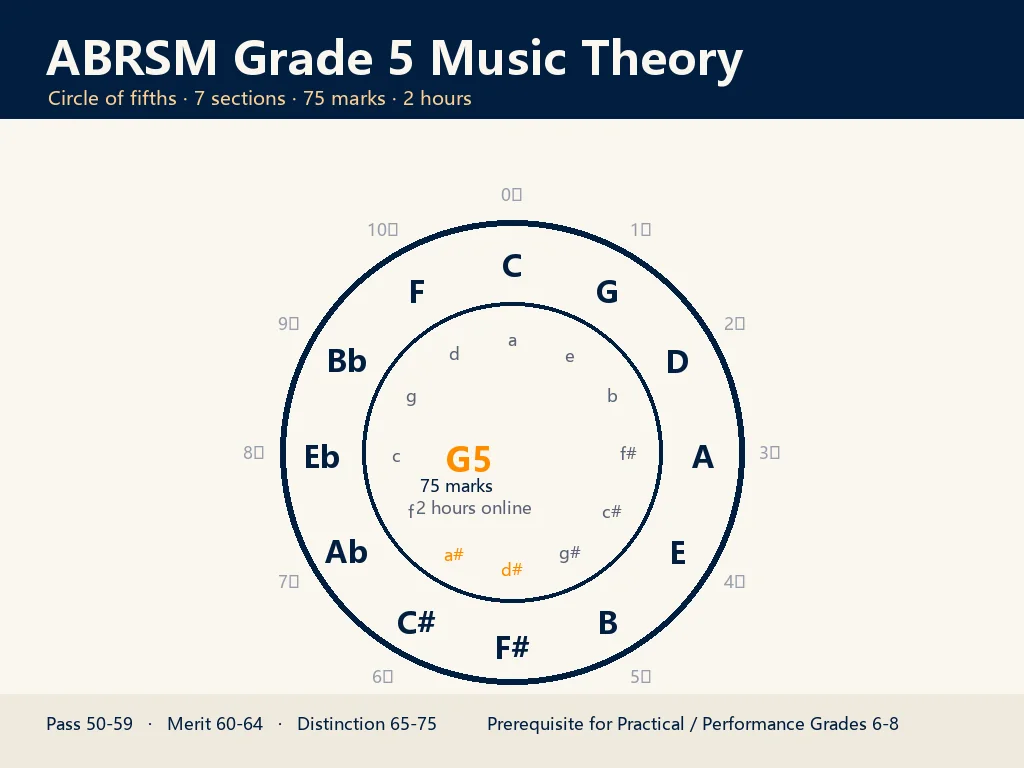
Assessment at a glance (2027)
| Component | Content | Weighting | Duration |
|---|---|---|---|
| Section 1 Rhythm | Time signatures, note grouping, rests, single and compound time | 10 | about 15 min |
| Section 2 Pitch and transposition | Treble and bass clef reading, ledger lines, transposition by a given interval | 10 | about 15 min |
| Section 3 Keys and scales | Key signatures, major scales, three minor forms, degrees | 15 | about 20 min |
| Section 4 Intervals | Melodic and harmonic intervals, major/minor/perfect/augmented/diminished, compound | 10 | about 15 min |
| Section 5 Chords and cadences | Tonic triads and inversions, V and V7, perfect, imperfect, interrupted and plagal cadences | 10 | about 15 min |
| Section 6 Terms, signs and instruments | Italian, German and French terms, dynamics and tempo marks, instrument families and ranges | 10 | about 15 min |
| Section 7 Music in context | Reading a score for period, texture, dynamics and performance directions | 10 | about 15 min |
Seven sections in 2 hours: about 15 min on rhythm, 15 on pitch and transposition, 20 on keys and scales, 15 on intervals, 15 on chords and cadences, 15 on terms and instruments, 15 on music in context, leaving 10 to check.
What each paper is actually testing
| Paper | Drill focus | How marks are lost |
|---|---|---|
| Section 1 Rhythm | work the time signature back from the note values | Grouping notes before fixing the time signature, or miscounting the bar total |
| Section 2 Pitch and transposition | transpose by interval number and accidentals only | Transposing note names but not accidentals; misreading ledger lines |
| Section 3 Keys and scales | name all three minor forms correctly | Writing natural minor when harmonic or melodic minor was asked |
| Section 4 Intervals | number and quality are two separate steps | Giving the number but not the quality, or treating compound intervals as simple |
| Section 5 Chords and cadences | the cadence is decided by the last two chords | Missing the third, misjudging the inversion, reading the cadence from one chord |
| Section 6 Terms, signs and instruments | learn term roots instead of isolated words | Guessing foreign terms, or mixing up dynamics and tempo marks |
| Section 7 Music in context | every answer cites something in the score | Answering context questions with adjectives and no reference to the score |
What is each ABRSM Music Theory G5 paper really testing, and what should you drill?
Section 1 Rhythm: work the time signature back from the note values; Section 2 Pitch and transposition: transpose by interval number and accidentals only; Section 3 Keys and scales: name all three minor forms correctly; Section 4 Intervals: number and quality are two separate steps; Section 5 Chords and cadences: the cadence is decided by the last two chords; Section 6 Terms, signs and instruments: learn term roots instead of isolated words; Section 7 Music in context: every answer cites something in the score
Drill order: by topic, then by year, then the mark scheme
| Step | What you do | Why |
|---|---|---|
| 1. By topic | Work through each topic, starting with the paper that allows least help (no calculator / closed book) | Exposes what is genuinely not understood |
| 2. By year | Whole papers to time, one or two a week | Trains pace, stamina and question selection |
| 3. Mark scheme | Go through the marking scheme question by question and log the scoring steps you missed | Most lost marks are written wrong, not thought wrong |
Should drilling go by topic first or by year?
By topic first, then whole papers by year, then the mark scheme. The first third of the time goes topic by topic (8-10 years of the same topic back to back), the middle switches to timed whole papers, and the last fortnight only redoes the recurring errors from your log.
A 12-week drilling timetable
| Week | Phase | What to do |
|---|---|---|
| Weeks 1-3 | By topic: foundation | Topic by topic, starting with the easiest marks, building habits and recall |
| Weeks 4-6 | By topic: core | 8-10 years of the same topic back to back, errors classified by topic |
| Weeks 7-8 | By topic: advanced and electives | Elective and higher-order topics, now under time pressure |
| Weeks 9-10 | By year: timed papers | One full paper a week, timed, no reference materials |
| Week 11 | Mark scheme work | Question by question against the marking scheme; list the scoring steps you omitted |
| Week 12 | Plug holes and simulate | Only the recurring errors from your log, then one full exam simulation |
Subject-specific weighting for this timetable: Twelve weeks move from recognition to speed to full papers: weeks 1-3 clear one section at a time (time signatures and note values, staves and ledger lines, key signatures and the three minor forms), five short questions a day; weeks 4-6 put 8-10 years of the same section back to back, until intervals and chords need no counting; weeks 7-8 are transposition and context under time; weeks 9-10 one timed paper a week; week 11 marks every answer and builds the term list; week 12 only the recurring errors.
Use it properly: this is not a checklist to finish. Every week must keep time for redoing errors, or from week 9 you will be repeating the same batch.
Pacing
| Paper | Time | Suggested split |
|---|---|---|
| Section 1 Rhythm | about 15 min | write the time signature first, then count each bar |
| Section 2 Pitch and transposition | about 15 min | fix the clef and middle C, then count note by note |
| Section 3 Keys and scales | about 20 min | key signature, then the scale, then the degrees |
| Section 4 Intervals | about 15 min | count the number first, then the semitones |
| Section 5 Chords and cadences | about 15 min | write the chord notes, then the inversion, then the cadence |
| Section 6 Terms, signs and instruments | about 15 min | answer the known ones first, then use word roots |
| Section 7 Music in context | about 15 min | key signature and time first, then the recurring figure |
How should the time be split inside each ABRSM Music Theory G5 paper?
Section 1 Rhythm: write the time signature first, then count each bar; Section 2 Pitch and transposition: fix the clef and middle C, then count note by note; Section 3 Keys and scales: key signature, then the scale, then the degrees; Section 4 Intervals: count the number first, then the semitones; Section 5 Chords and cadences: write the chord notes, then the inversion, then the cadence; Section 6 Terms, signs and instruments: answer the known ones first, then use word roots; Section 7 Music in context: key signature and time first, then the recurring figure
The drilling mistakes that cost the most marks
| Mistake | What it looks like | What actually happens | Instead |
|---|---|---|---|
| Wrong time signature | Grouping the notes before writing the time signature | The bar total already fixes the time signature | Write the time signature, then check the bar total |
| Accidentals dropped | Moving the note names but not the accidentals | Transposition moves pitch, not just letters | Check each interval against the original key |
| Wrong minor form | Writing natural minor every time | The question may ask for harmonic or melodic minor | Confirm which minor form before writing |
| Interval without quality | Answering “a fifth” and stopping there | An interval needs number and quality | Always give both |
| Chord missing the third | Writing root and fifth, and mislabelling the inversion | A triad needs three notes; the inversion is the bass note | Write all three notes, then name the bass |
| Cadence from one chord | Calling it perfect on sight of the tonic | A cadence is the last two chords | Read the last two chords together |
| Guessing terms | Reading -issimo as “slightly” | The root -issimo means “most” | Work from the root, then check the term list |
| Adjectives only | Writing “lyrical and lively” | Nothing in the score is cited | Quote one place in the score per item |
The error log and the mark scheme
Four columns: reading (clef, ledger lines, note values), concept (the three minor forms, interval quality, chord inversion), wording (units and reasons written or not) and terms (roots misread). Most Grade 5 marks go on omissions rather than ignorance, so every row ends with the next action, e.g. write the time signature first.
How many years should you drill?
ABRSM publishes official past papers for Grades 1-5 every year plus sample papers, and Grades 1-5 can be sat online on demand. Use the sample paper to fix the seven section shapes, then the last five years as timed whole papers (2 hours, aiming to finish inside 1 h 45 min); older papers are for keys and scales, intervals and chords only. Wording has changed across years, so check the session against the current format.
How many years of past papers is enough?
ABRSM publishes official past papers for Grades 1-5 every year plus sample papers, and Grades 1-5 can be sat online on demand. Use the sample paper to fix the seven section shapes, then the last five years as timed whole papers (2 hours, aiming to finish inside 1 h 45 min); older papers are for keys and scales, intervals and chords only. Wording has changed across years, so check the session against the current format.
Frequently asked questions
Is this page a mock paper or a drilling guide?
This is the ABRSM Music Theory G5 drilling guide: assessment structure, drill order, a 12-week timetable, pacing, common mark losses and the error-log method. For questions with answers, use the ABRSM Music Theory G5 mock papers linked under Related.
By topic or by year first?
By topic. Eight to ten years of the same topic back to back is what exposes repeating errors; going straight to whole papers just repeats the same batch under time pressure.
How should the error log be written?
Do not copy out questions. Per error record four things: question reference, which step failed (concept, wording, calculation), what the mark scheme requires, and the correct action next time.
What makes Grade 5 theory hard?
Not depth but breadth: 75 marks spread over seven sections, each with a fixed answer format (time signature, number plus quality, chord notes plus inversion). Drilling makes those formats automatic rather than adding more theory.
Which section should be drilled first?
Keys and scales – the only 15-mark section – because intervals, chords and music in context all rest on it. Terms and instruments come last: they accumulate in short bursts and need no block of drilling time.
Official references
| Resource | What to use it for |
|---|---|
| https://www.abrsm.org/en/our-exams/music-theory-exams | ABRSM music theory exams: levels and format |
| https://www.tutorzone.com.hk/en-abrsm-grade-5-music-theory-mock-paper/ | Our ABRSM Grade 5 original mock paper (75 marks, with answers) |
Related: ABRSM Grade 5 original mock (75 marks, answers) · ABRSM Grade 6 drill guide · practice area