
 中文(繁體)
 中文(简体)
 English




ABRSM Music Theory Grade 8 Mock: Trio Sonata, Keyboard, Melody, Reading
TUTORZONE ORIGINAL MOCK PAPER · ABRSM MUSIC THEORY GRADE 8
Written to the ABRSM theory syllabus (from 2020): Grade 8 is a 3-hour, 100-mark written exam (Pass 66-79, Merit 80-89, Distinction 90-100), with all standard diatonic and chromatic chords. Four types: trio-sonata continuation, keyboard passage, melody writing and score reading. Four questions for 100 marks with model answers.
What is in ABRSM Music Theory Grade 8?
Direct answer: Grade 8 is a 3-hour, 100-mark written exam (Pass 66-79, Merit 80-89, Distinction 90-100) with trio-sonata continuation, keyboard passage, melody writing and score reading, covering all diatonic and chromatic chords.
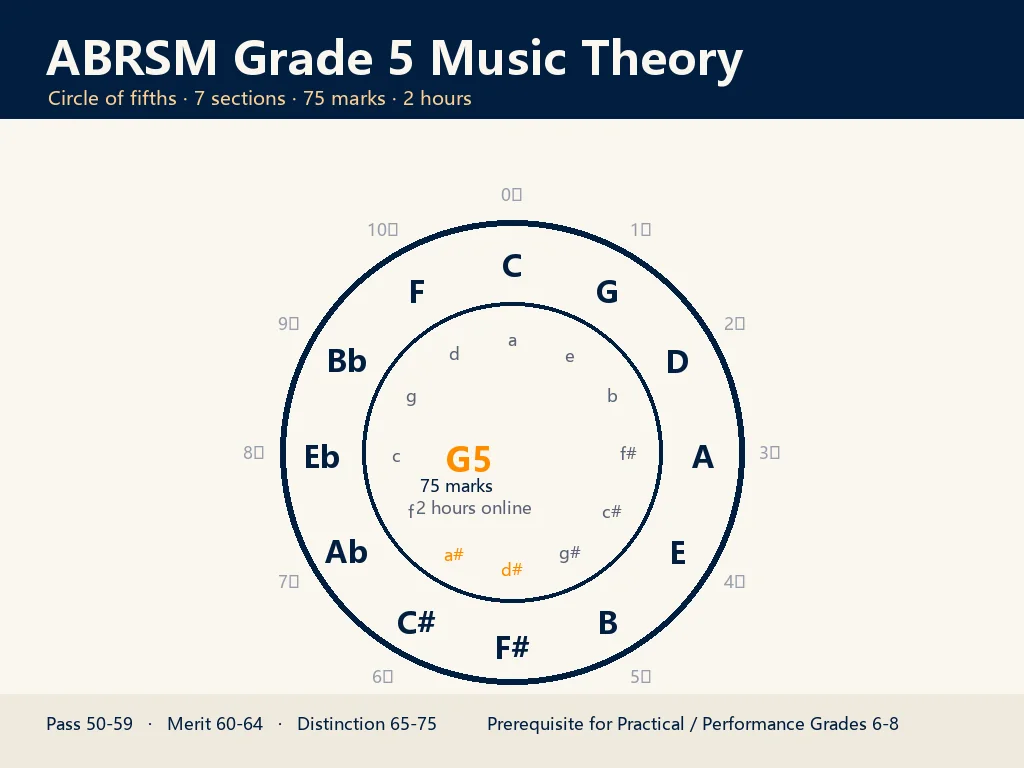
Assessment at a glance (2027)
| Component | Content | Weighting | Duration |
|---|---|---|---|
| Q1 Trio-sonata continuation | Two trebles plus figured continuo, imitative counterpoint | ~25 | about 45 min |
| Q2 Keyboard passage | Complete a Haydn-onwards keyboard outline | ~15 | about 25 min |
| Q3 Melody writing | Continue a solo opening, with optional modulation | ~25 | about 45 min |
| Q4 Score reading | Key, ornaments, chords, form and forces | ~35 | about 55 min |
Four questions in 3 hours: about 45 min on the trio sonata, 25 on keyboard, 45 on melody and 55 on reading, leaving 10 to check.
How this paper was built
This is a TutorZone original mock paper: the questions follow the ABRSM Grade 8 structure and the model answers are our own, not ABRSM papers or marking references.
Notation is letter note-names plus Roman/figured-bass symbols (text); in the real exam write on staves.
Pacing
| Section | Marks | Suggested time | What to do first |
|---|---|---|---|
| Q1 Trio-sonata continuation | ~25 | fix the imitation point, then the continuo | exact imitation, clear entry and exit |
| Q2 Keyboard passage | ~15 | fix the chord skeleton, then the melody | balanced phrases and perfect cadence |
| Q3 Melody writing | ~25 | plan phrases and the modulation point | stay within the instrument’s range |
| Q4 Score reading | ~35 | answer each item with a reason | judgement, reason and example |
What matters in the trio-sonata continuation?
Direct answer: the second part imitates exactly after a fixed gap; the continuo realises the figures; and you close with a V-I perfect cadence.
Grade 8 mock: 4 questions (100 marks)
Four questions for 100 marks; notation is letter note-names plus Roman/figured-bass symbols – in the real exam write on staves.
Question 1 (25 marks)
Question 1: trio-sonata continuation. Continue the opening of a Baroque trio sonata (two treble parts plus a figured basso continuo) for about 4 bars, using imitative counterpoint and ending with a perfect cadence.
Question 2 (15 marks)
Question 2: keyboard passage. Complete the outline of a short keyboard passage (in a Haydn-onwards style), filling in the chords and melody and labelling the chords used.
Question 3 (25 marks)
Question 3: melody writing. In A major, continue an 8-bar flute melody (from the given opening), modulating to the dominant E major and ending with a perfect cadence.
Question 4 (35 marks)
Question 4: score reading. For a string-quartet extract: (1) name the key and justify it; (2) identify one ornament and its realisation; (3) describe the chord structure, noting any sevenths; (4) describe the form and forces.
What style is needed for the keyboard passage?
Direct answer: the Classical (Haydn-onwards) style: balanced phrases, tonic-dominant-subdominant chords, perfect cadences and a clear melody.
Model answers and marks per question
Question 1
Model-answer points: (1) the second treble imitates the first about a bar later (8); (2) the continuo supplies the harmonic skeleton, realising the figures (8); (3) the last two bars make a perfect cadence (V-I), the trebles resolving by step (9). Make the imitation exact and its entry and exit clear.
Question 2
Model-answer points: (1) lead with tonic, dominant and subdominant, with the occasional dominant seventh (5); (2) a stepwise melody with decoration at the cadence (5); (3) a perfect cadence at the phrase end, in a balanced Haydn-style phrase (5). Match the left-hand bass to the right-hand melody.
Question 3
Model-answer points: (1) bars 1-4 stay in A major, developing the given figure; (2) introduce D sharp as the pivot into E major, with V-I (B major to E major); (3) the last two bars make a perfect cadence (B-E) in E major. Keep the flute line within range with breathing points.
Question 4
Model-answer points: (1) Key: from the key signature and cadence (e.g. three sharps, ending on A) (8). (2) Ornament: a trill – the note alternating rapidly with the upper auxiliary (9). (3) Chords: tonic, dominant and subdominant, with V7 resolving to the tonic (8). (4) Form and forces: sonata form (exposition, development, recapitulation), two violins, viola and cello (10).
Is G8 the highest theory grade?
Direct answer: yes, Grade 8 is the highest theory grade and a pass satisfies the prerequisite for Practical Grades 6-8.
Where these marks are usually lost
| Mistake | What it looks like | What it costs | Instead |
|---|---|---|---|
| Inexact imitation | The second part not imitating the subject | The trio sonata rests on imitation | Imitate the subject exactly after a fixed gap |
| Unfigured continuo | No chords over the bass | The continuo realises the figures | Realise the figured bass with chords |
| Unclear cadence | No V-I at the close | Baroque style closes with a perfect cadence | End with V-I in the last two bars |
How to use this paper
First sit: the full 3 hours with no references.
Mark it: check the imitation, the continuo figures and the cadences.
Second sit: redo three to seven days later, aiming to finish inside 2 h 40 min.
What should I do after finishing this paper?
Direct answer: log errors on imitation, continuo figures and cadences; redo in three to seven days; and consolidate Grade 7 foundations.
FAQ
Is this an ABRSM paper?
No. The questions and model answers are TutorZone originals, not ABRSM papers or marking references.
What does G8 theory test?
A 3-hour, 100-mark written exam: trio-sonata continuation, keyboard passage, melody writing and score reading.
How does G8 differ from G7?
G8 tests Baroque trio-sonata continuation and a Haydn-onwards keyboard passage, with all chromatic chords.
Official references
| Resource | What to check |
|---|---|
| ABRSM Music Theory syllabus (from 2020, Grades 6-8) | Confirm the G8 harmonic vocabulary and question types |
| https://www.tutorzone.com.hk/en-abrsm-grade-7-music-theory-mock-paper/ | ABRSM Grade 7 theory mock (the prerequisite for G8) |
Related: ABRSM Grade 8 theory drill guide · Grade 7 theory mock · practice area
Next step: find a tutor / register as a tutor
After drilling, the hard part is telling a conceptual error from a writing error. Tell us the year group, the school and your available times, and TutorZone will match you with a tutor who knows the HKEAA assessment requirements.
Demand for tutors in this subject is steady, and those who can explain the marking scheme and where marks are won are especially sought after. Register free; you pay only when a match succeeds.
