
 中文(繁體)
 中文(简体)
 English




IB Chemistry Mock Paper (first assessment 2025): Paper 1 Data Questions and Paper 2 Extended Response with Answers
TUTORZONE ORIGINAL MOCK PAPER · IB CHEMISTRY (first assessment 2025)
Written to the IBO subject brief for first assessment 2025: Paper 1 (multiple-choice plus data-based questions) is 36%% (SL 1.5 h / HL 2 h), Paper 2 (short-answer and extended-response) is 44%% (SL 1.5 / HL 2.5 h) and the scientific investigation is 20%%. This paper has 10 MC items, 2 data-based and 2 extended-response questions with answers and mark allocation.
How are Paper 1 and Paper 2 weighted in IB IB Chemistry?
Direct answer: per the IBO subject brief for first assessment 2025, Paper 1 (1A multiple-choice + 1B data-based) is 36% of the final grade (SL 1.5 h / HL 2 h), Paper 2 (short-answer and extended-response) is 44% (SL 1.5 / HL 2.5 h) and the scientific investigation is 20%.
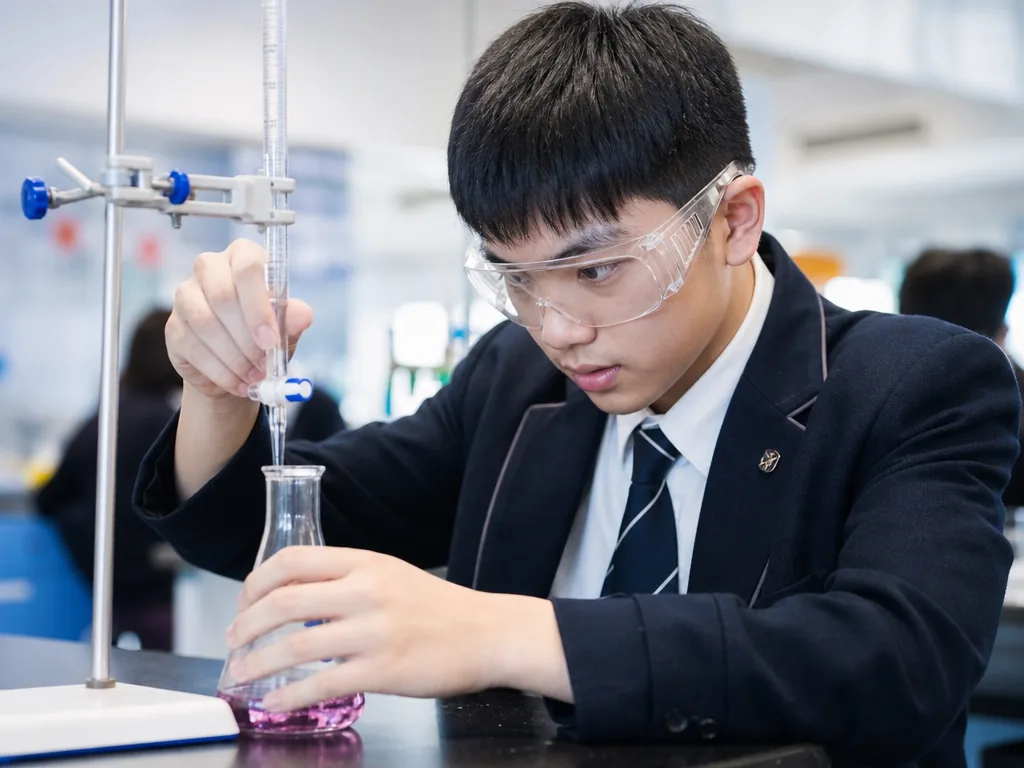
Assessment at a glance (2027)
| Component | Content | Weighting | Duration |
|---|---|---|---|
| Paper 1 (1A multiple-choice + 1B data-based) | All syllabus themes; 36% of the final grade | 36% | SL 1.5 h / HL 2 h |
| Paper 2 (short-answer + extended-response) | Short-answer and extended-response; 44% of the final grade | 44% | SL 1.5 h / HL 2.5 h |
| Scientific investigation (IA) | Open-ended investigation, 20% of the final grade (10 recommended hours) | 20% | done in school |
Paper 1B marks come from reading, calculation and unit – miss one and you lose the mark. Paper 2 extended-response answers should be point, mechanism, example, with evidence behind every claim. Finish 1A in about 25 minutes and spend the rest on 1B and the essays.
How this paper was built
This is a TutorZone original mock paper: the questions follow the Paper 1/Paper 2 formats of the 2025 first assessment and the answers are our own, not IB past papers or official marking references; only the 36/44/20 weightings come from the IBO subject brief.
The IB publishes no fixed question count, so this paper sets its own: 10 MC items, 2 data-based questions and 2 extended-response questions. Every numeric answer was recomputed programmatically.
Pacing
| Section | Marks | Suggested time | What to do first |
|---|---|---|---|
| Paper 1 (1A multiple-choice + 1B data-based) | 36% | about 25 min for 1A, 45 for 1B (SL) | On 1B show reading, calculation and unit |
| Paper 2 (short-answer + extended-response) | 44% | roughly 70% short-answer, 30% extended-response | Structure essays as point, mechanism, example |
| Scientific investigation (IA) | 20% | not covered here | Handled by your school; this page trains Papers 1 and 2 |
How do I score fully on Paper 1B data questions?
Direct answer: write all three: the value read from the graph with its unit, the formula and substitution, and the answer with significant figures. Marks are allocated to those three steps, so a bare final answer earns only the answer mark.
Paper 1A: multiple-choice (10 questions)
Aim for about 25 minutes at SL.
Question 1
What is the mass of 0.25 mol of CO₂ (44 g mol⁻¹)?
A. 11 gB. 44 gC. 22 gD. 5.5 g
Question 2
0.5 mol of solute in 250 cm³ of solution gives a concentration of?
A. 2.0 mol dm⁻³B. 4.0 mol dm⁻³C. 0.2 mol dm⁻³D. 0.5 mol dm⁻³
Question 3
A 0.010 mol dm⁻³ strong acid has a pH of?
A. 1B. 13C. 12D. 2
Question 4
100 g of water warms by 5 K in a calorimeter (c = 4.18 J g⁻¹ K⁻¹). The energy absorbed is?
A. 209 JB. 20 900 JC. 2 090 JD. 4 180 J
Question 5
At 273 K and 100 kPa, the volume of 0.5 mol of an ideal gas is about (molar volume 22.7 dm³ mol⁻¹)?
A. 45.4 dm³B. 2.27 dm³C. 22.7 dm³D. 11.4 dm³
Question 6
The oxidation number of Mn in MnO₄⁻ is?
A. +7B. +6C. +5D. +8
Question 7
What is the effect of a catalyst on a reversible reaction?
A. 縮短到達平衡的時間,不改變平衡位置B. 改變平衡常數C. 提高平衡產率D. 使反應單向進行
Question 8
Which describes the behaviour of an oxidising agent?
A. 釋出電子並被氧化B. 不參與電子轉移C. 提供質子D. 接受電子並被還原
Question 9
Going down Group 1 from lithium to caesium, reactivity?
A. 不變B. 增加C. 先減後增D. 減少
Question 10
Butane and 2-methylpropane are examples of?
A. 同位素B. 同系物C. 同素異形體D. 同分異構物
Paper 1B: data-based questions (2 questions)
Aim for about 45 minutes. Read the values off the graph, calculate, then give the unit.
Question 1 (8 marks)
Titration data: 25.0 cm³ of NaOH solution is titrated with 0.100 mol dm⁻³ HCl; the three runs are 24.9, 25.0 and 25.1 cm³. (a) Find the mean volume; (b) find the concentration of the NaOH; (c) explain why several titres are averaged.
Question 2 (7 marks)
Calorimetry: burning 2.0 g of a fuel raises 150 g of water by 12.0 K (c = 4.18 J g⁻¹ K⁻¹). (a) Find the energy absorbed by the water; (b) find the energy released per gram of fuel; (c) explain why the experimental value is usually lower than the theoretical enthalpy of combustion.
Paper 2: short-answer and extended-response (2 questions)
Use point, mechanism, example for each extended answer.
Question 1 (12 marks)
Discuss how Le Chatelier’s principle explains (a) the effect of higher pressure on ammonia synthesis and (b) the effect of heating on an exothermic equilibrium, giving one industrial or everyday example each.
Question 2 (10 marks)
Compare the trends down Group 1 and Group 7 and explain the changes in reactivity in terms of atomic structure.
Where are the answers, and is there a mark allocation?
Direct answer: each question is followed by an answer-and-marks block: data questions give the reading, the working and the unit, and extended answers give each point with its mechanism, example and marks, ready to use as a self-marking sheet.
Paper 1A answers and explanations
Question 1
Answer: A (11 g) 0.25 × 44 = 11 g.
Question 2
Answer: A (2.0 mol dm⁻³) 0.5 ÷ 0.250 = 2.0 mol dm⁻³.
Question 3
Answer: D (2) pH = −log(0.010) = 2 (fully ionised).
Question 4
Answer: C (2 090 J) q = mcΔT = 100 × 4.18 × 5.
Question 5
Answer: D (11.4 dm³) 0.5 × 22.7 = 11.35 ≈ 11.4 dm³.
Question 6
Answer: A (+7) Four oxygens give −8 and the ion is −1, so Mn is +7.
Question 7
Answer: A (縮短到達平衡的時間,不改變平衡位置) A catalyst lowers the activation energy of both directions, so equilibrium is reached sooner but not shifted.
Question 8
Answer: D (接受電子並被還原) It accepts electrons, is reduced, and oxidises the other species.
Question 9
Answer: B (增加) The atomic radius grows and the outer electron is lost more easily, so reactivity increases down the group.
Question 10
Answer: D (同分異構物) Both have the formula C₄H₁₀ but different structures, so they are isomers.
Paper 1B answers and mark allocation
Question 1
(a) Mean = (24.9 + 25.0 + 25.1) ÷ 3 = 25.0 cm³ (2 marks); (b) n(HCl) = 0.100 × 0.0250 = 2.50 × 10⁻³ mol, a 1:1 reaction, so n(NaOH) = 2.50 × 10⁻³ mol and the concentration is 2.50 × 10⁻³ ÷ 0.0250 = 0.100 mol dm⁻³ (3 marks); (c) individual titres carry random error, so averaging reduces its effect and also shows whether the runs agree (3 marks).
Question 2
(a) q = mcΔT = 150 × 4.18 × 12.0 = 7 524 J (3 marks); (b) 7 524 ÷ 2.0 = 3 762 J g⁻¹ (2 marks); (c) heat escapes to the surroundings, the apparatus absorbs some and combustion may be incomplete, so the measured temperature rise is too small (2 marks).
Paper 2 answers and mark allocation
Question 1
(a) N₂(g) + 3H₂(g) ⇌ 2NH₃(g) has four moles of gas on the left and two on the right, so higher pressure shifts the equilibrium towards the right and raises the ammonia yield (4 marks); the Haber process therefore runs at high pressure, around 200 atm (2 marks). (b) Heating shifts an equilibrium in the endothermic direction, so an exothermic reaction is pushed back and yields less (4 marks); ammonia synthesis is exothermic, which is why industry uses a moderate temperature near 450 °C to trade rate against yield (2 marks).
Question 2
Group 1: metallic character rises, melting points fall and reactivity increases down the group (2 marks) because the atomic radius and shielding grow, so the outer electron is lost more easily (3 marks). Group 7: non-metallic character falls, boiling points rise and reactivity decreases (2 marks) because the larger radius means weaker attraction for an incoming electron, making ion formation harder (3 marks).
Where are marks most easily lost on this paper?
Direct answer: data questions without a recorded reading; essays that list points with no mechanism; ignored significant figures and uncertainty; and answering HL questions at SL depth or the reverse. All four are cases of knowing the science but writing too little.
Where these marks are usually lost
| Mistake | What it looks like | What it costs | Instead |
|---|---|---|---|
| No reading recorded on data questions | Straight to the calculation | 1B marks are reading, calculation and unit – each is separate | Write the value read off the graph, then the working, then the unit |
| Listing points in an essay | Three lines of bullet points | Extended-response answers need mechanism and example | Add a mechanism and a syllabus example to every point |
| Ignoring uncertainty | A single bare number | IB science marks uncertainty and significant figures | State the accuracy and identify a source of error |
| Confusing SL and HL depth | One depth for both | HL expects deeper mechanisms and quantitative treatment | Decide whether you sit SL or HL first |
How to use this paper
First sit: no references, timing Paper 1 (25 minutes for 1A, 45 for 1B) and Paper 2 as separate blocks.
Mark it: check reading, calculation and unit on every data part, and that each essay point carries a mechanism and an example.
Second sit: redo it three to seven days later aiming to hit every mark-allocation point on the essays.
What should I do after this paper?
Direct answer: turn reading-calculation-unit into a fixed template for data questions; template the extended answers as point, mechanism, example; drill by topic and keep an uncertainty-analysis note; then redo this paper three to seven days later.
FAQ
Is this an IB paper?
No. The questions, answers and mark allocation are TutorZone originals; only the weightings (Paper 1 36%, Paper 2 44%, investigation 20%) come from the IBO subject brief for first assessment 2025.
What is the difference between SL and HL?
Paper 1 runs 1.5 h at SL and 2 h at HL; Paper 2 runs 1.5 h at SL and 2.5 h at HL, with greater depth and breadth at HL. These questions cover the SL core, with extension work left for HL students.
How do I prepare for the IA?
It is done in school and worth 20%: research question, variable control, data processing and uncertainty analysis. This page trains Papers 1 and 2.
Official references
| Resource | What to check |
|---|---|
| https://www.ibo.org/programmes/diploma-programme/curriculum/sciences/ | IBO DP sciences curriculum and subject briefs (first assessment 2025) |
| https://www.tutorzone.com.hk/en-ib-chemistry-past-paper-drill-guide/ | IB Chemistry drilling guide: pacing and answering frames for Papers 1 and 2 |
Related: practice area · IB Maths AA SL mock
Next step: find a tutor / register as a tutor
After drilling, the hard part is telling a conceptual error from a writing error. Tell us the year group, the school and your available times, and TutorZone will match you with a tutor who knows the HKEAA assessment requirements.
Demand for tutors in this subject is steady, and those who can explain the marking scheme and where marks are won are especially sought after. Register free; you pay only when a match succeeds.
